

Snack Essentials For Muscle Growth
Your muscles are like a worksite, and your snacks are the delivery trucks bringing in raw materials. Get that load right, and construction moves smoothly.
- Protein: 20–30 g to spark muscle protein synthesis
- Carbs: 15–25 g to refill energy reserves
- Fats: 5–10 g for hormone balance and lasting satisfaction
- Calories: 150–300 kcal to hit energy needs without going overboard
- Timing: Between meals or within 45 minutes post-workout
Each of these numbers works in concert, so you charge repair and growth without piling on extra calories.
Key Benefits At A Glance
When you balance macros in a quick snack, you keep your body in an anabolic state. On average, consistent protein feedings can boost lean mass by 0.5–1 kg over 8–12 weeks of resistance training.
Below is a concise breakdown of why each element matters and how much you need:
Snack Feature Summary
| Feature | Why It Matters | Recommended Range |
|---|---|---|
| Protein | Triggers repair and new muscle | 20–30 g |
| Carbs | Refuels your energy stores | 15–25 g |
| Fats | Supports hormone health and fullness | 5–10 g |
| Calories | Balances fuel without excess | 150–300 kcal |
| Timing | Optimizes the post-exercise window | Between meals or post-workout |
Use this table as a quick reference when you’re picking or packing your next snack.
Gym Snack delivers over 15 g protein per serving in a crunchy, plant-based format that fits every snack window.
Gym Snack Advantages
- High Protein Punch: 15 g per pack, 30 g per bag keeps you on track.
- Clean Ingredients: No dairy, soy, gluten, or seed oils—gentle on digestion.
- Bold Flavors: Cheddar Cheeze and other options that satisfy without extra sugar.
- On-The-Go Crunch: Perfect for slipping into your bag and hitting that post-workout window.
Keep Gym Snack in your rotation to maintain a steady flow of nutrients and power your muscle-building mission anytime, anywhere.
Understanding Core Concepts Of Muscle Building Snacks
Growing muscle is a lot like tending a garden. Tiny fibers need constant nourishment, and snacks become the delivery trucks bringing just the right nutrients.
Just as a gardener times water and fertilizer for peak growth, the body relies on protein timing to spark muscle repair through muscle protein synthesis.
- Protein Timing sets the pace for repair signals.
- Feed Frequency keeps the anabolic process alive.
- Portion Control hits growth targets without extra calories.
Role Of The Anabolic Window
Right after a workout, your muscles open a nutrient “gate” that peaks within 45 minutes. Feeding that window boosts the body’s ability to absorb amino acids and kickstart recovery.
Relying on one big meal leaves long nutrient gaps. Instead, aim for snacks every 2–3 hours with about 20–30 g of protein to keep muscle-building signals firing.
Metaphor Insight: Think of each snack as a mini fertilizer spike, ensuring your muscle “garden” never runs dry.
Importance Of Leucine Threshold
Leucine is the spark that fires up mTOR, the engine behind muscle growth. You need roughly 2.5–3 g of leucine per feeding, which translates to about 20–30 g of high-quality protein.
When a snack meets this leucine mark, it’s like adding a fortified blend to your mix. A cup of Greek yogurt plus a whey shot, for instance, delivers a potent dose right when you need it.
| Snack Option | Protein (g) | Leucine (g) |
|---|---|---|
| Greek Yogurt (170 g) | 17–20 | ~2.0 |
| Whey Protein Shot (30 mL) | 20–25 | ~3.0 |
| Pea Protein Bar (40 g) | 15–20 | ~2.5 |
In one 12-week study, participants who added 1–2 protein-rich snacks daily alongside resistance training gained +0.57 kg of muscle—a 2% relative increase (p = 0.01).
Read the full research about strategic snack timing and lean-mass gains
Over time, these little boosts stack up into meaningful progress.
Strategy For Protein Portions
Keep snacks in the 20–30 g protein range to hit the leucine target without extra calories. Research suggests this window is ideal for most adults, with older trainees aiming for the higher end.
- Greek yogurt (170 g) + whey shot: ~20–23 g protein, ~2 g leucine
- Whey/protein bar (30–40 g): ~25–30 g protein, fast absorption
- Hard-Boiled Eggs (2 large): ~12.5 g protein, with healthy fats
Regularly feeding this amount lays bricks one at a time, building your muscle over the course of the day.
Explore additional snack strategies in our guide on how to increase protein intake
Applying Snack Timing Throughout Your Day
Plan snacks between meals and immediately post-workout. A mid-morning bite, a mid-afternoon pick-me-up and a post-training snack will keep amino acids flowing nonstop.
Treat each snack as a small investment. By spreading feedings evenly, you maintain a steady state of muscle repair and growth.
Key Aspects That Make Muscle Building Snacks Effective
Think of building muscle like erecting a skyscraper: pillows won’t hold the beams. Your snack choices should deliver the raw materials your body needs for repair and growth.
Here Are The Five Key Criteria To Watch:
- Protein Quality
- Leucine Content
- Carb/Fat Balance
- Calorie Load
- Timing
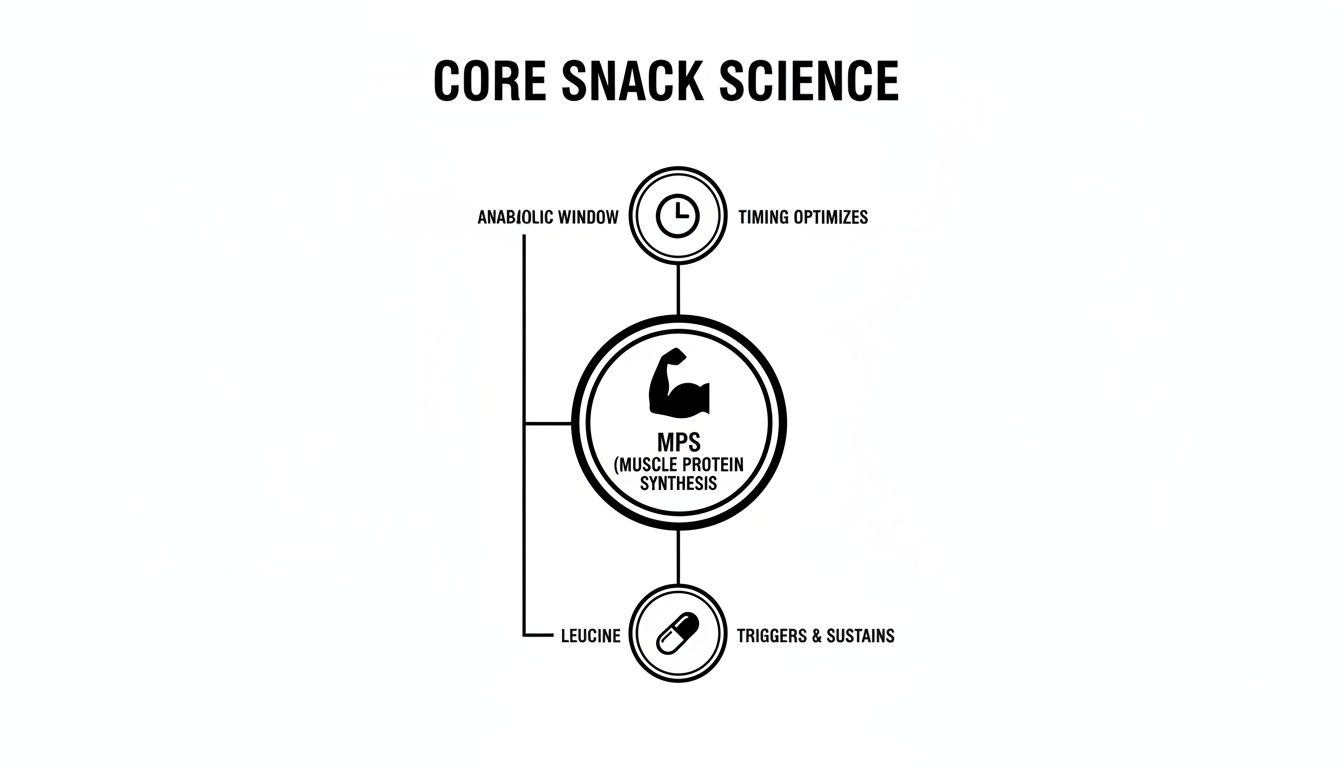
The infographic lays out how protein dose, timing, and leucine triggers team up to spark muscle protein synthesis.
Protein Quality And Leucine Content
Protein’s real value lies in its amino acid profile—especially leucine, which flips the mTOR switch to ignite repair. Seek snacks made from single-source proteins—grilled chicken strips, egg-white bites, or low-fat Greek yogurt—rather than mystery blends.
For example, 100 g of lean chicken delivers about 26 g protein and 2.5 g leucine without extra fat. That means a direct, no-nonsense boost to muscle synthesis. For deeper insights on how whole foods stack up, Learn more about whole-food protein benefits.
Carbohydrate And Fat Balance
Carbs refill your energy tanks, and fats help stabilize blood sugar while slowing protein digestion just enough for steady release. Aim for 15–25 g carbs alongside 5–10 g healthy fats from whole grains, nuts, seeds, or starchy veggies.
- 1 small apple + 3 tbsp almond butter: 18 g carbs, 12 g fat
- ½ cup cooked oats with berries: 22 g carbs, 3 g fat
- Rice cakes topped with hummus: 20 g carbs, 5 g fat
Total Calories And Macronutrient Ratios
A snack in the 150–300 kcal range fuels muscle growth without tipping into storage mode. Shoot for a 2:1 carb-to-protein ratio and keep fats around 10–20% of total calories. Adjust these targets if you’re cutting or bulking.
When weighing options, compare nutrient density and ingredient lists. Cleaner sources often translate to clearer gains.
When choosing between whole foods and processed options, it’s helpful to see them side by side.
Comparison Of Whole Food And Processed Snacks
Description: Analyzing protein, fat, leucine content and impact on muscle synthesis
| Snack Type | Protein (g) | Fat (g) | Leucine (g) | Effect On Muscle Synthesis |
|---|---|---|---|---|
| Grilled Chicken (100 g) | 26 | 3 | 2.5 | Rapid, high synthetic response |
| Greek Yogurt (170 g) | 18 | 0.5 | 2.0 | Steady amino release |
| Protein Bar (40 g) | 20 | 8 | 2.3 | Slower absorption, check label accuracy |
| Tuna in Water (100 g) | 23 | 1 | 2.2 | Fast digest, lean matrix |
This comparison highlights how whole foods typically deliver cleaner protein and more precise leucine triggers, translating to a stronger muscle-building signal.
Timing And Anabolic Response
Timing is everything. Snack within 45 minutes after training, then every 2–3 hours between meals to keep amino levels steady. Think of it like watering a plant—consistent, well-timed sips foster growth.
- Pre-workout: Greek yogurt + banana 30 minutes before lifting
- Post-workout: Tuna on rice cakes immediately after your session
- Mid-afternoon: Edamame with fruit 2–3 hours after lunch
- Evening: Egg-white omelet two hours before bed to sustain overnight repair
Snack Evaluation Checklist
Before you grab a snack, run through this list:
- 20–30 g high-quality protein
- At least 2.5 g leucine per serving
- Balanced carbs (15–25 g) and fats (5–10 g)
- 150–300 kcal matched to your goal
- Fits your workout and daily schedule
Spotting Misleading Claims
Labels can be tricky. Words like “clean,” “natural,” or “premium” mean little if the ingredients list is clogged with fillers and sugars.
- Check for added sugars under 5 g
- Look for simple, whole-food ingredients
- Ensure protein sources appear at the top of the list
Reading Nutrition Facts Panel
The Nutrition Facts box is your fact-checker. Focus on grams of protein, carbs, fats, and calories per serving. Don’t forget to check fiber, sodium, and sugar to keep your snack balanced.
Combining high-quality protein with balanced macros, proper calories, and well-timed snacks transforms a simple bite into a muscle-builder. Make Gym Snack a staple in your routine—each pack offers 15 g of clean protein, steady-release carbs, and minimal additives so you can hit those goals on the go.
Enjoy the gains!
Choosing Muscle Building Snacks For Different Needs
Everyone’s routine looks different—some of us stick to a plant-based diet, others juggle meetings and workouts, and a few manage appetite-suppressing meds. Picking a snack that aligns with your lifestyle makes all the difference. The goal? Hit the leucine threshold, balance macros, and keep things practical.
Plant Based Protein Strategies
Think of plant proteins as puzzle pieces. On their own, they’re good—but together, they complete the picture.
Pea protein and brown rice work like best friends: they fill in each other’s amino acid gaps and deliver about 20–25 g protein with 2.5–3 g leucine per serving. Imagine shaking up a quick bowl after your session and fueling that muscle repair.
You can also layer 200 g soy yogurt with berries, chia seeds, and a dollop of nut butter. You’ll get fiber, healthy fats, and steady energy that won’t spoil in your bag.
- Pea Rice Protein Bowl: 25 g pea protein powder + brown rice + spinach
- Soy Yogurt Parfait: 200 g soy yogurt + berries + chia seeds + almond butter
Appetite Management And Macro Adjustments
On average, snacks make up about 30% of our daily calories in many high-income nations. That’s a huge window for upgrade.
Swapping a cookie for a Greek-yogurt-and-nut combo can trigger muscle protein synthesis—roughly 2.5–3 g leucine, equivalent to 20–30 g of protein plus moderate carbs. Do this twice a day, and you’re adding 30–40 g of protein without extra meals.
- Spot the usual suspect: a cookie, chip bag, or candy bar at 200–300 kcal with almost zero protein.
- Swap in Greek yogurt and nuts: 18–25 g protein and 2–3 g leucine.
- Repeat midday and evening to spark muscle-building pathways consistently.
Snacks For Busy On The Go Days
If your calendar flips from desk to gym to dinner dates, you need snacks that won’t wilt. Portable, shelf-stable packs loaded with 15 g protein are lifesavers—and they taste great, too.
Here are a few grab-and-go combos under 300 kcal:
- Tuna pouches + rice cakes
- Beef jerky + almonds
- Protein crisps + dried fruit
Each pairing hits 20–25 g protein, 5–10 g fats, and 15–20 g carbs, keeping you fueled between meetings and lifts. Check out our guide on high-protein snacks for athletes for more ideas.
GLP-1 And Weight Loss Friendly Snacks
When appetite meds are in play or calories are tight, choose high-protein, high-fiber bites to curb hunger and protect muscle. A serving of Gym Snack’s pea-protein blend—paired with raw veggies or a handful of berries—adds 18 g protein, 8 g fiber, and 200 kcal.
This combo presses the “full” button on your hormones without overshooting your calorie goal. It’s perfect for mid-afternoon cravings or a pre-dinner buffer.
Practical Snack Planning Tips
Routine is your secret weapon. Carve out four snack windows—morning, midday, post-workout, evening—spaced every 2–3 hours. A few simple tools can keep you on track:
- Meal-prep containers with portioned snacks
- Phone alarms labeled by snack type
- A smart water-bottle app that nudges you to sip and snack
On heavy lift days, slot in an extra 10–15 g protein snack in the afternoon. On rest days, aim for maintenance with 15–20 g protein plus more fiber-rich veg.
“Tailoring snacks to your routine turned my energy around,” says athlete Jane Doe, who saw a 12% strength gain in six weeks.
Sample Snack Combos And Timing
Getting your snack timing right can feel like a game of Tetris. Slot these protein-plus-carb pairings into your day and you’ll fuel muscle repair with surgical precision.
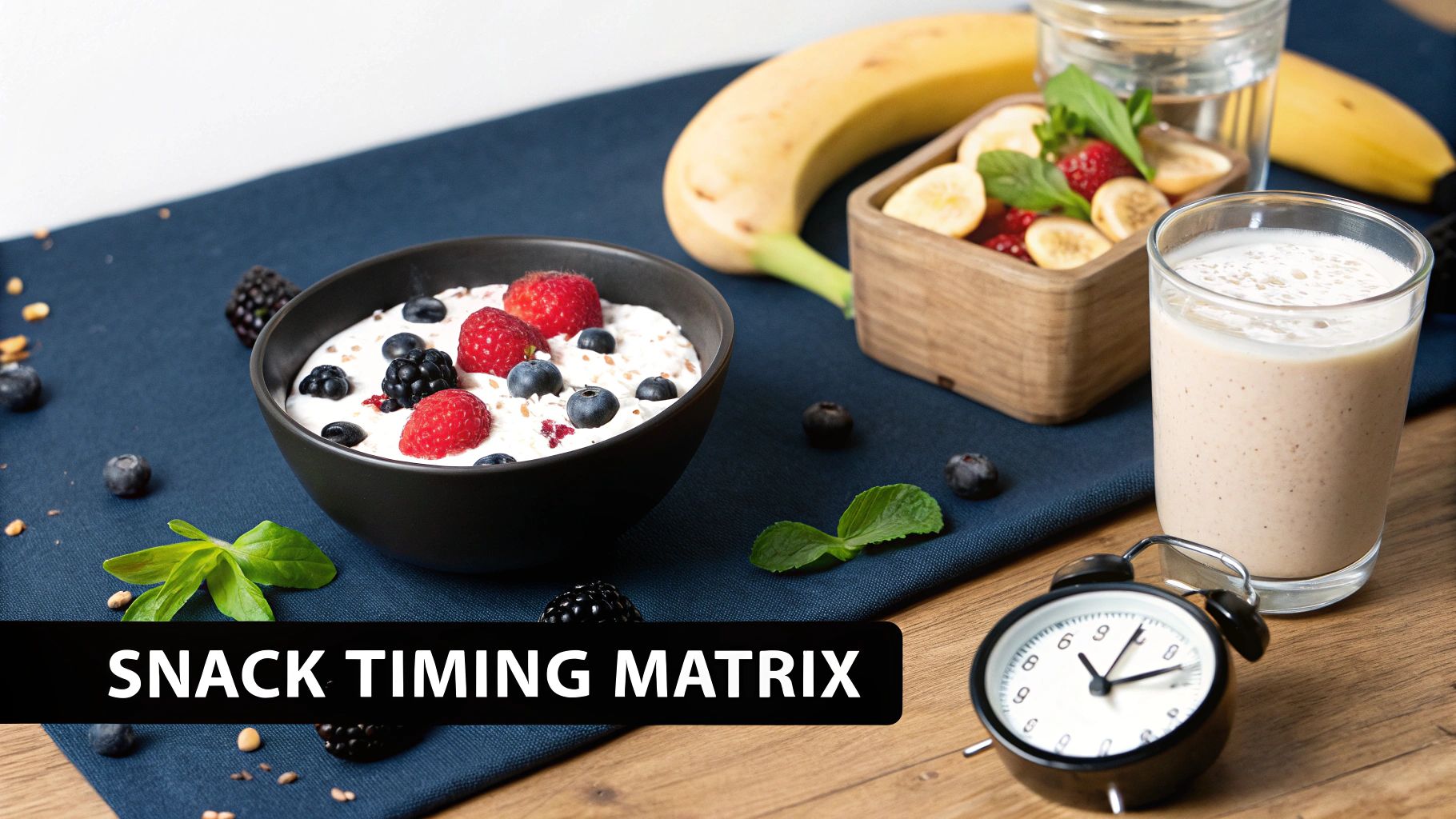
Below is a Snack Combo Timing Matrix to guide your choices. It breaks down simple duos, highlights their macro profile, and shows the best window to enjoy them.
Snack Combo Timing Matrix
| Snack Combo | Protein (g) | Carbs (g) | Timing | Ideal For |
|---|---|---|---|---|
| Greek yogurt plus berries | 20 | 25 | 30 minutes before | Beginners and morning lifts |
| Whey shake with banana | 25 | 30 | Within 45 minutes after | All lifters |
| Tuna pouch on rice cake | 22 | 15 | 2 hours after lunch | Busy professionals |
| Edamame with fruit | 18 | 20 | Mid-afternoon | Plant based |
| Egg white omelet | 15 | 5 | Before bedtime | Nighttime recovery |
Use this table as your daily playbook—whether you’re warming up, cooling down, or squeezing in a bite between meetings.
A quick Greek yogurt snack before squats can give you that extra push. Then, a whey shake after deadlifts kicks off muscle repair when it matters most. The trick is to keep amino acids flowing, so your body never runs low on building blocks.
Pre Workout Boosts
Kick off your session with a snack 30 minutes before you lift. You’re aiming for quick carbs and moderate protein—about 15–20 g carbs and 10–15 g protein.
- Oatmeal bowl with almond butter: 25 g carbs and 12 g protein
- Banana with Greek yogurt: 30 g carbs and 20 g protein
A snug pre-workout snack raises your blood sugar, supplies amino acids, and wards off that mid-set slump. Learn more about timing your pre-workout fuel in our article on best pre-workout snacks for muscle gain
Post Workout Recoveries
Right after you finish, your muscles are primed for nutrients. Shoot for 20–30 g protein and 30–40 g carbs within 45 minutes to refill glycogen and spark repair.
- Whey banana shake: 25 g protein and 35 g carbs
- Turkey wrap on whole wheat: 22 g protein and 30 g carbs
Locking in this combo helps shuttle amino acids where you need them most.
Mid Day Protein Picks
Bridge the gap between lunch and dinner with a snack that balances carbs, protein, and even a bit of fat. This keeps your energy steady and your muscles fed.
- Beef jerky and apple slices: 15 g protein and 20 g carbs
- Edamame with fruit: 18 g protein plus fiber-rich carbs
- Egg white frittata muffin with veggies: 15 g protein
Rotate these choices to hit different micronutrients and keep boredom at bay. Consistency in timing and macros turns everyday bites into real muscle-building opportunities.
“Snacks scheduled right feel like pit stops for your muscles.”
Conclusion On Effective Muscle Building Snacks
Think of your snacks as precision tools in your muscle workshop. When you dial in protein quality, hit the leucine threshold, balance your macros and nail timing, each bite turns into a tiny growth accelerator.
Of course, consistency is the real secret weapon. Over weeks and months of training, steady snack habits carve out lean mass.
Tracking makes it real: jot down what you eat, watch how your strength and recovery shift, then refine your plan.
Small, strategic snacks can boost lean mass by 0.5–1 kg in 8–12 weeks.
These insights capture the science behind the most effective muscle-building bites. Whether you lean plant-based, need GLP-1-friendly picks, or race out the door, keep this checklist close.
Use numbers as your compass: 20–30 g protein, 15–25 g carbs, 5–10 g fats, and 150–300 kcal per snack.
Timing matters just as much: aim for a snack within 45 minutes post-workout and every 2–3 hours between meals.
Balance your macros to fuel recovery and steady energy without tipping into storage mode. Clean ingredients help digestion and ensure a steady stream of amino acids for repair.
Leucine is your ignition switch. You need at least 2.5 g per snack to spark mTOR.
Key Takeaways For Your Snack Strategy
- Protein Quality (20–30 g): Hits muscle repair targets.
- Leucine Threshold (2.5–3 g): Flips the growth switch.
- Balanced Carbs & Fats: 15–25 g carbs and 5–10 g fats refill energy without spikes.
- Timing Windows: Within 45 min post-workout and every 2–3 h between meals.
- Calorie Range (150–300 kcal): Supports gains without unwanted storage.
Turn this list into habit by prepping snacks that meet every criterion.
Implementing Your Snack Routine
- Set Your Targets: Define goals for protein, leucine, carbs, fats, and calories.
- Pick Winning Combos: Think Greek yogurt with berries, tuna on rice cakes, or pea-protein crisps.
- Schedule Your Snacks: Slot four windows a day—morning, pre-workout, post-workout, evening.
- Log And Observe: Note your energy, performance, and body changes after each snack.
- Tweak And Repeat: Every 2–4 weeks, adjust portions or timing based on your data.
Regular check-ins keep your snack science in line with real results. Track strength gains and body composition to catch plateaus or celebrate progress.
Consistency and data-driven tweaks fuel better results over every training cycle.
Start today by packing your optimized snack.
FAQ
Navigating snack choices for muscle growth can feel overwhelming. This FAQ breaks down the essentials so you can fuel gains with confidence.
What Makes a Snack Ideal for Muscle Building and How Much Protein Should It Contain?
You’ll want roughly 20–30 g of high-quality protein per snack—that’s the sweet spot to trigger muscle repair. Within that, aim for at least 2.5 g of leucine, the amino acid that flicks the “growth switch” (mTOR) in your muscles.
On top of protein, a modest dose of carbs and fats helps maintain energy levels and smooth nutrient absorption.
- Protein (20–30 g): Triggers muscle protein synthesis
- Leucine (≥2.5 g): Activates the anabolic “spark”
- Balanced Carbs & Fats: Steady fuel and better nutrient uptake
Can Plant-Based Snacks Support the Same Muscle Gains as Animal-Based Options?
Absolutely. Think of leucine as the spark plug—whether it comes from dairy or plants, it still fires up growth. You just need to combine plant proteins so they cover all the essential amino acids.
- Soy yogurt + chopped nuts
- Pea-protein shake + a sprinkle of hemp seeds
- Hummus with whole-grain crackers
Snack Timing Advice
How Often Should I Snack Between Meals and Workouts?
Spacing your snacks every 2.5–3 hours keeps you in an anabolic state without overwhelming digestion. Be sure to squeeze in one snack right after training to ride that post-exercise window.
- Morning: Greek yogurt with berries
- Afternoon: Steamed edamame and an apple
- Post-workout: Whey shake and a banana
Are Protein Bars as Effective as Whole-Food Snacks?
Whole foods win more often thanks to their natural nutrient blend. Bars can work in a pinch, but read labels carefully.
- Look for third-party testing to confirm protein content
- Avoid bars loaded with sugar or artificial fillers
“Whole-food snacks deliver more consistent amino-acid profiles than most bars.” – Sports Dietitian
Additional Tips
- Check labels for sugar under 5 g to avoid energy slumps
- Stay hydrated alongside your snacks for optimal recovery
- Rotate protein sources weekly—variety keeps you covered and engaged
Refer back to this FAQ whenever you need a quick refresher on snack strategy. Consistency is what turns good habits into lasting results.
For grab-and-go options that hit these targets each time, check out Gym Snack. They specialize in clean, plant-based protein snacks designed for muscle fueling on the move.