

Let's get one thing straight right from the start: yes, you can absolutely build serious muscle using only plant based protein for muscle growth. The whole game is about strategy—getting enough high-quality, varied plant protein to give your body all the building blocks it needs to repair and grow.
Can You Really Build Muscle with Plant Protein
The old idea that you need meat, eggs, or whey to get strong is one of the most stubborn myths in fitness. But the truth is, a well-planned vegan or plant-based diet can support muscle gains just as effectively as one that includes animal products. The basic rules of muscle growth don’t change depending on where your protein comes from. It all boils down to two things: stimulating your muscles with resistance training and then fueling them with the right nutrients to recover and get stronger.
Think of it like this: your muscles are a house you’re building. A tough workout is like the demolition crew, breaking things down. To rebuild bigger and better, you need a steady supply of bricks—and those bricks are amino acids, which come from protein.
A construction crew can’t build a solid wall with just one type of brick. In the same way, your body needs a full spectrum of essential amino acids to build strong, resilient muscle tissue.
This is where you'll hear talk about bioavailability and amino acid profiles. It’s true that many animal proteins are "complete," meaning they have all nine essential amino acids in one place. Some plant proteins might be lower in one or two, but this is a non-issue with a little bit of planning. By simply eating a variety of plant foods throughout the day, you give your body every single "brick" it needs.
Debunking the Animal Protein Myth
The whole debate around plant based protein vs animal protein often misses the most important point: your body doesn't care where its amino acids come from. An amino acid from a pea is the same as an amino acid from a chicken breast once it's in your system.
More and more research is backing this up, showing that the source is far less important than the total quantity and quality of protein you eat over the course of a day.
In fact, one game-changing study directly compared muscle protein synthesis in vegans and omnivores. The result? No significant difference between the groups, proving that a smart plant-based diet is more than capable of fueling muscle growth.
Of course, nutrition is only half the equation. To actually trigger that muscle-building process, you need to pair your diet with a science-backed strength training program. It's this one-two punch of intelligent training and thoughtful nutrition that really unlocks your potential.
How Your Muscles Actually Use Plant Protein to Grow
To get the most out of your plant-based diet for muscle growth, it’s incredibly helpful to know what's happening under the hood after you finish a tough workout and refuel. The whole process hinges on a biological mechanism called Muscle Protein Synthesis, or MPS for short. Think of MPS as the master switch that tells your body to start repairing and building muscle.
When you train hard, you're essentially creating tiny, controlled tears in your muscle fibers. That might sound bad, but it’s the whole point. Your body's natural response is to repair this damage, and it doesn't just patch up the holes—it rebuilds the fibers to be thicker and stronger than before. That’s how we get stronger. But to do this incredible construction job, your body needs the right raw materials: amino acids from the protein you eat.
The Leucine Threshold: Your Muscle-Building Ignition
When it comes to flipping that MPS switch, not all amino acids are created equal. One, in particular, an essential amino acid called leucine, is the main trigger. Imagine your muscle-building potential is a powerful engine. Leucine is the spark plug. Without a strong enough spark, the engine won't turn over, no matter how much fuel you pour in.
This concept is known as the leucine threshold. The research is pretty clear that you need about 2.5 to 3 grams of leucine in one sitting to give that muscle-building signal a serious jolt. If you get less than that, the signal is weak, and you're leaving potential gains on the table. This is exactly why the quality of your protein matters just as much as the quantity.
For instance, 30 grams of protein from a source packed with leucine will kickstart way more muscle growth than 30 grams from a source that's low in it.
You can think of leucine as the foreman on a construction site. Without the foreman giving the order, the crew (your body's repair systems) won't start building, even if all the bricks and mortar (other amino acids) are ready to go.
The great news is that hitting this threshold is totally doable on a plant-based diet. It just requires being a bit more intentional with your food choices. For a complete picture of building muscle, it's also worth exploring different strategies to improve muscle recovery that work alongside smart nutrition.
What About Plant Protein Digestibility?
Another piece of the puzzle is protein digestibility. This is just a fancy way of asking: how well can your body actually break down a protein source and put its amino acids to use? Scientists often measure this with a score called the PDCAAS (Protein Digestibility Corrected Amino Acid Score).
Here’s the deal: plant proteins are often packaged with fiber and other plant compounds (sometimes called "anti-nutrients") that can make them slightly harder for our bodies to digest compared to animal proteins. This isn't a deal-breaker, but it is something to keep in the back of your mind. It simply means you might need to eat a little more total protein from plant sources to get the same amount of usable amino acids.
Here’s what that looks like in the real world:
- Don't overthink it. For most active people, this small difference is easily covered by eating a varied diet with plenty of protein-rich foods.
- Aim a little higher. If you’re really focused on maximizing muscle, shooting for the higher end of the recommended protein range—somewhere around 1.6 to 2.2 grams per kilogram of body weight—is a smart move. This builds in a buffer to account for any digestibility differences.
- Preparation is key. Simple techniques like cooking, sprouting, and fermenting (think tempeh or miso) can significantly improve the digestibility of plant proteins, making those valuable amino acids more accessible.
At the end of the day, the science backs it up. By focusing on getting enough total protein, making sure your meals are built around leucine-rich sources, and eating a wide variety of whole foods, you have everything you need to trigger muscle protein synthesis and build serious strength.
The Best Plant Protein Sources for Building Muscle
Knowing the science behind muscle growth is one thing, but translating that into what you put in your grocery cart is where the real results happen. When your goal is building muscle on a plant-based diet, you quickly learn that not all protein sources are created equal. The trick is to consistently choose foods that are not only high in total protein but also loaded with that all-important muscle-building trigger: leucine.
Let's get practical and move beyond just a simple list. We’re going to dive into the absolute powerhouses that should become staples in your kitchen. These are the foods that reliably deliver a complete amino acid profile and a hefty dose of leucine, making them incredibly effective for kicking muscle protein synthesis into high gear.
The A-List of Plant Proteins
When you're putting together a meal, think of these foods as your primary building blocks. They offer the best bang for your buck in both protein quality and quantity, which makes hitting your daily targets—and that critical leucine threshold—so much easier.
- Soy-Based Foods (Tofu, Tempeh, Edamame): Soy is, without a doubt, the champion of the plant protein world. It’s a complete protein, containing all nine essential amino acids, and its digestibility is fantastic. Tempeh is the real star, packing around 20 grams of protein per 100g serving, with firm tofu close behind at about 16 grams.
- Lentils: These little legumes are a true nutritional powerhouse. A single cooked cup serves up roughly 18 grams of protein along with a serious dose of fiber. Their solid leucine content makes them a top-tier choice for muscle repair and recovery.
- Seitan: Often called "wheat meat" for good reason, seitan is made from wheat gluten and has a dense, satisfyingly chewy texture. Its protein content is off the charts, often boasting 25 grams or more per 100g.
- High-Protein Seeds (Hemp and Pumpkin): Don't sleep on seeds. Just three tablespoons of hemp seeds provide about 10 grams of complete protein and a great balance of healthy fats. Pumpkin seeds are another excellent choice, perfect for sprinkling over salads or oatmeal for an extra protein kick.
This chart really drives home how a well-planned, leucine-rich meal can push you over the line needed to activate muscle protein synthesis.
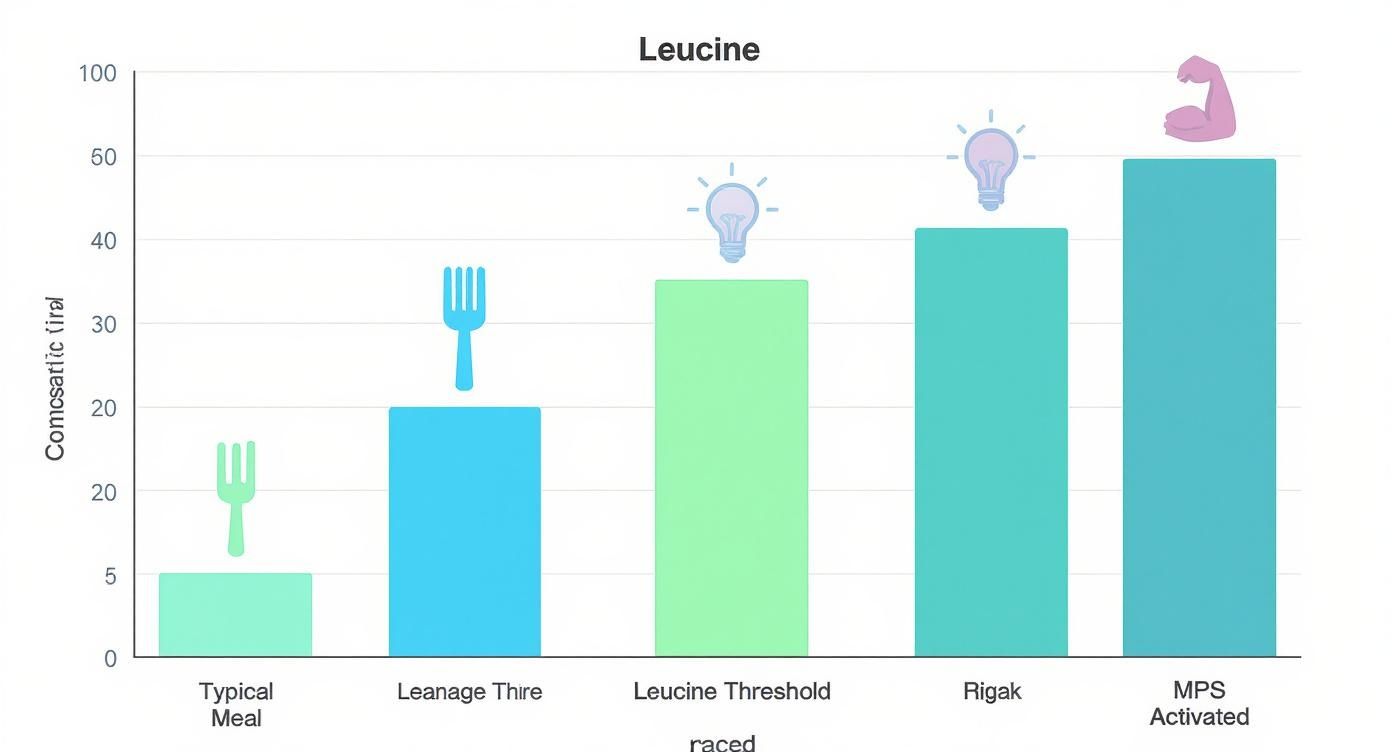
As you can see, a typical meal might not quite get you there. But a meal intentionally built around high-quality protein sources? That’s what flips the switch for muscle growth.
Why Soy Stands Out in the Crowd
Soy has been on the receiving end of some outdated myths, but the modern science tells a completely different story. It's one of the very few plant proteins that consistently goes head-to-head with animal-based sources in clinical studies on muscle growth. Its powerful amino acid profile, especially its high leucine content, makes it incredibly efficient at triggering muscle protein synthesis.
Soy isn’t just "good enough"—it's a top-tier protein source that can stand shoulder-to-shoulder with whey. For athletes and anyone serious about building muscle on a plant-based diet, soy products like tofu, tempeh, and soy milk are non-negotiable staples.
In fact, the evidence is so compelling that major scientific reviews have confirmed its effectiveness. A comprehensive meta-analysis that directly compared different protein sources found that while some plant proteins resulted in slightly lower muscle gains, soy protein delivered results that were statistically identical to milk protein. This is a powerful reminder that choosing the right plant proteins is what truly matters. You can dig into the data yourself in this study on how high-quality plant proteins support muscle growth.
Top Plant Protein Sources Ranked by Leucine and Protein Content
To take the guesswork out of meal planning, here is a comparison of popular plant-based foods. This table highlights their protein per 100g serving and estimated leucine content to help you prioritize the most effective options for muscle synthesis.
| Protein Source | Protein per 100g (cooked/prepared) | Estimated Leucine per 100g | Key Benefits |
|---|---|---|---|
| Seitan | ~25g | ~1.8g | Extremely protein-dense, meaty texture. |
| Tempeh | ~20g | ~1.6g | Complete protein, great for gut health (fermented). |
| Lentils | ~9g (18g per cup) | ~0.7g | High in fiber, affordable, and versatile. |
| Firm Tofu | ~16g | ~1.3g | Complete protein, incredibly versatile for cooking. |
| Hemp Seeds | ~31g (raw) | ~2.2g | Complete protein, rich in omega-3s and 6s. |
| Pumpkin Seeds | ~30g (raw) | ~2.4g | High in protein, magnesium, and zinc. |
| Edamame | ~11g | ~0.9g | Complete protein, great as a snack or appetizer. |
| Quinoa | ~4.4g (8g per cup) | ~0.3g | Complete protein, serves as a great carb base. |
By prioritizing the foods at the top of this list, you ensure every meal is a powerful opportunity to stimulate growth and recovery.
Building a Strong Foundation with Other Sources
While the "A-listers" should form the core of your diet, variety is key for getting a wide range of micronutrients and keeping things interesting. These foods are fantastic supporting players that help you easily round out your daily protein intake:
- Beans and Chickpeas: Classics like kidney beans, black beans, and chickpeas are excellent sources of protein and fiber. A single cup of cooked black beans adds about 15 grams of protein to your day.
- Nuts and Nut Butters: Almonds, peanuts, and their butters are perfect for adding both protein and healthy fats. Two tablespoons of peanut butter can give a snack or meal a quick 8-gram protein boost.
- Quinoa: This ancient grain stands out because it's also a complete protein source, offering about 8 grams of protein per cooked cup. It makes a fantastic, nutrient-dense base for any muscle-building meal.
How to Combine Plant Proteins for Maximum Gains
So, how do you take all this science and actually apply it to what you put on your plate? It’s a lot easier than you might think.
For years, a stubborn myth followed plant-based diets around: the idea that you had to painstakingly combine “incomplete” proteins at every single meal. This created a ton of confusion and made eating feel like a complicated math problem.
The good news? That idea is completely obsolete. We now know our bodies are way more resourceful than we gave them credit for. Your body keeps a free-floating pool of amino acids on hand, ready to be pulled for jobs like repairing muscle tissue whenever the need arises.
This completely changes the game. Your goal isn't perfect, meal-by-meal pairing. Instead, think of it as building a complete amino acid toolkit throughout the entire day. By eating a good variety of plant protein sources over a 24-hour period, you keep that internal amino acid pool stocked and ready for anything.
Smart Pairings That Build Your Toolkit
Even though you don't need to stress about combining proteins in every single bite, some food pairings are just naturally brilliant. They work together seamlessly to create a powerhouse amino acid profile, making it effortless to build that toolkit. These classic combos are popular for a reason—they just make sense.
Here are a few classic examples you're probably already eating:
- Beans and Rice: This is the quintessential pairing. Beans are a bit lower in the amino acid methionine, while rice is lower in lysine. Eat them together, and you get a complete protein profile that's perfect for muscle recovery.
- Lentil Soup with Whole-Grain Bread: A warm bowl of lentil soup is a protein hero, but enjoying it with a slice of whole-grain bread helps round out the amino acid profile, turning it into a truly well-rounded, muscle-building meal.
- Hummus with Pita Bread: The chickpeas in hummus paired with the whole wheat in pita bread offer a complementary mix of amino acids. It turns a delicious snack into a surprisingly solid choice for plant based protein for muscle growth.
Focusing on these kinds of simple, natural combinations ensures you're getting a diverse amino acid intake without having to track every gram. If you're looking for more pantry-stocking ideas, check out our guide on the best protein sources for vegans.
The real key is variety. Think of your daily diet like a collection of tools. The more diverse your protein sources—from legumes and grains to nuts and seeds—the better equipped your body is to build and repair muscle on demand.
The Power of Protein Blends
This exact same principle is why you see so many plant-based protein powders sold as blends. While a single-source powder like rice or hemp protein is good, a well-designed blend is often far better. A perfect example is the classic pea and rice protein blend.
Pea protein is loaded with lysine but has less methionine. Rice protein is the opposite—lower in lysine but higher in methionine. By combining them, you get a final product with a complete amino acid profile that’s much more effective for muscle building than either source would be alone.
And the research backs this up. Recent studies have confirmed that optimized plant-based protein blends are fantastic for muscle recovery and growth, especially in doses of 30 grams or more containing at least 2.5 grams of leucine. This research shows that thoughtfully formulated blends can go toe-to-toe with whey protein, which is huge news for plant-based athletes. This approach gives you a potent, complete protein source in a super convenient form, perfect for that post-workout shake.
A Sample Meal Plan For Plant-Based Muscle Growth
Theory is great, but putting it all into practice is what actually builds muscle. Seeing how these principles—protein combining, hitting the leucine threshold, and nailing your daily targets—come together in a real-world plan can make all the difference.
Think of this as a blueprint, not a rigid prescription. The goal is to show you how a delicious and sustainable day of eating can fuel your body for peak performance and recovery. Feel free to swap out foods based on what you like and what's in your fridge.
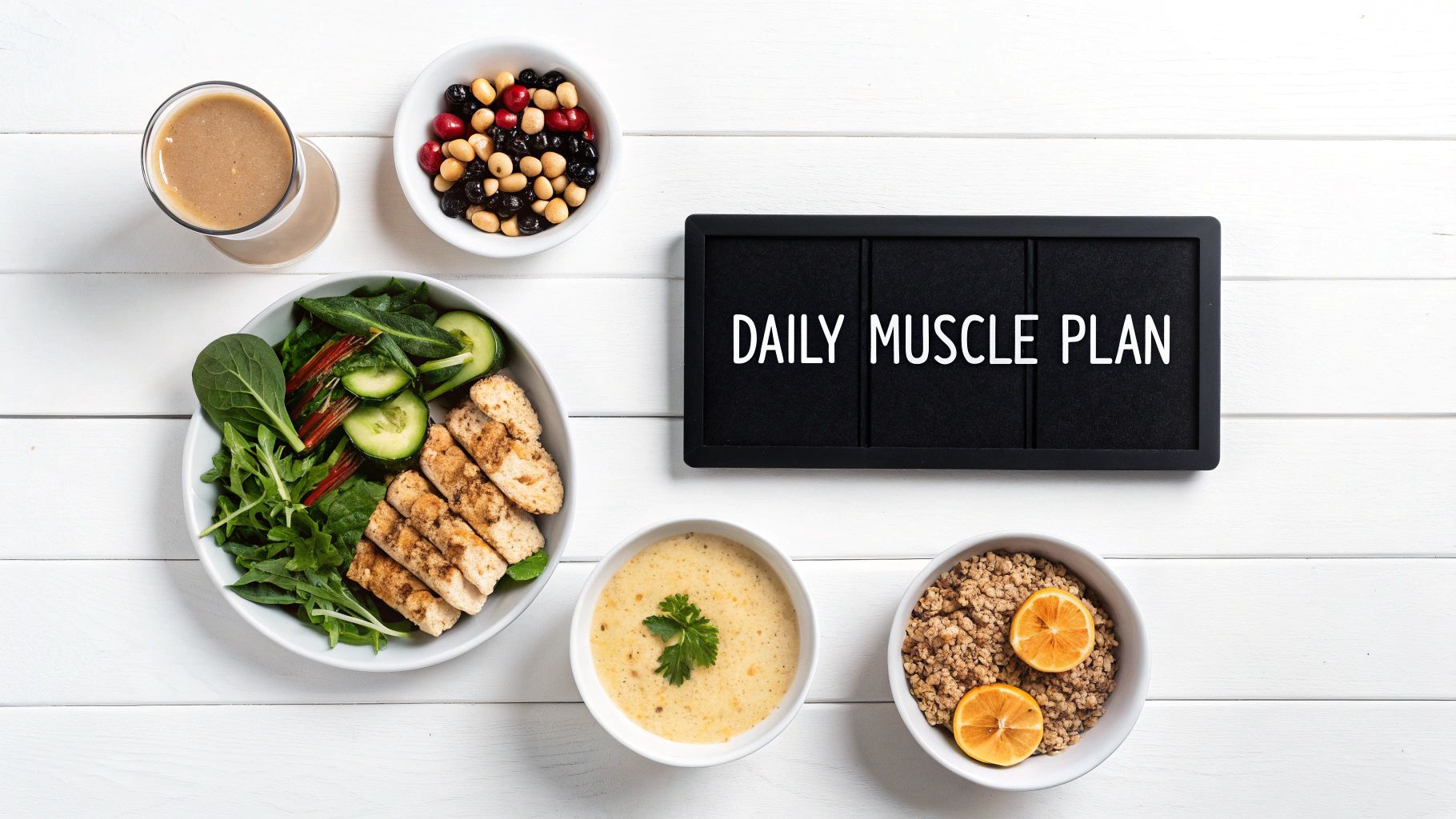
Here’s a look at how to structure a day to get the most out of your plant-based protein for muscle growth.
Sample High-Protein Plant-Based Meal Plan
This table lays out a full day of eating, designed to keep your muscles fed with high-quality amino acids from morning till night. Notice how each meal and snack strategically combines different protein sources to ensure you’re getting a complete profile and plenty of leucine.
| Meal | Sample Dish | Key Protein Sources | Estimated Protein (grams) |
|---|---|---|---|
| Breakfast | Savory Tofu Scramble with black beans & whole-grain toast | Tofu, black beans, whole-grain bread | ~35g |
| Lunch | Hearty Lentil and Quinoa Power Bowl with pumpkin seeds | Lentils, quinoa, pumpkin seeds | ~30g |
| Snack 1 | High-Leucine Protein Smoothie | Plant protein powder, soy milk, hemp seeds | ~30g |
| Dinner | Tempeh and Broccoli Stir-Fry with brown rice | Tempeh, broccoli, brown rice | ~30g |
| Snack 2 | Roasted Edamame or Crispy Tofu Bites | Edamame (soybeans) or Tofu | ~18g |
This structure easily brings the daily total to 143 grams of high-quality plant protein. It's a powerful example of how you can meet, and even exceed, your muscle-building needs with delicious, whole foods.
H3: Morning Fuel: The Savory Tofu Scramble
Let’s kick the day off right. A protein-packed breakfast sets the stage for muscle protein synthesis and gives you sustained energy. A savory tofu scramble is an amazing choice here because it’s loaded with complete protein and is so easy to customize.
To make it, you'd use about 200g of firm tofu (crumbled), a half-cup of black beans, and toss in some spinach, onions, and bell peppers. Serve that alongside half an avocado on a slice of whole-grain toast.
This combo hits the leucine threshold and then some. Tofu brings the high-quality protein, while the beans and toast add complementary amino acids and the complex carbs you need for energy. The total protein count? A solid ~35 grams.
H3: Midday Power: The Lentil & Quinoa Bowl
Lunch needs to be a substantial meal that refills your energy stores and keeps a steady supply of amino acids flowing to your muscles. A big lentil and quinoa bowl is perfect for this, and it’s a meal-prepper's dream.
Just combine 1.5 cups of cooked lentils with 1 cup of cooked quinoa over a bed of mixed greens. Add chopped cucumber and tomatoes, and for a crucial leucine boost, sprinkle on a generous handful of pumpkin seeds. A simple lemon-tahini dressing ties it all together beautifully.
This is protein combining at its best, giving you around ~30 grams of protein.
H3: Smart Snacking: Keeping MPS Elevated
Snacks are your secret weapon for hitting higher protein goals and keeping muscle protein synthesis humming along between meals. Forget sugary bars and opt for savory, satisfying options that pack a real protein punch.
Smart snacking is a huge part of getting enough protein on a plant-based diet.
-
Post-Workout or Mid-Afternoon: Blend a High-Leucine Protein Smoothie. Use one scoop of a pea/rice blend protein powder, a cup of soy milk, a handful of spinach, half a banana, and a tablespoon of hemp seeds. This delivers about ~30 grams of fast-digesting protein right when you need it.
-
Late Afternoon: For a crunchy, savory fix, go for Roasted Edamame or Crispy Tofu Bites. A cup of shelled edamame or a half-block of air-fried tofu will net you around ~18 grams of high-quality soy protein, which is far more satisfying than a bag of chips.
H3: Evening Repair: The Tempeh Stir-Fry
Your last meal of the day is all about setting your body up for overnight recovery and repair. You want a protein-rich meal that digests a bit more slowly, feeding your muscles while you sleep. A tempeh stir-fry is an ideal choice.
Stir-fry about 150g of cubed tempeh with a big serving of broccoli, bell peppers, and snap peas in a soy-ginger sauce. Serve it over a bed of brown rice.
Tempeh is a fermented, complete protein that's easy on the gut. Paired with fiber-rich veggies and complex carbs, it provides that slow, steady release of nutrients your body craves for overnight repair, all while delivering another ~30 grams of protein.
Common Questions About Plant Protein and Muscle
Let’s be honest, switching to a plant-based approach for building muscle brings up a lot of questions. As you start rethinking your meals to prioritize plant based protein for muscle growth, it's only natural to wonder about the specifics. Let's dive into some of the most common concerns and get you clear, science-backed answers to build your plan with confidence.
How Much Plant Protein Do I Actually Need Per Day?
This is the big one, but the answer is more straightforward than you might think. For anyone actively training to build muscle, the scientific consensus lands on a target of 1.6 to 2.2 grams of protein per kilogram of body weight. If you think in pounds, that’s roughly 0.7 to 1.0 grams per pound.
Here's a pro tip: since some plant proteins aren't absorbed quite as efficiently as animal-based ones, I always recommend aiming for the mid-to-high end of that range. It’s a simple strategy that builds in a safety net, making sure your body has all the building blocks it needs for repair and growth.
So, what does this look like in the real world? A 180 lb (82 kg) person should be shooting for about 130-180 grams of protein per day. But just hitting a number isn't the whole story. The real key is spreading that intake out across four or five meals and snacks to keep your muscle-building signals firing all day long.
Do I Need a Plant-Based Protein Powder Supplement?
The short answer is no, you don't need them. But they are an incredibly useful tool. Think of protein powder as a convenient shortcut to help you nail your daily targets, especially during that crucial post-workout window when you might not feel like cooking a full meal.
A good plant protein powder, especially a blend combining sources like pea and rice, makes it ridiculously easy to get 25-30 grams of high-quality protein in a single shake. That amount is usually more than enough to hit the leucine threshold and maximize the muscle-building response. It's a lifesaver for busy days or when whole food just isn’t an option.
That said, you can absolutely hit your goals with whole foods alone. It just takes a bit more planning and conscious effort to make sure every meal is contributing enough protein and leucine.
A protein supplement isn't a magic bullet for muscle growth. It's a tool for convenience and consistency. The real magic lies in your total daily protein intake, your training intensity, and your overall diet.
What’s the Best Time to Eat Plant Protein?
For years, everyone was obsessed with the "anabolic window"—the idea that you had to chug a protein shake within 30 minutes of your last rep. While post-workout nutrition is definitely helpful, we now know that two things matter far more: your total daily protein intake and how you distribute it.
Instead of cramming all your protein into one or two giant meals, your goal should be to spread it out. Aiming for 30-40 grams every 3-4 hours is a far better strategy. This approach creates a steady drip of amino acids into your bloodstream, keeping your muscles in a constant state of repair and growth.
Of course, the time after your workout is still a great opportunity. Grabbing a protein-rich meal or shake within an hour or two of training will absolutely give your recovery a boost and kickstart the muscle-building process. Just remember that it's one piece of a 24-hour puzzle.
Can I Really Get Enough Leucine from a Vegan Diet?
Absolutely. There's a myth that it's tough to get enough leucine on a vegan diet, but with a little know-how, it's totally achievable. While it’s true that animal sources tend to pack more leucine per gram, hitting your targets with plants just requires being a bit more strategic. The goal is to build meals that consistently deliver 2.5-3 grams of leucine.
To do this, you just need to lean on the plant-based, high-leucine all-stars.
- Soy Products: Tofu, tempeh, and edamame are absolute powerhouses of leucine.
- Lentils: A staple for a reason, this humble legume packs a serious punch.
- Pumpkin Seeds: A fantastic source of both protein and leucine, perfect for snacking or adding to meals.
- Corn: It's often overlooked, but corn has a surprisingly strong amino acid profile.
By building your meals around these foods—and using a quality plant protein powder when you need a quick hit—you can easily and consistently hit that leucine threshold. This ensures you’re sending a powerful signal to your body to build new muscle after every single workout.
Ready to power your workouts with a snack that’s as serious about gains as you are? Gym Snack delivers over 15g of clean, plant-based protein in craveable cheesy flavors, without any of the junk. Upgrade your snack game and hit your protein goals the delicious way at https://gymsnack.com.