

You open the pantry because you want crunch, not another sweet bar. Chips sound good for about five seconds, then the part of your brain that cares about energy, training, or staying full kicks in. You want something salty and satisfying that doesn't feel like a nutritional detour.
That's where plant based protein puffs have started to stand out. They aim to deliver the snack experience people crave, crispy, savory, portable, while also doing some of the work of a more purposeful food. The category isn't a niche anymore. The global protein puffs market reached an estimated USD 320.36 million in 2023 and is projected to reach USD 552.58 million by 2030 at a 8.2% CAGR, with the plant-based segment identified as the fastest-growing category, according to Grand View Research's protein puffs market report.
The Search for a Smarter Crunch
A lot of my clients describe the same moment. It's late afternoon, lunch feels far away, dinner is still a few hours off, and they want something crunchy enough to feel satisfying. Not a cookie. Not a shake. Not plain carrots. They want a real snack.

Plant based protein puffs fit that moment well because they sit between traditional junk food and performance nutrition. They're savory like chips, but they can be built around protein-rich ingredients instead of mostly starch and oil. For people trying to stay consistent with workouts, appetite control, or a plant-forward diet, that matters.
This category is growing for a reason. Shoppers aren't just looking for “healthy snacks” anymore. They're looking for food that helps them feel full, supports recovery, and travels well in a gym bag, desk drawer, or carry-on.
Plant based protein puffs make the most sense when you stop judging them like chips and start judging them like fuel.
If you've been trying to move beyond bars and shakes, it also helps to explore better ways to fuel your body that give you more variety in texture and taste. Crunch can be useful. It slows you down, feels more like real eating, and often leaves people more satisfied than drinking their snack.
Why this category clicks with busy people
Some foods are technically nutritious but hard to use in real life. A bowl of lentils is great. It's just not always practical between meetings or after a workout. Plant based protein puffs solve a different problem. They're built for convenience.
They also appeal to people who are tired of sweet “fitness foods.” If you've ever looked at a shelf full of brownie-flavored bars and thought, “I just want something salty,” you already understand the appeal.
Deconstructing the Perfect Protein Puff
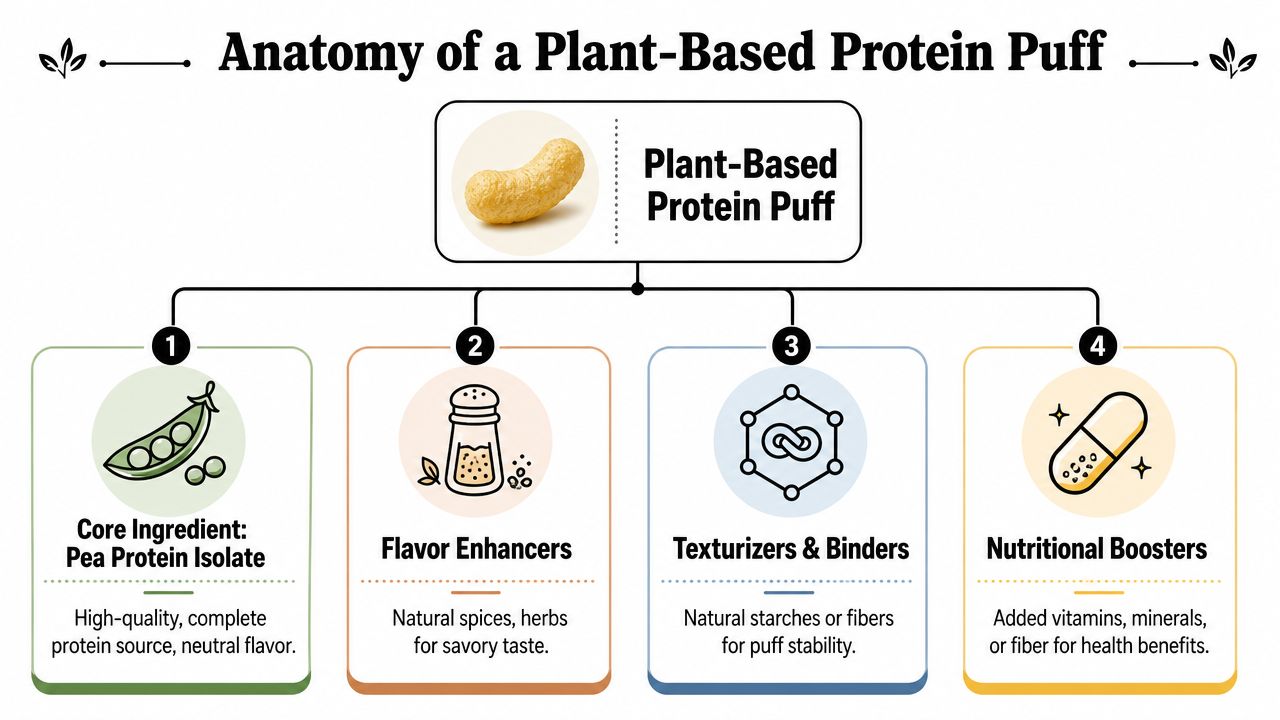
Not all puffs are built the same. Some are basically airy snack foods with a little protein added. Others are designed from the ingredient list upward to deliver a much more meaningful amount of protein in a small serving.
The first place I look is the protein source. Pea protein isolate is one of the most useful foundations for a high-quality puff because it's concentrated and relatively neutral in flavor. According to this review of plant and animal proteins in the NIH database, pea protein contains approximately 80% protein by weight and has a strong essential amino acid profile. The same review notes that plant proteins are generally lower in certain amino acids such as methionine than animal proteins, which is why formulation matters.
What to look for first
A strong puff usually has a short, easy-to-follow ingredient list. That doesn't mean every ingredient has to be a whole food. It means each ingredient should have a clear job.
- Protein base means something concentrated enough to raise the protein content meaningfully, such as pea protein isolate.
- Flavor system should come from seasonings, spices, and savory ingredients rather than relying only on sweetness or heavy coating.
- Structure ingredients help the puff hold shape and crunch without turning it into a greasy chip.
- Fat source should be used carefully, because it affects both flavor and how heavy the snack feels.
If you want a primer on the ingredient itself, this explanation of what pea protein isolate is is useful background before you start comparing labels.
Why formulation matters
A lot of readers get stuck on one question: “If plant proteins are lower in some amino acids, does that make the snack low quality?” Not necessarily. It means the recipe has to be built intelligently.
A well-formulated puff can still support workout recovery and satiety goals. The practical takeaway is simple. Don't stop at the phrase “plant-based.” Look for a product that treats protein as the main event, not a marketing add-on.
Practical rule: The more a puff depends on concentrated protein instead of just whole legumes alone, the easier it is to reach a genuinely useful protein level per serving.
Another point people miss is allergen positioning. A product can be vegan and still contain ingredients some shoppers need to avoid. If you're choosing plant based protein puffs because you're also trying to skip dairy, soy, or gluten, you still need to verify that on the label.
The Nutritional Advantage Over Other Snacks
The biggest benefit of plant based protein puffs isn't that they're trendy. It's that the better ones can do something ordinary snacks rarely do well. They combine crunch with enough protein to influence fullness.
That's important because protein-rich snacks tend to work differently from low-protein snack foods. Instead of giving you a quick hit and then leaving you hungry again, they're more likely to help you feel steady for longer. In plain language, they're better at taking the edge off hunger.
Why fullness matters more than willpower
People often blame themselves for snacking badly, but appetite is physical. When a snack has more protein and fiber, it can support the body's natural fullness signaling. The broader plant-based snacks market report notes demand for protein-rich options that support hormones involved in fullness signaling, including GLP-1 and PYY, in a market that was valued at USD 19.56 billion in 2024 and projected to reach USD 38.69 billion by 2032, with North America holding 42.3% revenue share in 2024 according to Market Data Forecast's plant-based protein market coverage.
You don't need to memorize hormone names to use that information well. The key takeaway is this: a snack with meaningful protein and some fiber tends to feel more satisfying than one that's mostly refined starch and fat.
Snack comparison at a glance
Here's a practical way to compare options when you're standing in a store.
| Snack Comparison (Per 1oz/28g Serving) | Protein (g) | Fiber (g) | Saturated Fat (g) | Calories |
|---|---|---|---|---|
| Traditional potato chips | Low | Low | Varies | Moderate |
| Almonds | Moderate | Moderate | Low | Dense |
| Typical whey protein bar | Higher | Varies | Varies | Higher |
| Lower-protein bean or chickpea puffs | 5 to 8 | Varies | Varies | Moderate |
| Higher-density pea-isolate puffs | 15 or more | Varies | Lower in better formulas | Moderate |
This table mixes exact verified protein ranges where available with qualitative comparisons where no verified numbers were provided. That's still enough to make a smart choice.
What makes them useful for active people
For gym-goers, the advantage is straightforward.
- More helpful post-workout when the snack provides enough protein to contribute to recovery, not just curb cravings.
- Easier for appetite control because a crunchy, savory protein snack can feel more satisfying than sweet snack foods.
- Useful for plant-forward eating when you're trying to add more protein without relying entirely on shakes.
A “healthy snack” keeps you busy for ten minutes. A good protein snack buys you time until your next real meal.
Plant based protein puffs won't replace balanced meals, but the stronger ones can outperform many common grab-and-go options when fullness and protein intake are the goal.
How to Read the Label and Choose Wisely
You're standing in the snack aisle with two bags that both say plant-based and high protein. One will work like a crunchy convenience snack. The other can do a better job holding you over after a workout or between meals. The label is what separates them.
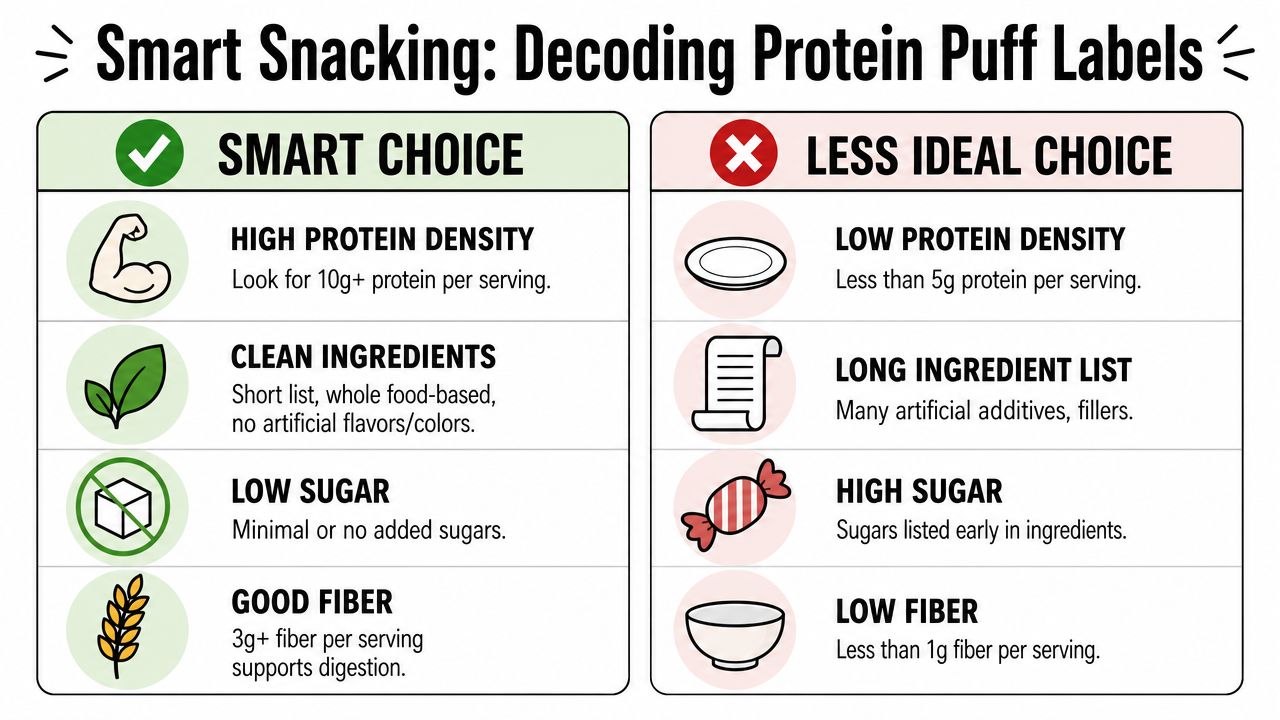
The fastest way to spot the difference is to look for protein density, not just a protein claim on the front. Some puffs are made mostly from whole beans or chickpeas, so they deliver a modest amount of protein. Others use a more concentrated protein source, such as pea protein or pea isolate, and pack much more protein into the same handful. As noted earlier, that difference can be large enough to change whether the snack feels like light munching or actual fuel.
A simple store-aisle label check
Start with the Nutrition Facts panel, then move to the ingredient list. That order matters because it keeps you from getting distracted by front-of-bag marketing.
- Check grams of protein per serving. Higher numbers usually mean the product is built to do more than provide crunch.
- Check serving size. A bag can look impressive until you notice the protein number is tied to a very small serving.
- Read the first few ingredients. If pea protein, pea isolate, or another concentrated protein source shows up early, protein is probably central to the formula.
- Look at fiber, sugar, and saturated fat together. A better puff usually keeps the focus on protein without loading the product with extras that make it more like junk food in a health costume.
- Check sodium in context. Savory snacks need some salt, but very high sodium can make an everyday snack harder to fit into your routine.
A helpful rule is this: a training-oriented puff should look strong on the nutrition panel before you even get to the marketing language. If the protein is modest and the ingredients read like a standard puffed snack, treat it as a snack first and a protein food second.
If you want more practice with that process, this guide on how to read nutrition labels makes the shortcuts easier to use in real life.
Why the ingredient list matters more than people expect
Ingredients tell you how the product was built. Whole legumes can add fiber and a familiar food base, but they do not always create a high-protein end product. Concentrated plant proteins can raise the protein level enough to make the puff more useful for satiety and recovery.
That matters because your body responds differently to a snack with a little protein versus one with enough to make a real dent in hunger. Protein-rich foods are associated with stronger satiety signals, including hormones such as GLP-1 and PYY. You do not need to memorize the science. The practical takeaway is simple. A better protein puff has a better chance of helping you stay full longer, which can make it easier to avoid the second snack an hour later.
The allergen check is a separate step
Plant-based does not mean allergy-friendly.
A vegan puff may still contain soy, wheat, or other common allergens. It may also be produced in a facility that handles milk, peanuts, tree nuts, or eggs. For anyone with food sensitivities, or for parents, students, and athletes sharing snacks, that line matters just as much as the protein number.
Use this quick filter:
- “Vegan” tells you the product does not use animal-derived ingredients.
- “Free from” or allergen statements tell you whether it avoids ingredients that matter to your health.
- “May contain” tells you there may be cross-contact during manufacturing.
Those labels answer different questions. Check all three if allergies or intolerances are part of your decision.
A short video can also help if you're trying to get more label-confident while shopping.
Strategic Snacking for Fitness and Fuel
A good protein puff isn't just something to eat when you're bored. It works best when you use it with intention.
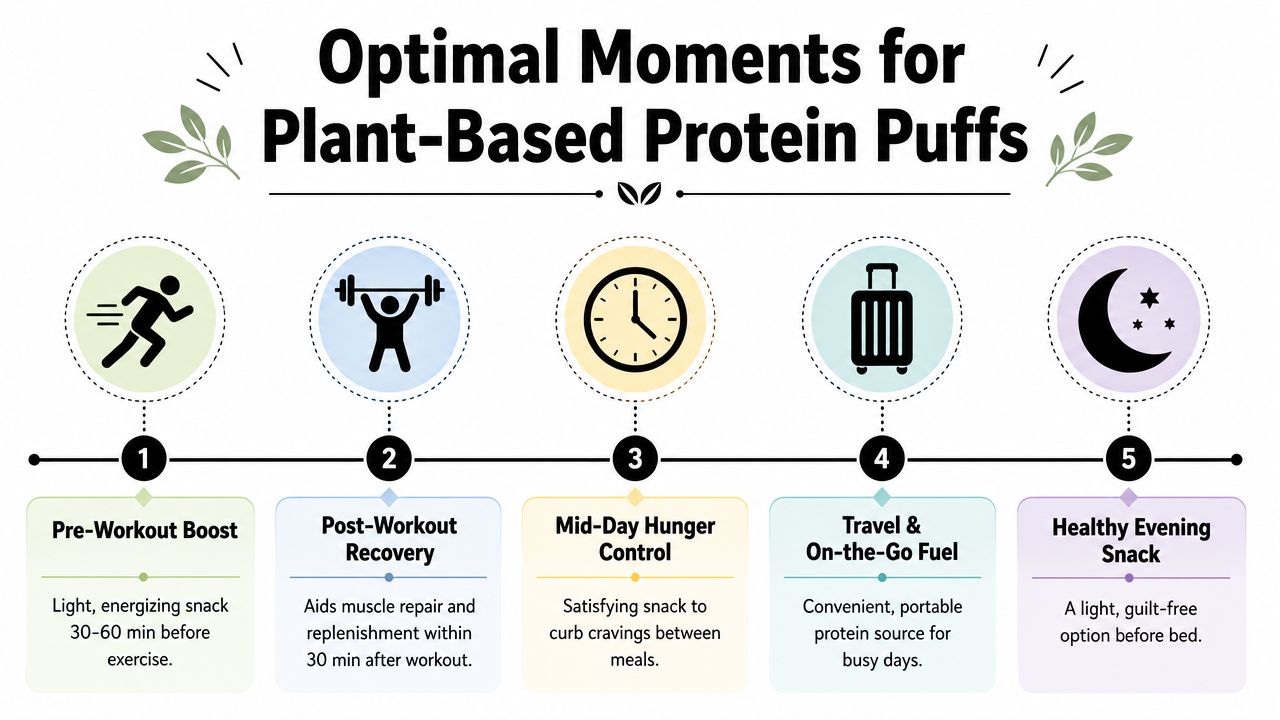
For exercise, many people do well with a light savory snack before training because it's easier to tolerate than a heavy meal. If your stomach doesn't love dense food before movement, puffs can be a convenient middle ground. They're also practical after training when you need something fast and portable.
When they make the most sense
- Before a workout they can bridge the gap when your last meal was too long ago and you need something light.
- After a workout they can help you start recovering when a full meal isn't available yet.
- Mid-afternoon they're useful when you want to prevent the energy dip that pushes you toward vending machine choices.
- During travel or commuting they solve a portability problem that many protein foods don't.
How to use them without overthinking it
Think of them as a bridge food, not a replacement for lunch or dinner. If you know you'll be stuck between meals for several hours, they can help stabilize appetite. If you're heading into a workout and don't want something sweet, they're an easy fit.
Choose your snack based on the job it needs to do. If the job is “hold me over,” protein matters a lot more than branding.
Busy professionals often benefit most from keeping one bag where decision fatigue hits. A desk drawer, car console, backpack, or gym locker works better than relying on perfect planning.
Creative Ways to Enjoy Your Protein Puffs
Puffs are often eaten straight from the bag, which is fine. But they're more versatile than that, especially if you like adding crunch to meals.
Easy ways to use them beyond snacking
- Crush them over soup. They can work like croutons, but with a more protein-forward profile.
- Add them to salads. A handful on top gives texture and can make a light salad feel more substantial.
- Pair with hummus or bean dip. That combination turns a simple snack into a more balanced mini-meal.
- Use them in snack plates. Add sliced vegetables, fruit, and a dip so the whole plate feels more complete.
If you want more practical meal and snack ideas, this collection of easy high-protein snack recipes can help you build simple combinations without much prep.
A lot of people stick with better habits when a food does more than one job. That's part of the appeal here. Plant based protein puffs can be crunchy on their own, but they can also act as a topping, side, or bridge snack that makes other meals more satisfying.
Frequently Asked Questions About Protein Puffs
A common real-life question sounds like this: you want something crunchy at 3 p.m., or after a workout, and the bag says “plant-based protein.” Does that make it a smart snack, or just a snack with better branding? The answer depends on how much protein you get for the calories, and whether that protein is enough to help with fullness and recovery.
Are plant based protein puffs good for weight loss
They can fit a weight-loss plan if they help you stay satisfied between meals. Protein supports fullness by increasing satiety signals such as GLP-1 and PYY, which is one reason a protein-dense puff tends to do more for appetite control than a standard airy snack with only a little added protein.
That is the key difference between snack puffs and training puffs. If the protein amount is high enough to change how full you feel, the product is doing a different job.
Can kids eat them
Usually, yes. But it helps to treat them as a convenient snack, not as a nutrition shortcut.
For active teens, a higher-protein puff can make sense after school or after sports. For younger kids, focus on the basics first: easy-to-chew texture, moderate sodium, and an ingredient list that fits their needs. A snack should support regular meals, not crowd them out.
Do they taste like cardboard
Older protein snacks often struggled with texture and flavor. Newer puffs are better because brands have improved seasoning systems and the structure of the puff itself, so you are less likely to get that dry, chalky finish people associate with early protein products.
A good savory puff should eat like a real snack first. The nutrition should feel like a bonus, not a penalty.
Are they allergen-free because they're plant-based
No. Plant-based only tells you where the protein comes from. It does not automatically mean free from soy, wheat, peas, nuts, or dairy cross-contact.
Read the allergen statement and the ingredient list separately. A product can be vegan and still contain common allergens, or be made in a facility that handles them. As noted earlier, this is one of the easiest places for shoppers to get confused.
Can they replace a meal
Usually not. Most protein puffs work best as a bridge snack, a pre-workout bite, or part of a light meal.
If you want them to function more like a meal, pair them with foods that add staying power. Fruit gives fiber and carbs. A dip like hummus adds more substance. Edamame or tofu can raise the protein further. That combination works more like fuel, especially on active days.
If you want a real-world example of what a training-focused savory puff can look like, Gym Snack is built around the qualities that matter most: plant-based protein, crunchy texture, bold flavor, and a formula designed for people who want smarter fuel instead of another sugary bar.