

Alright, let's break down how to read a nutrition label. Forget the overwhelm—it's a skill you can master, and it really comes down to a simple flow: start with the serving size and calories, move on to the macros and key nutrients, and finish by scanning the ingredients list. Once you get the hang of this, you’ll be able to tell in seconds if a food actually supports your goals.
Your Superpower for Smarter Food Choices
Learning to read a nutrition label is one of the most powerful things you can do for your health. Seriously. It’s easy to get lost in the sea of numbers and text, but I promise it's simpler than it looks. This guide will walk you through it, so you can confidently decide if a product deserves a spot in your cart.
Think of it this way: you're learning to see past the flashy marketing. A brightly colored box might scream "high protein" or "all-natural," but the label tells the real story. For anyone serious about their fitness—whether for performance, muscle growth, or recovery—this isn't just a good skill to have; it's essential.
Why Label Literacy Matters More Than Ever
If you've ever felt confused by a food label, you're not alone. Recent surveys show a pretty big gap between what people want to do and what they understand. While 83% of adults say they check labels before buying something, one in five admit they have a hard time actually interpreting the information. It’s clear we're paying attention, but the details can still trip us up. You can read more about these consumer insights on food labeling to see just how common this is.
This guide is here to close that gap. We'll go through the actionable steps to analyze any label with confidence. By the end, you'll know how to:
- Spot Misleading Serving Sizes: Uncover how tiny portions can make not-so-healthy foods look like a good choice.
- Judge Macronutrient Quality: Tell the difference between good fats, complex carbs, and high-quality protein.
- Find Hidden Sugars and Additives: Learn to recognize the sneaky ingredients that hide in plain sight.
- Match Food to Your Goals: Whether you're building muscle, managing weight, or eating plant-based, you’ll know exactly what to look for.
The Nutrition Facts panel isn't just a list of numbers; it's a blueprint of the fuel you're giving your body. Learning to read it is like learning the language of your own health and performance.
Key Sections of a Nutrition Label at a Glance
Before we tear into the details, let's get a bird's-eye view. Every FDA-regulated label follows the same basic format, which makes comparing products a breeze once you know your way around.
Here’s a quick rundown of what you’ll be looking at.
| Label Section | What to Look For | Why It Matters for Your Goals |
|---|---|---|
| Serving Info | Serving Size, Servings Per Container | Everything else on the label is based on this amount. Get this wrong, and all your math is off. |
| Calories | The big, bold number at the top | The cornerstone of energy balance, whether you're in a deficit, surplus, or just maintaining. |
| Nutrients | Fats, Carbs, Protein, Sodium, Key Vitamins | This is where you dig into the quality of the food and check its macro and micronutrient profile. |
| % Daily Value | The percentages down the right side | A quick reference to see if a food is high (20% or more) or low (5% or less) in a nutrient. |
| Ingredients List | The list of all components, ordered by weight | This reveals the true nature of the product and uncovers any fillers, allergens, or hidden sugars. |
Think of this table as your cheat sheet. Now, let’s get into what each of these sections really means for you.
Start at the Top: Serving Size and Calories

Before your eyes even think about drifting down to the protein or carb count, stop. The very first place to look on any nutrition label is the serving size. This number, along with the calories per serving, sets the stage for everything else on that panel.
Trust me on this one: food companies are masters of "health-washing," and using a tiny, unrealistic serving size is their oldest trick. It's an easy way to make the calories, sugar, and fat look surprisingly low at first glance. Always, always check the servings per container to see the full story.
Do the Portion Math Before You Snack
I call this "portion math," and it's the most critical habit you can build. Before you open that bag or box, you have to compare the serving size on the label to how much you actually plan on eating. This is the gap where good intentions fall apart.
A small bag of chips, for example, might list a serving as "about 11 chips" for 150 calories. But if the bag contains three servings and you finish it—which most of us do—you didn't just have a 150-calorie snack. You had a 450-calorie snack.
That single bag of chips just became the caloric equivalent of a small meal. This simple multiplication is the most important calculation you can do when looking at a label.
Getting this right becomes second nature once you start doing it. It’s what separates someone who is in control of their diet from someone who accidentally sabotages their progress.
A Tale of Two Snacks
Let's walk through a common scenario in the snack aisle. You're trying to pick between two snacks that both look like they're for one person: a protein bar and a bag of those "healthy" veggie straws.
- The Protein Bar: The label is straightforward. The serving size is "1 bar," which has 190 calories. Easy. What you see is what you get.
- The Veggie Straws: This is where it gets tricky. The "single-serving" bag says a serving is "1 oz (about 38 straws)" for 130 calories. But right next to it, you see "Servings Per Container: 2.5."
If you eat that whole bag of veggie straws, you're actually consuming 325 calories (130 calories x 2.5 servings), not the 130 you might have quickly registered. All of a sudden, that protein bar looks like a much more calorie-conscious choice.
If you want to avoid the complicated math, sticking with straightforward, single-serving options can make life easier. Exploring a good list of https://gymsnack.com/blogs/gym-alpha/high-protein-low-calorie-snacks is a great way to find choices built for fitness goals.
Calories Are King for Weight Management
Once you've figured out your actual portion and done the math, the calorie count is your next stop. This number, now thankfully in a large, bold font on most labels, tells you how much energy you're getting from that serving.
For anyone trying to manage their weight, this number is non-negotiable, especially if you're working toward understanding a calorie deficit.
Ultimately, calories drive weight gain or loss. While the quality of those calories is hugely important (we'll get to that later), the total quantity is what determines your energy balance. Whether your goal is fat loss, muscle maintenance, or even bulking up, you have to know your numbers.
The FDA made the calorie count bigger and bolder for a reason—it’s that important. Don't just glance at it. Calculate it for the portion you’re actually going to eat. This one habit will completely change how you see food and empower you to make choices that get you closer to your goals.
Cracking the Code on Macros and Micros
Alright, we’ve covered serving sizes and calories. Now it's time to get into the real meat of the label—the stuff that actually dictates how you'll feel and perform. We're talking about the macronutrients (fats, carbohydrates, and protein) and the key micronutrients that fuel your body.
Think of this section as the command center for your nutrition strategy. These numbers tell a story about the quality of your food. Is this going to give you sustained energy, or are you signing up for a sugar crash in an hour? Let’s break it all down.
The Big Three: A Closer Look at Macronutrients
For anyone with fitness goals, this part of the label is where the magic happens. Your macros are the building blocks and the fuel source for everything your body does. Honestly, learning to read this section is a non-negotiable skill if you're serious about your results.
If you want to go deeper into how these nutrients work together, our guide on understanding macros for weight loss is a great place to start. It sets the stage perfectly for what we're about to cover.
Good Fats, Bad Fats
The Total Fat line is your starting point, but the real story is in the indented lines below it: Saturated Fat and Trans Fat. Your body definitely needs fat to function, but the type of fat makes all the difference.
- Saturated Fat: You’ll find this in animal products and certain oils like coconut and palm. The general advice is to keep your intake moderate.
- Trans Fat: This is the one you want to avoid like the plague. Always look for 0g on the label. It’s a marker of highly processed junk food and has no place in a healthy diet.
A pro tip for fitness folks: since healthier unsaturated fats often aren't listed, you have to play detective with the ingredients list. Look for things like nuts, seeds, and avocado oil instead of hydrogenated or partially hydrogenated oils.
Carbohydrates: Your Primary Fuel Source
Next up is Total Carbohydrates. This number lumps everything together—fiber, starches, and sugars. Carbs are your body’s go-to energy source, especially for tough workouts, but quality is everything.
The label gives you two crucial clues about that quality:
- Dietary Fiber: Fiber is your friend. A higher number here usually points to a more whole, less-processed food that will keep you full longer. I always look for at least a few grams per serving.
- Total Sugars vs. Added Sugars: "Total Sugars" includes sugars that occur naturally (like in fruit), but the line to zero in on is "Added Sugars." These are the syrups and sweeteners dumped in during processing.
Key Takeaway: Your mission is to keep added sugars to a minimum. A high number here is a massive red flag. It usually means the food is low in nutrients and will send your energy levels on a rollercoaster.
Protein: The Muscle Builder
For anyone hitting the gym, Protein is the main event. It’s absolutely essential for repairing and building muscle, keeping you full, and firing up your metabolism. When I’m trying to decide if a product is worth it, this is the first number I check.
Here’s a simple trick I use to gauge a product's protein quality: check its protein density.
A good rule of thumb is to aim for roughly 1 gram of protein for every 10-15 calories. So, a snack with 150 calories and 15g of protein hits that perfect 10:1 ratio. That tells you it’s a legitimate protein source, not just a carb-heavy snack with a token amount of protein thrown in.
Using Percent Daily Value (%DV) for a Quick Scan
That column on the far right, the Percent Daily Value (%DV), can look a bit confusing, but it's actually a fantastic shortcut. It's designed to show you, at a glance, whether a food is high or low in a certain nutrient.
The rule is incredibly simple:
- 5% DV or less means a serving is low in that nutrient.
- 20% DV or more means a serving is high in that nutrient.
This makes scanning labels a breeze. If you're a plant-based athlete looking to boost your iron, a food with 25% DV for iron is a big win. On the flip side, if you're watching your sodium intake, you'll want to stick with products that are 5% DV or less.
This system isn't just a random guideline; it's backed by research. Studies consistently show that people who pay attention to the %DV on nutrition labels make healthier food choices. You can dive into the science behind how label use improves nutrition literacy and dietary choices if you want to learn more.
The table below summarizes what to look for based on your specific dietary goals.
Nutrient Guide for Fitness and Plant-Based Diets
This quick guide highlights which nutrients to prioritize and which to watch out for, depending on whether your focus is on fitness performance, a plant-based diet, or both.
| Nutrient | Goal for Fitness (Prioritize/Limit) | Goal for Plant-Based (Prioritize/Limit) | What to Look For on the Label |
|---|---|---|---|
| Protein | Prioritize | Prioritize | High gram count, 1g per 10-15 calories |
| Added Sugars | Limit | Limit | Low grams, aim for 5% DV or less |
| Saturated Fat | Limit | Limit | Low grams and low %DV |
| Dietary Fiber | Prioritize | Prioritize | High gram count, 20% DV or more |
| Iron | Prioritize | Prioritize | High %DV, especially from plant sources |
| Sodium | Limit | Limit | Low mg count, aim for 5% DV or less |
Using this table as a mental checklist when you're shopping can help you make smarter, faster decisions that align with your health and performance objectives. It’s all about learning to see past the marketing on the front of the box and understanding the real story told on the back.
The Ingredient List: Your Guide to Food Quality
Think of the Nutrition Facts as the "what" and the ingredient list as the "how." While the numbers give you a snapshot of the macros, the ingredients tell you the real story behind your food. This is where you separate the genuinely clean, high-performance fuel from the junk food dressed up in a healthy-looking package.
Becoming a pro at reading labels means you have to play detective, and the ingredient list is where you'll find all the most important clues.
The #1 Rule of Reading Ingredients
If you only remember one thing, make it this: ingredients are listed in descending order by weight. Whatever is listed first makes up the biggest portion of that product. The last ingredient? The smallest.
That simple fact is a game-changer. It lets you instantly cut through the marketing fluff. Pick up a "protein" bar and see sugar listed as the first ingredient? You know it's a candy bar in disguise, no matter what the front of the wrapper claims.
Pro Tip: Look for products where the first few ingredients are whole, recognizable foods. When you see things like almonds, pea protein, or oats at the very top, you know you're on the right track.
Spotting Hidden Sugars and Junk Fillers
Food companies have gotten incredibly sneaky, using dozens of different names to hide sugar in plain sight. A product might boast "no high-fructose corn syrup," but a quick scan of the ingredients reveals dextrose, maltodextrin, or brown rice syrup. It's all just added sugar.
Here’s a quick guide to spotting them:
- Any word ending in “-ose” is a red flag (e.g., sucrose, dextrose, fructose).
- Be cautious of syrups like brown rice syrup, tapioca syrup, or agave.
- Even "natural" sweeteners like cane juice, honey, or fruit juice concentrate count as added sugars.
Beyond sugar, a long list of unpronounceable, chemical-sounding names is another major warning sign. This usually means the food is heavily processed and loaded with artificial flavors, preservatives, and emulsifiers. The shorter and simpler the list, the better.
What to Look for in a High-Quality Product
So, what does a good ingredient list look like? Honestly, it should read more like a recipe you’d make in your own kitchen and less like a science experiment.
For a great plant-based protein snack, you want to see the protein source listed right up top. Look for ingredients like pea protein or brown rice protein as one of the first few items. This confirms you're getting a meaningful dose of protein, not just a sprinkle of it from some background grain.
Pay close attention to the fats, too. Far too many snacks are packed with cheap, inflammatory seed oils like soybean, canola, or sunflower oil. A better choice will use healthier fats like avocado oil, olive oil, or the natural fats found in nuts and seeds. If you want to get serious about this, our guide on how to avoid seed oils is a great resource for spotting and ditching them for good.
Finding Common Allergens Fast
For anyone with food sensitivities, the ingredient list is non-negotiable. Thankfully, federal law makes this part pretty straightforward.
Major allergens must be clearly identified. The most common ones include:
- Milk
- Eggs
- Peanuts
- Tree nuts
- Soy
- Wheat
- Fish
- Shellfish
Most companies make this incredibly easy by putting a bolded "Contains" statement just below the full ingredient list (e.g., "Contains: Soy, Wheat"). This is a lifesaver if you're avoiding dairy, soy, or gluten and need to quickly vet a product.
Putting It All Together with Real-World Examples
Alright, we’ve covered the theory. Now, let's put it into practice where it actually matters—in the grocery store aisle. This is where the rubber meets the road.
We’re going to walk through a classic scenario: comparing two common snack choices. Think of a fitness-focused protein bar going head-to-head with a standard candy bar. This is how you learn to see past the flashy marketing and make choices that genuinely line up with your goals.
The Head-to-Head Snack Showdown
Picture this: you're standing in front of the snack shelf, looking for a quick pick-me-up. You grab a popular chocolate-covered candy bar and a high-protein bar. They look about the same size, right? But once you flip them over, the labels tell two completely different stories.
Scenario 1: The Candy Bar First up, the candy bar. You turn it over and immediately check the serving size. It might say "1 fun size bar," but you notice the package you're holding has two of them. This is a classic trap manufacturers use.
- Serving Size: 1 bar (but the pack contains 2)
- Calories: 210 per bar (meaning 420 for the whole thing)
- Added Sugars: 22g per bar (44g total!)
- Protein: 4g per bar (8g total)
- Saturated Fat: 7g (35% DV) per bar
The red flags are already waving. That "quick snack" is actually over 400 calories with a massive sugar hit. A quick glance at the ingredients confirms it, with "Sugar" and "Corn Syrup" listed right near the top. You're getting minimal protein and a huge chunk of your daily saturated fat limit in just a few bites.
Scenario 2: The High-Protein Bar Next, you grab the protein bar. The label feels much more honest right away.
- Serving Size: 1 bar (the entire package)
- Calories: 200
- Added Sugars: 1g
- Protein: 20g
- Saturated Fat: 2g (10% DV)
The difference is night and day. For roughly the same calories as half the candy bar pack, you’re getting five times the protein, almost no added sugar, and a much lower saturated fat count. The ingredients list starts with a protein blend (like pea or whey), not sugar. This snack is built to actually fuel your body, not just give you a temporary rush.
This quick comparison shows how two products that seem similar on the shelf can have wildly different impacts. One is a sugar bomb that leads to a crash, while the other delivers sustained energy and the protein your muscles need.
Analyzing the Ingredient Quality
Going beyond just the numbers, a quick scan of the ingredients reveals the real quality of each snack. I have a simple, three-step mental checklist I run through for any ingredient list.
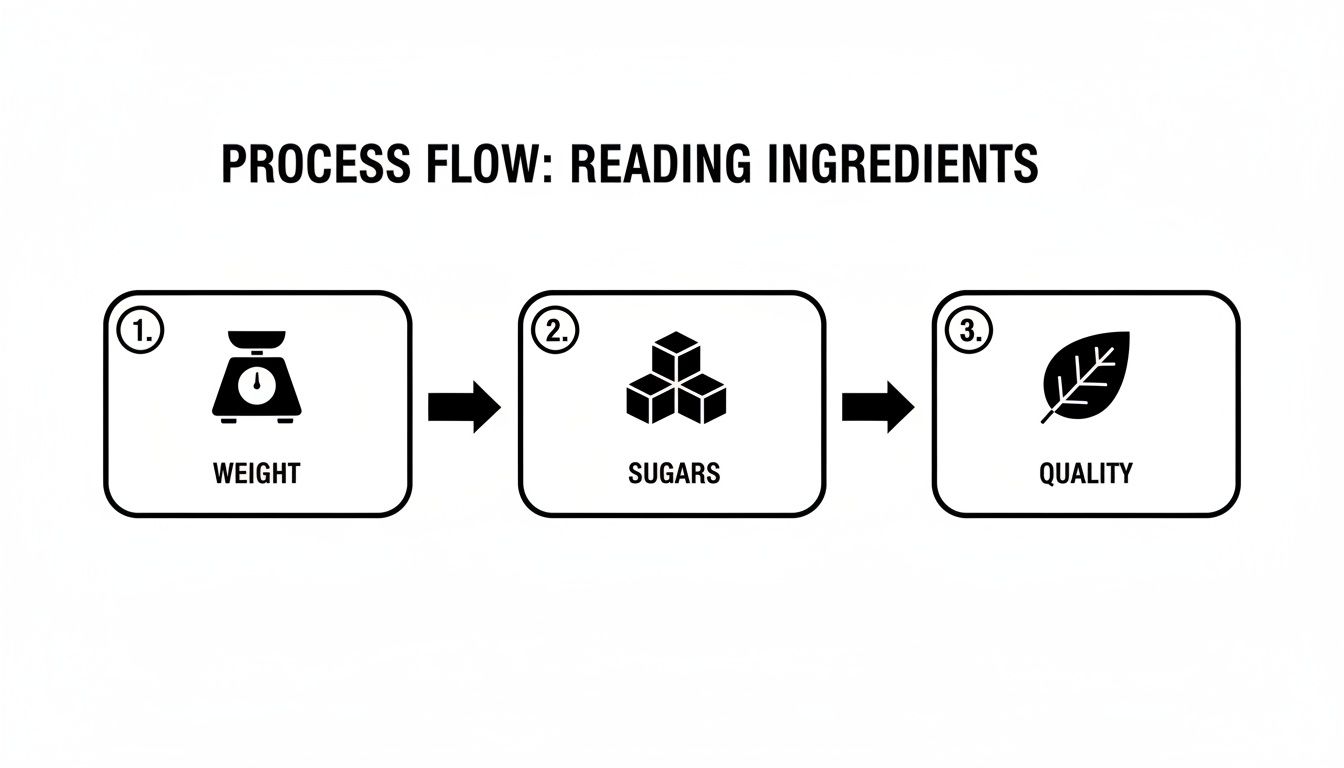
This process is simple: the first few ingredients matter most (they're listed by weight), hidden sugars are a major red flag, and the best products are made from recognizable, whole-food components.
The candy bar’s list is a novel of various sugars, hydrogenated oils, and artificial flavors. The protein bar, on the other hand, leads with its protein source and uses things like nuts or natural sweeteners. One is a highly processed confection; the other is engineered for performance.
By learning to read these labels, you're giving yourself the power to see beyond the wrapper. You can instantly tell the difference between food that works for you and food that works against you.
This skill isn't about chasing perfection. It's about being informed. With just a few seconds of analysis, you can confidently make choices that keep you on track, feeling strong, and ready for whatever comes next.
Got Questions About Nutrition Labels? Let's Clear Things Up.
Even when you know the basics, the grocery aisle can still throw you a curveball. Certain questions seem to pop up constantly when you're trying to make a quick, healthy choice. Let's break down some of the most common head-scratchers so you can shop with more confidence.
How Can I Spot a Genuinely High-Protein Snack?
Here's a trick I use all the time: the 10:1 ratio. For a food to be truly protein-dense, aim for at least 1 gram of protein for every 10 calories.
It's simple math that cuts through the marketing fluff. A snack with 150 calories and 15g of protein? That's a perfect match. This little rule helps you distinguish snacks that are truly packed with protein from those that just slap a "good source of protein" claim on the front but are mostly carbs and fat.
And don't forget to glance at the ingredients to see where that protein is coming from. You want to see quality sources like pea, soy, or whey high up on the list.
What's the Single Biggest Red Flag on an Ingredient List?
For me, it's seeing sugar listed as one of the first three ingredients. Because ingredients are listed by weight, this is a dead giveaway that the product is mostly sugar, no matter what health claims are on the box. Keep an eye out for its many disguises, too—high-fructose corn syrup, dextrose, and sucrose are all just sugar.
Another major red flag? A long, unpronounceable list of ingredients. This usually signals a highly processed food loaded with chemical additives and preservatives. My advice is to stick with foods that have shorter ingredient lists you can actually recognize.
Should I Bother With "Net Carbs"?
Honestly, "net carbs" is more of a marketing term than a nutritional one. It isn't regulated by the FDA, and brands calculate it by subtracting fiber and sugar alcohols from the Total Carbohydrates.
While people on strict keto or low-carb diets might find it useful, it's best to be skeptical. The numbers you can always trust are the officially standardized ones: "Total Carbohydrates" and "Dietary Fiber."
For most of us focused on overall health and fitness, focusing on getting enough dietary fiber is a much smarter play than getting lost in confusing "net carb" math. Prioritizing fiber naturally leads you to more whole, less-processed foods that provide sustained energy and support good digestion.
Ready to stop searching and start snacking smarter? Gym Snack crafts savory, plant-based protein snacks with clean ingredients you can actually pronounce. With 15g of protein per serving and zero junk, it's the perfect fuel for your fitness journey. Find your new favorite snack.