

You're standing in a store aisle, flipping over one bar after another. The front says plant-based. The side says high protein. Then the ingredient list says soy lecithin, soy protein isolate, or “may contain” warnings that leave you less certain than when you started.
That's a common spot to be in. Some people need protein bars without soy because of allergy concerns. Others avoid soy for digestive reasons, ingredient preferences, or because they feel better with other protein sources. Whatever brought you here, the challenge isn't just finding one decent bar. It's learning how to judge any bar quickly and confidently, whether you're in a grocery store, airport, gym café, or scrolling online.
A good soy-free bar should do more than skip one ingredient. It should fit your training, your stomach, your schedule, and your bigger nutrition goals.
Why Finding Great Protein Bars Without Soy Is a Challenge
Soy shows up in a lot of bars because it's convenient for manufacturers. It can raise protein content, help texture, and keep costs manageable. That means when you remove soy, the product often has to be rebuilt from the ground up.
That's part of why shopping gets confusing. A bar can look healthy from the front of the package and still miss the mark for your needs. “Plant-based” doesn't automatically mean soy-free. “Dairy-free” doesn't automatically mean allergen-friendly. Even “high protein” doesn't tell you whether the protein source works for your body.
The demand is real, though. One industry guide projects the global protein bar market will reach $15.85 billion in 2025, and notes that plant-based and soy-free segments are growing faster than the overall category, which reflects stronger demand for cleaner and more allergen-conscious snacks, as described in this soy-free protein bar market overview.
Why shoppers still feel stuck
Most product roundups focus on brand lists. That helps for a moment, but it doesn't solve the bigger problem. Brands change formulas. Stores rotate inventory. The bar your friend loves may not suit your digestion, protein target, or other allergies.
Here's where people usually get tripped up:
- Front-of-pack claims can distract from the ingredient list.
- Soy-free can be confused with safe for all allergies, which it isn't.
- Protein amount gets attention, while fiber, calories, and sweeteners get ignored.
- Vegan bars often rely on protein blends that vary a lot in taste and texture.
Practical rule: Don't shop for a perfect brand first. Shop for a repeatable decision process.
That's also why allergy-friendly shopping takes more than a quick glance. If you want a deeper look at how to think through broader sensitivity issues, this guide on finding your go-to allergy-friendly protein bars is useful alongside your soy-free search.
The real skill to build
You don't need memorized product lists. You need a filter.
Ask four questions every time:
- Is it free of soy ingredients?
- What protein source is doing the work?
- Do the macros fit my goal?
- Will my body tolerate the rest of the formula?
Once you can answer those fast, protein bars without soy stop feeling like a guessing game.
Decoding the Label to Find Truly Soy-Free Bars
A lot of shoppers look only for soy protein isolate and stop there. That's a start, but it's not enough. Soy can appear in more than one form, and some forms are easy to miss when you're in a hurry.
The first thing to read is the full ingredient list. The second is the allergen statement. The third is any manufacturing warning, especially if soy exposure matters to you medically.
The red-flag ingredient scan
Use this as a mental checklist when you pick up a bar:
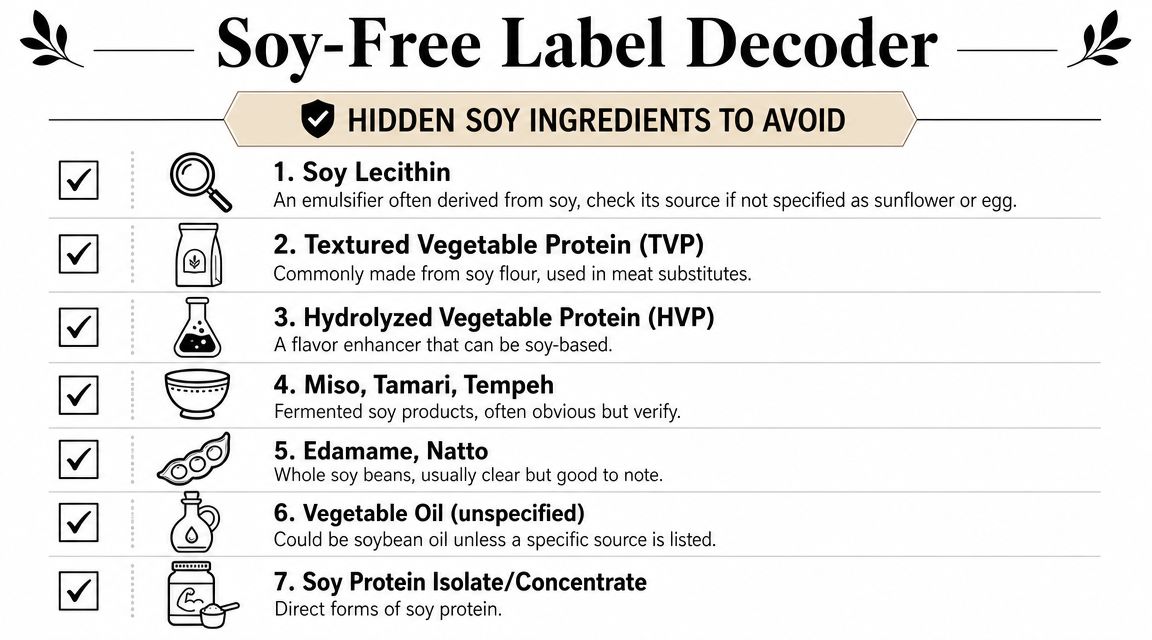
Some ingredients are obvious. Others are less so.
- Soy protein isolate or concentrate usually appears as a direct protein source.
- Soy lecithin is often used as an emulsifier. Some people avoiding soy strictly will want to flag it immediately.
- Textured vegetable protein is commonly soy-based.
- Hydrolyzed vegetable protein can also come from soy.
- Miso, tamari, and tempeh are fermented soy foods.
- Edamame and natto are whole-soy forms.
- Vegetable oil can sometimes be soybean oil if the source isn't made clear on the package.
Read in this order
If labels overwhelm you, use the same order every time. It keeps the process simple.
-
Allergen statement first
If it says contains soy, you can put it back immediately. -
Ingredient list second
Scan for the soy terms above. Don't overthink the rest until this step is done. -
Marketing claims last
“Natural,” “clean,” and “performance” language can wait.
A bar isn't soy-free because the front label feels wholesome. It's soy-free only if the ingredients and allergen details support that claim.
Where people misread labels
A common mistake is assuming the main protein source tells the whole story. A bar may use pea protein and still include soy lecithin elsewhere in the formula. Another mistake is assuming “vegan” means easier on allergies. It may remove dairy and egg, but still use soy heavily.
A good companion read is this breakdown of protein bar nutrition facts, especially if you want to get faster at sorting ingredients from useful marketing.
What to do in the store
If you're comparing several bars, sort them into three quick piles:
| Label result | What it means | What to do |
|---|---|---|
| Clearly soy-free | No soy ingredients listed, no soy in allergen line | Move to macro review |
| Questionable | Unclear oils, vague ingredients, or confusing claims | Check brand site or skip |
| Not soy-free | Soy appears in ingredients or allergen statement | Put it back |
That small habit saves time and cuts decision fatigue.
Choosing Your Protein Source Whey vs Pea vs Other Options
Once soy is out, the next question is what replaces it. Different proteins digest differently, fit different diets, and behave differently in a bar.
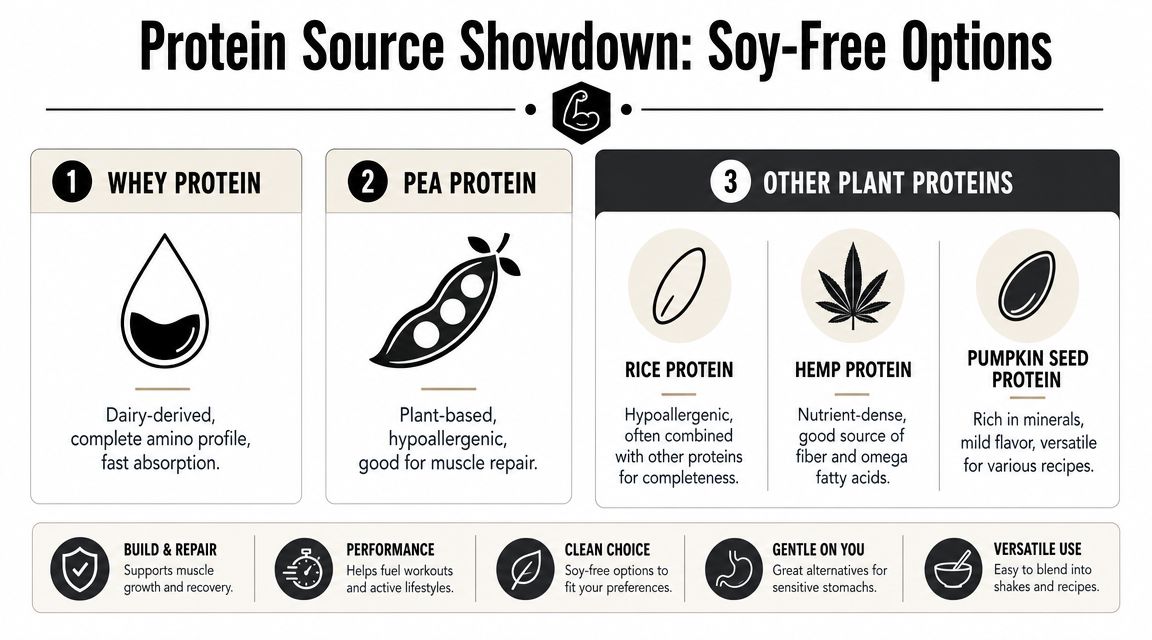
A soy-free bar may use pea, rice, hemp, whey, or egg-white proteins, and formulators often blend plant proteins, such as lysine-rich pea protein, to build a more complete amino acid profile without soy, as explained in this overview of common soy-free protein sources.
Animal-based options
If you eat dairy or eggs, these bars can be straightforward.
Whey often works well for people focused on training recovery and a more concentrated protein hit. It's dairy-derived, so it won't suit everyone, but many high-protein bars use it because it can help keep texture more manageable when protein levels climb.
Egg white protein is another soy-free option. It fits people who avoid dairy but still use animal products. Texture can vary. Some bars with egg white feel lighter and less chalky, while others turn chewy fast.
Plant-based options
Plant-based doesn't mean one thing. The source changes the experience.
Pea protein is one of the most practical options in protein bars without soy. It's widely used, works well in blends, and usually fits vegan and dairy-free needs.
Rice protein is often paired with pea rather than used alone. Brands use combinations because different plant proteins can balance each other better.
Hemp and seed-based proteins can appeal to shoppers who want simpler ingredient lists or a less processed feel, but they may bring a more earthy flavor.
Quick comparison
| Protein source | Best for | Watch-outs |
|---|---|---|
| Whey | Higher-protein performance bars | Dairy sensitivity |
| Egg white | Soy-free, dairy-free but not vegan | Egg allergy |
| Pea | Vegan, common, versatile | Texture varies by brand |
| Rice | Often gentle, useful in blends | Usually better blended |
| Hemp or seed blends | Whole-food-leaning shoppers | Stronger flavor, lower density in some formulas |
If you want a more focused comparison between two of the most common choices, this guide on pea protein vs whey protein is a helpful side-by-side read.
Choose protein the way you'd choose fuel for training. The best one is the source your body handles well and your routine can actually sustain.
How to match source to goal
Use a simple filter:
- For vegan eating pick pea or a plant blend.
- For dairy-free but non-vegan egg white may fit.
- For gym recovery and a denser protein format whey is often a practical contender.
- For a gentler ingredient strategy look for simpler blends with fewer extras.
You don't need the “best” protein in the abstract. You need the one you'll digest well, enjoy eating, and buy again.
Analyzing Macros and Ingredients for Your Goals
A soy-free label is only step one. The next question is whether the bar is useful for your goal.
Some bars are basically candy bars with a better headline. Others are engineered much more carefully. A published comparison found a custom protein bar reached 25.52 g of protein per 100 g and 13.46 g of fiber per 100 g, compared with a commercial bar at 18.5 g protein per 100 g and 3.7 g fiber per 100 g, which is a strong reminder to judge nutrient density, not just the absence of soy, in this nutritional comparison study.
Start with the job of the bar
Ask what you want the bar to do.
- Post-workout support calls for a solid protein base.
- Midday hunger control benefits from protein plus fiber.
- Travel or emergency backup may make shelf stability more important than perfect texture.
- Light pre-workout fuel usually feels better when the bar isn't overly heavy or packed with ingredients that sit in your stomach.
Read the label as a whole
Don't isolate one number. Look at the relationships.
Protein tells you the bar's main value.
Calories tell you how much room it takes in your day.
Fiber often changes fullness more than people expect.
Ingredients tell you how that nutrition was built.
A practical way to compare bars is to put two packages side by side and ask, “Which one gives me a better protein and fiber payoff for the calories, with ingredients I'm comfortable eating?”
Ingredients matter beyond the macro line
Two bars can have similar protein totals and feel completely different in your body. One may use a long list of syrups, coatings, and fillers. Another may rely on a shorter, cleaner build.
That's where ingredient quality becomes useful, especially for brands formulating with alternatives to standard sweeteners or coatings. If you're curious how specialty ingredients enter product development, a resource like this global carob supplier for producers offers a useful look at one ingredient category manufacturers may consider when building different snack formats.
A smart bar choice supports your goal and your stomach. If it only does one of those, it's not a smart choice.
A fast evaluation checklist
When you pick up a new bar, scan for:
- Protein first because that's the primary reason for purchasing the bar
- Fiber next because it changes satiety and steadier energy
- Sugar and sweetener pattern because that affects taste and tolerance
- Ingredient length and clarity because confusing formulas often create guesswork
That habit helps you move from “Is this soy-free?” to “Is this worth eating?”
Navigating Allergies and Digestive Health
A package can be soy-free in formula and still not be simple for your body. That's where many people get frustrated. They find a bar without soy, eat it, and still deal with bloating, stomach discomfort, or allergy concerns from something else.
Many shoppers looking for soy-free bars are also avoiding dairy, gluten, or nuts, so the search is often about a broader multi-allergen fit rather than soy alone, as discussed in this article on vegan protein bars and broader allergen concerns.

Soy-free doesn't answer every allergy question
If you manage allergies, the phrase to pay attention to is not just soy-free. It's also whether the product has a warning about shared equipment or shared facilities.
For some people, a formula without soy is enough. For others, especially with stronger allergy risk, cross-contact matters just as much as the ingredient list.
Here's a simple distinction:
| Label language | What it tells you |
|---|---|
| No soy ingredients | Soy isn't intentionally added to the formula |
| Contains statements | Legally recognized allergens in the product |
| May contain or shared facility warnings | Possible cross-contact risk |
If your concern is medical rather than preference-based, treat that third line seriously.
Common digestive troublemakers in bars
Sometimes soy gets blamed when the underlying issue is elsewhere. A few repeat offenders show up often:
- Dairy-based proteins can bother people sensitive to lactose or certain milk ingredients.
- Gluten-containing ingredients may affect people with celiac disease or gluten sensitivity.
- Sugar alcohols can cause digestive discomfort in some people.
- Large fiber loads can be helpful for fullness, but they can also feel rough if your gut isn't used to them.
How to test a new bar wisely
Don't make your first test the morning of a hard workout or before a long drive.
Instead:
- Try the bar on a normal day.
- Eat half first if you're sensitive.
- Notice how you feel for the next few hours.
- Keep the wrapper until you know it agrees with you.
Your best protein bar on paper may still be the wrong bar for your digestion.
That's not failure. It's useful feedback. The goal is not to find the bar that looks most impressive online. It's to find the one your body handles consistently.
Smart Shopping Tips and Easy DIY Alternatives
Buying protein bars without soy gets easier when you know where to look and what tradeoffs matter. You're not just choosing a flavor. You're choosing a format that has to balance protein, taste, texture, and shelf life.
Commercial soy-free bars often land around 10 to 20 g of protein, and the higher end is harder to achieve cleanly without creating texture or shelf-life issues, which is why thoughtful formulation matters in this overview of soy-free protein bar options.
Shopping smarter in stores and online
In stores, don't start in the candy-style bar section and hope for the best. Check the natural foods aisle, sports nutrition shelf, or allergy-friendly area first. Online, search by both soy-free and your second filter, such as vegan, dairy-free, or gluten-free.
These habits help:
- Use two filters at once so you don't waste time on bars that solve only one problem.
- Read the ingredient image, not just the product title because online listing titles are often incomplete.
- Check texture clues like “crispy,” “chewy,” or “cookie dough” if mouthfeel matters to you.
- Buy a small variety first instead of committing to a full case.
If you're specifically comparing powders for homemade options or shakes, this roundup of the best vegan protein without soy can help you think through ingredient choices before you buy in bulk.
Two easy DIY routes
Store-bought bars are convenient. Homemade bites give you more control.
Option one is a soft oat-based bite.
Use a soy-free protein powder, oats, nut or seed butter, and a liquid binder such as water or another simple mix-in that works for your diet. Chill, roll, and keep portions ready for the week.
Option two is a crunchier seed-based bite.
Mix soy-free protein powder with seeds and a binding ingredient, press into a pan, chill, and slice. This works well if you like a firmer texture and want fewer mystery ingredients.
A quick visual can help if you like seeing snack prep in action:
When DIY is better than buying
Homemade options make sense if you:
- Need tighter allergen control
- Want a simpler ingredient list
- Care more about function than shelf life
- Get tired of sweet, dessert-like bars
Store-bought still wins when speed matters. DIY wins when precision matters.
That's the tradeoff.
Your Action Plan for Confident Soy-Free Snacking
You don't need to memorize every brand on the shelf. You need a repeatable way to choose well.
Start with the ingredient list. If soy shows up in any form that doesn't fit your needs, move on fast. Then look at the protein source and decide whether it matches your diet, digestion, and training. After that, read the full nutrition panel like a coach would. Not just “How much protein?” but also “What else comes with it?”
Keep this checklist in mind
- Scan for hidden soy first before you even look at flavor.
- Match the protein source to your body instead of chasing trends.
- Judge the full label because soy-free alone doesn't make a bar useful.
- Watch for other allergens and irritants if your gut is sensitive.
- Test bars in real life and notice how you feel, not just how the macros look.
The best soy-free snack is the one you can identify quickly, tolerate well, and use consistently.
That's the skill that saves you time every single week. Once you build it, you won't need a perfect shopping list handed to you. You'll know how to walk into any store and sort the good options from the distracting ones.
You're not just looking for protein bars without soy anymore. You're choosing with purpose.
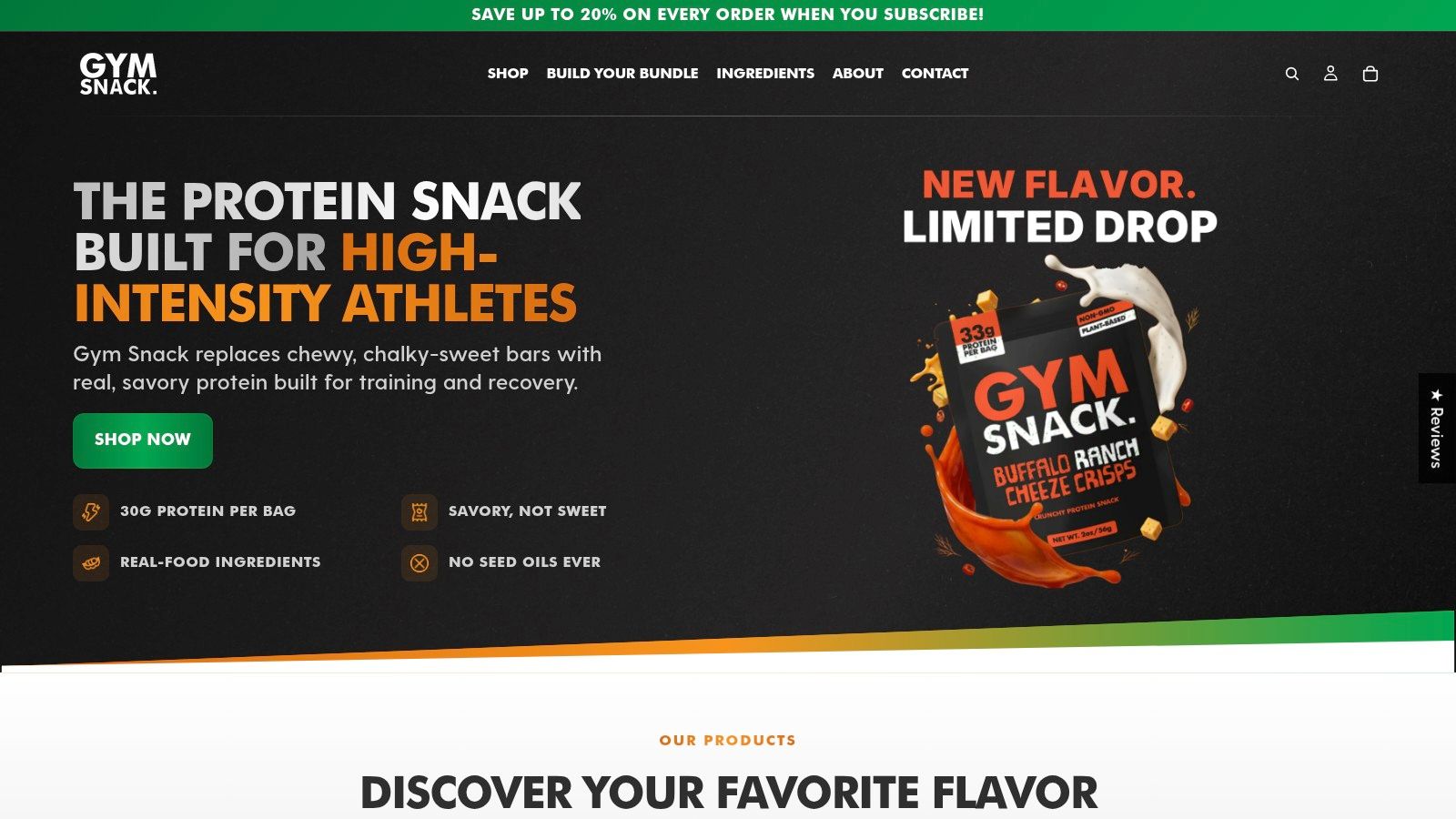
If you want a savory alternative to the usual sweet bar aisle, Gym Snack is worth a look. It offers plant-based, soy-free, dairy-free, and gluten-free protein snacks built around clean pea protein, with a crunchy texture and bold cheesy flavors that can fit pre-workout, post-workout, or on-the-go snacking.