

If you've ever wondered what people mean by "complete protein," you're in the right place. Simply put, these are foods that give your body all nine essential amino acids it can't make on its own.
Think of it like this: your body is constantly building and repairing itself—from muscle tissue to hormones. Amino acids are the LEGO bricks for this job. While your body can produce 11 of the 20 types of amino acids it needs, the other nine are non-negotiable; they must come from food.
Your Guide to Complete and Incomplete Proteins
When a food contains all nine of those essential "building blocks" in roughly the right proportions, we call it a complete protein. This is the gold standard for supporting your body's needs.
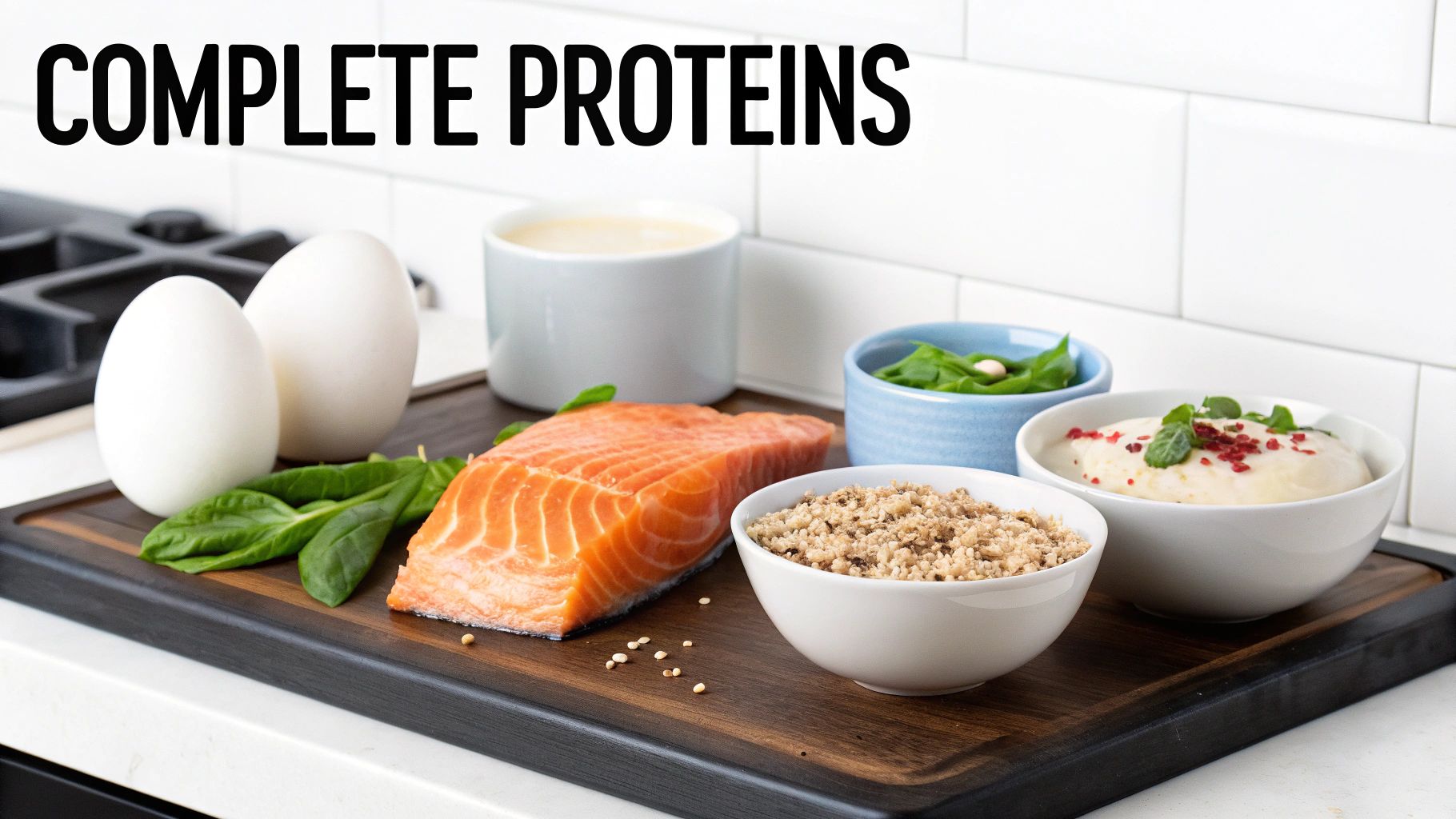
Animal-based foods like meat, fish, eggs, and dairy are the most famous examples. Their amino acid profiles are well-balanced, making them incredibly efficient for muscle repair and overall health. It’s no surprise they’re a go-to for so many athletes.
On the flip side, an "incomplete protein" is a food that's low in, or entirely missing, at least one of those nine essential amino acids. This is common for many plant-based foods, such as beans, rice, and nuts. That doesn't mean they're bad—far from it! It just means you need to be a bit more strategic. You can learn more about how to do this in our guide on how to increase protein intake.
The Key Takeaway: Your body is smart. It maintains a reserve of amino acids, so you don't need to stress about getting a perfect protein profile at every single meal. As long as you eat a good variety of protein sources throughout the day, you'll be covered.
For a side-by-side look, this simple table breaks down the key differences. For a more comprehensive overview, you can check out this What Makes a Complete Protein Your Ultimate Guide.
Complete vs Incomplete Protein at a Glance
This quick chart highlights the main distinction between the two types of protein and gives you a few common examples to keep in mind.
| Protein Type | Amino Acid Profile | Common Food Sources |
|---|---|---|
| Complete Protein | Contains all 9 essential amino acids | Meat, fish, eggs, dairy, quinoa, soy |
| Incomplete Protein | Low in one or more essential amino acids | Beans, lentils, nuts, seeds, grains |
Ultimately, understanding this difference empowers you to make smarter food choices, whether you're getting your protein from animal or plant sources.
Understanding Your Body's Essential Building Blocks
Think of protein as the ultimate raw material for your body. It’s the stuff we use to build and repair just about everything—from the muscles that power you through a workout to the enzymes that keep your metabolism humming.
But protein itself is made of smaller components called amino acids. You can picture them as a set of specialized LEGO bricks that your body clicks together to create whatever it needs.
Your body is a pretty clever manufacturer. Of the 20 different amino acids required for life, it can actually produce 11 of them on its own. We call these non-essential amino acids, not because they aren't important, but because we don't have to stress about getting them from our diet.
That leaves nine that our bodies simply can't make. These are the essential amino acids, and they’re non-negotiable. We must get them from the food we eat, day in and day out.
The Nine Essential Amino Acids
This is where the whole idea of a "complete protein" comes from. For a food to earn that title, it has to provide a sufficient amount of all nine of these essential players. If even one is missing, your body’s construction projects can grind to a halt.
Here’s a quick rundown of the essential nine and what they do:
- Histidine: Plays a part in your immune response, digestion, and sleep cycles.
- Isoleucine: A must-have for muscle metabolism and producing hemoglobin.
- Leucine: The superstar that really kicks off muscle protein synthesis.
- Lysine: Vital for producing hormones and absorbing calcium.
- Methionine: Helps with your metabolism and the detoxification process.
- Phenylalanine: A precursor for neurotransmitters like dopamine that affect your mood.
- Threonine: A key component of structural proteins like collagen and elastin.
- Tryptophan: Needed to make serotonin, the "feel-good" chemical that also regulates sleep.
- Valine: Helps stimulate muscle growth and regeneration.
Think of it like trying to assemble a piece of furniture that needs nine different types of screws. If you’re missing just one type, you can't finish the job, no matter how many of the other eight you have. It's the same with protein synthesis—your body needs the complete set.
Why This Matters for Your Health
This distinction is more than just nutrition trivia; it's the foundation of building a smart diet. When you eat a complete protein, you’re giving your body the full toolkit it needs to do its job properly. This includes everything from repairing muscle fibers after a tough gym session to creating the antibodies that keep you healthy.
If you're looking to get a better handle on how protein fits into the bigger picture of your diet, this guide on how to calculate macronutrients is a great place to start.
Grasping this "building block" concept is the first real step toward dialing in your nutrition. Whether you’re an athlete chasing performance goals or just someone trying to feel their best, it helps you understand why certain foods are better protein sources than others and sets the stage for making smarter choices.
The Most Reliable Animal-Based Complete Proteins
If you're looking for the most straightforward way to get complete proteins, animal-based foods are your best bet. They are the gold standard because they naturally contain all nine essential amino acids in proportions our bodies can use almost immediately. Think of them as pre-assembled toolkits for muscle repair, hormone regulation, and just about everything else that keeps you going.
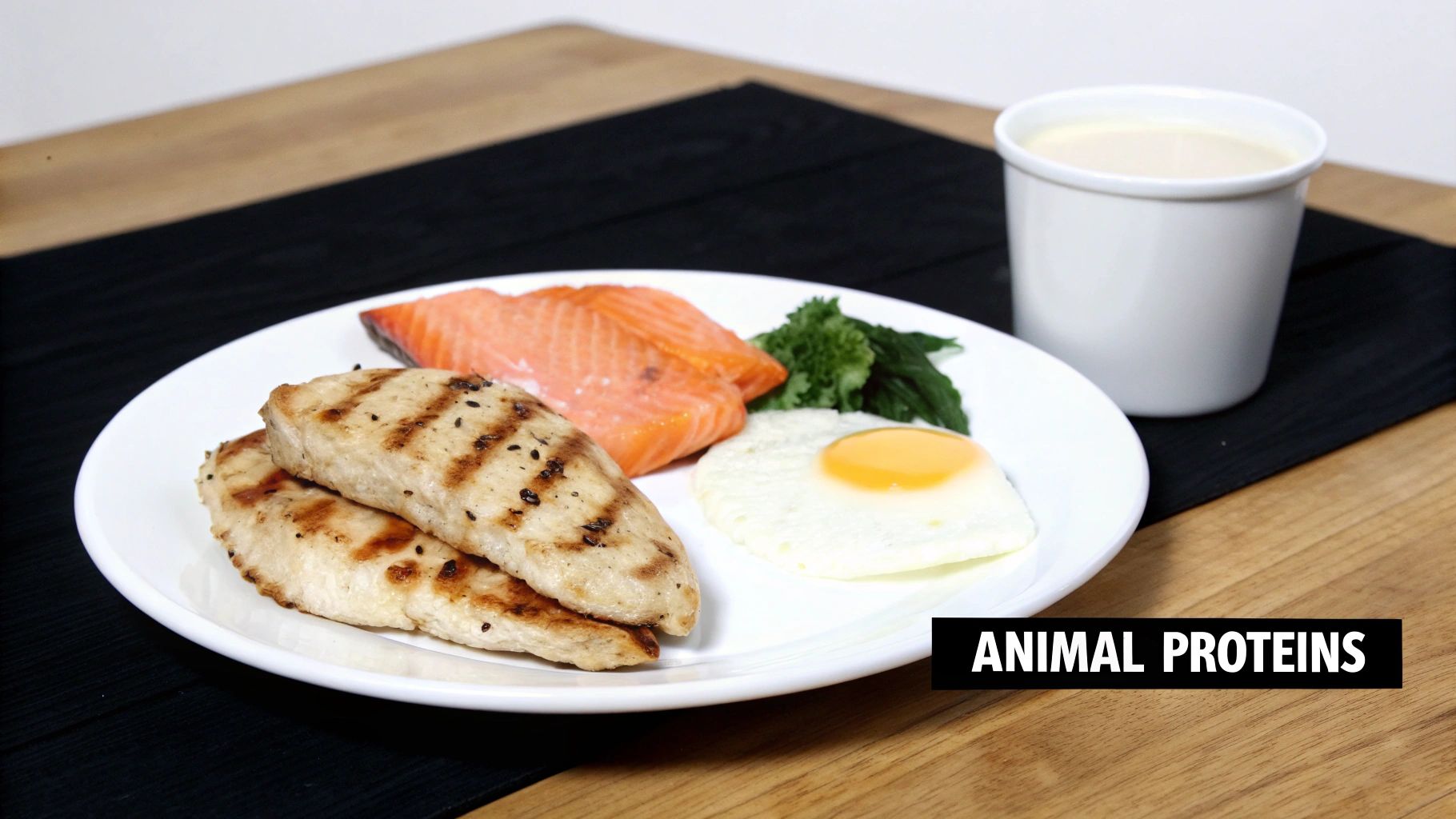
The secret to their effectiveness is their high bioavailability. This is just a fancy term for how easily your body can absorb and put a nutrient to use. Animal proteins are incredibly bioavailable, meaning your digestive system doesn't have to work very hard to break them down and get those amino acids into your system.
It's no surprise that they form the backbone of many diets. In the United States, about 85 percent of the average person's 81 grams of daily protein comes from animal sources. As access to these foods grows worldwide, we often see corresponding improvements in public health. You can dig deeper into these global trends over at the Sustainable Fisheries website.
Powerhouses of Animal Protein
Not all animal proteins are identical, of course. Each comes with its own unique nutritional perks, so knowing the differences can help you fine-tune your diet to hit specific goals.
Here are some of the top performers in the animal kingdom:
- Lean Meats and Poultry: A 3-ounce serving of grilled chicken breast or lean steak is a classic for a reason. It packs around 26 grams of top-tier complete protein, making it a cornerstone for building muscle and keeping hunger at bay.
- Fish and Seafood: Fish like salmon and tuna don't just deliver complete protein; they're also loaded with anti-inflammatory omega-3 fatty acids that are fantastic for brain health.
- Eggs: For years, eggs have been called "the perfect protein." A single large egg gives you a solid 6 grams of complete protein and other key nutrients like choline, which is vital for brain function.
- Dairy Products: Dairy is incredibly versatile. A cup of regular milk has about 8 grams of protein, but if you opt for a cup of plain Greek yogurt, you can get over 20 grams—a huge jump!
Why Bioavailability Matters in Practice
For athletes or anyone serious about muscle growth and recovery, the high bioavailability of animal protein is a game-changer. When you have a post-workout meal of grilled salmon or a bowl of Greek yogurt, you know your body is getting a fantastic return on that nutritional investment, with very little going to waste.
The amino acid profile in animal foods is so well-suited to our needs that it acts like a perfectly matched key in a lock, unlocking rapid cellular repair and growth with minimal effort.
This is exactly why animal-based foods are a dietary staple for millions. They offer a reliable and efficient path to getting all the essential building blocks your body needs to not just survive, but truly thrive. They take the guesswork out of the equation.
Finding Complete Proteins in the Plant Kingdom
It was a long-held myth that plant-based diets just couldn't deliver high-quality protein. We now know that’s simply not true. The plant kingdom is packed with powerful, nutrient-dense foods that offer impressive protein credentials, and several of them naturally contain all nine essential amino acids.
These are your plant-based complete protein sources, and they are fantastic additions to any diet, whether you're a committed vegan or just looking to eat more plants. They deliver the full set of "building block" amino acids your body can't make on its own.
Plant-Based All-Stars
A few key players stand out for providing the full package. Think of these as your go-to sources for a complete amino acid profile, no animal products required.
- Soy Products: Tofu, tempeh, and edamame all come from soybeans, one of nature's rare complete plant proteins. Just one cup of cooked soybeans delivers nearly 30 grams of high-quality protein.
- Quinoa: People often lump it in with grains, but quinoa is technically a seed. Not only is it a complete protein, but it’s also loaded with fiber, iron, and magnesium.
- Buckwheat: Don't let the name fool you—buckwheat has no relation to wheat at all. This gluten-free pseudocereal is another excellent complete protein, perfect for everything from pancakes to soba noodles.
- Hemp and Chia Seeds: These tiny seeds are true nutritional giants. Both offer a complete amino acid profile alongside a healthy dose of omega-3 fatty acids and fiber.
What "Incomplete" Protein Really Means
So if those are the heavy hitters, what about everything else? Most other plant foods—like beans, lentils, nuts, and grains—are called incomplete proteins. That term sounds a little negative, but it's misleading. It absolutely does not mean they are bad for you or "low in protein."
It simply means they are low in one or two of the nine essential amino acids.
The amino acid that's in short supply is called the limiting amino acid. It's the one missing piece that prevents that food from being considered 'complete' all by itself.
Think of it like trying to build a LEGO model that requires nine different types of bricks. If you have plenty of red, blue, and green bricks but you're running low on yellow ones, the yellow brick is your limiting factor. You can't finish the model with just that one pile of bricks.
The same logic applies to your diet. For a deeper dive into making this work for you, our guide on how to get enough protein on a plant-based diet offers some great practical strategies.
Limiting Amino Acids in Common Plant Foods
Once you know which amino acids are low in which foods, building a well-rounded diet becomes incredibly simple. You just pair different foods together to fill in each other's gaps.
The table below gives you a quick cheat sheet for the most common plant food groups.
| Plant Food Group | Primary Protein Source | Typically Low In (Limiting Amino Acid) |
|---|---|---|
| Legumes | Beans, lentils, chickpeas, peas | Methionine |
| Grains | Rice, wheat, corn, oats | Lysine |
| Nuts & Seeds | Almonds, walnuts, sunflower seeds | Lysine |
| Vegetables | Broccoli, spinach, potatoes | Methionine |
This is exactly why classic food pairings like rice and beans are a nutritional staple around the world. Rice is low in lysine, and beans are low in methionine. Eat them together, and you've got yourself a complete protein meal. It's that easy.
How to Master Plant-Based Protein Combining
If you're exploring a plant-based diet, the idea of "protein combining" can sound a bit intimidating. For a long time, the prevailing wisdom was that you had to eat specific foods together—like rice and beans—at the very same meal to form a "complete" protein.
Thankfully, we now know that's not the case. Your body is much smarter than that.
Think of it like this: your body keeps a small reservoir of amino acids on hand, often called an amino acid "pool." When you eat, it tops up this pool. So, if you have beans for lunch (which are low in one amino acid, methionine) and then snack on some nuts a few hours later (a great source of methionine), your body can pull from its pool to get the job done.
The Modern Rule of Thumb: Focus on variety throughout the day, not perfection in a single meal. Your body's internal pool of amino acids handles the mixing and matching for you.
This simple concept is a game-changer. It means you can stop stressing about every single plate and just focus on eating a good variety of plant foods over the course of the day.
Simple and Delicious Protein Pairings
What's really cool is that many traditional food pairings from cultures all over the world naturally create complete proteins. These classic combinations aren't just tasty; they're nutritionally brilliant without even trying.
Here are a few timeless examples you're probably already eating:
- Grains and Legumes: This is the most famous duo. Legumes are rich in an amino acid called lysine, which perfectly balances out the methionine found in grains. Think classic rice and beans, a hearty lentil soup with a side of whole-wheat bread, or creamy hummus with pita.
- Nuts/Seeds and Legumes: It’s as easy as tossing chickpeas and sunflower seeds into a salad or whipping up a delicious peanut sauce to pour over a lentil curry.
- Grains and Nuts/Seeds: A warm bowl of oatmeal topped with walnuts is a perfect example. Or, a simple slice of whole-grain toast with peanut butter. You've got a complete protein right there in your breakfast.
These pairings aren't just for athletes trying to build muscle; they're the foundation of smart plant-based eating for everyone. If you want to dive deeper into specific food choices, check out this guide on the best plant protein for muscle gain.
Actionable Strategies for Success
Instead of getting bogged down in the details of every meal, just zoom out. A great strategy is to simply aim to eat foods from at least two different plant protein groups each day. For example, make sure you get some legumes (like lentils or chickpeas) and also some grains (like brown rice or quinoa) at some point.
It also helps to know that some plant foods are already protein powerhouses, containing all nine essential amino acids on their own.
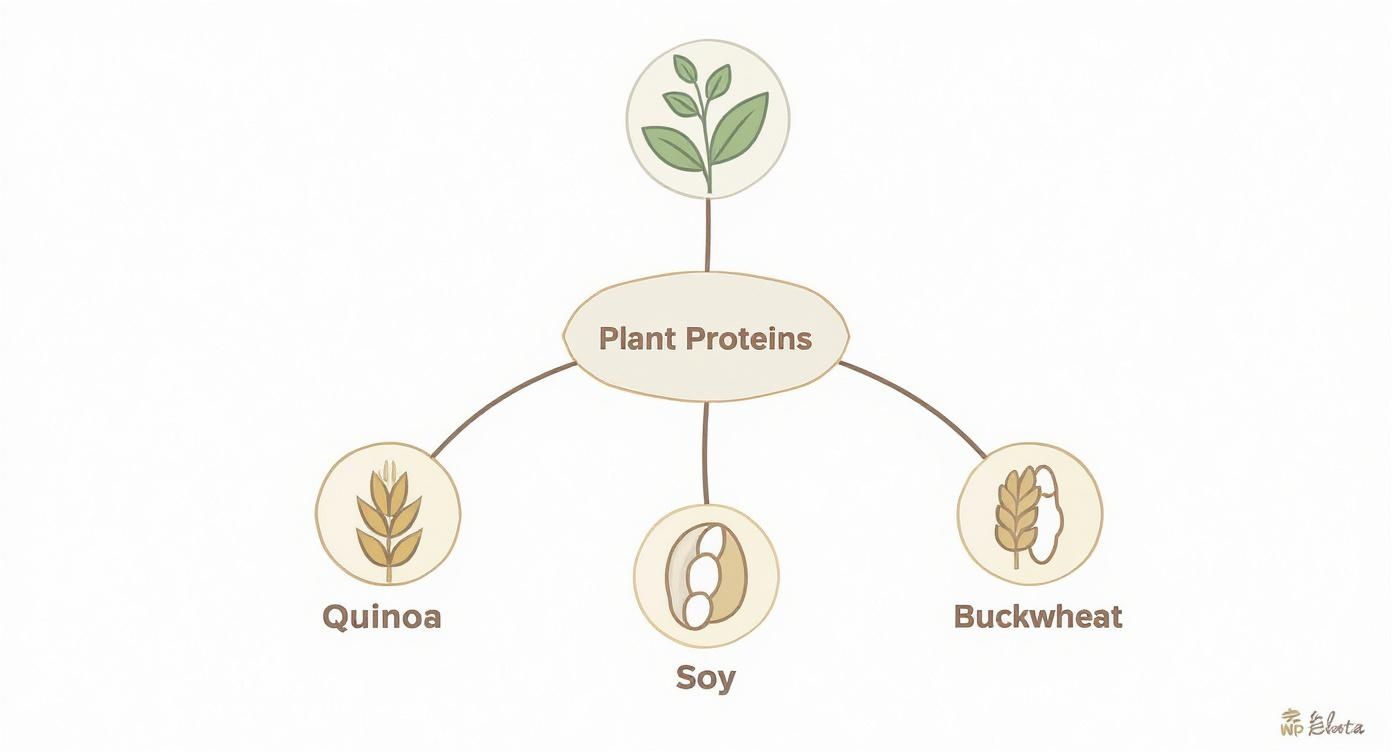
Making foods like quinoa, soy (tofu, edamame), and buckwheat regular parts of your diet gives you a fantastic head start. By building your meals around a diverse range of whole foods, you're naturally giving your body all the building blocks it needs to thrive.
Got Questions About Complete Proteins? We've Got Answers.
The world of protein can get confusing fast. Once you get a handle on the basics, though, you can start making smarter choices that align with your health and fitness goals. Let's tackle some of the most common questions people have about complete proteins.
We'll clear up a few myths and give you practical answers to help you build a better nutrition plan, whether you're trying to build muscle, improve your health, or just feel more energized every day.
Do I Really Need to Eat Complete Proteins at Every Single Meal?
Nope, this is probably the biggest myth out there. Your body is smarter than that. It keeps a reserve of amino acids—think of it as a "pool"—that it can pull from throughout the day.
As you eat different foods, your body stocks this pool with various amino acids. So, as long as you're eating a good variety of protein sources over the entire day, your body can grab the exact building blocks it needs, when it needs them, for things like muscle repair.
For example, if you have oatmeal for breakfast (which is low in the amino acid lysine) and a hearty lentil soup for lunch (which is packed with lysine), your body has everything it requires. The real goal is achieving a balanced amino acid intake over a 24-hour period, not stressing about creating a perfect combo on a single plate.
Are Plant-Based Complete Proteins Just as Good as Animal Proteins?
From a purely nutritional angle, yes. When a plant source like quinoa or soy is "complete," it provides the very same nine essential amino acids as an animal source like chicken or eggs. The building blocks themselves are identical.
Where things differ slightly is in bioavailability—basically, how easily your body can absorb and use them. Animal proteins tend to be absorbed a little more efficiently.
Plant proteins often come bundled with a lot of fiber. While fiber is amazing for your health, it can slightly slow down how quickly your body absorbs the amino acids. Even so, for the vast majority of people, a well-planned plant-based diet full of things like tofu, tempeh, or classic pairings like rice and beans is more than enough to meet all their protein needs.
Here's the bottom line: the source matters less than the outcome. As long as your body gets all nine essential amino acids in the right amounts throughout the day, it can build and repair tissue perfectly well, no matter if they came from a steak or a bowl of lentils.
So, How Much Complete Protein Do I Need Each Day?
This is one of those "it depends" questions because your protein needs are unique to you. The official guideline, the Recommended Dietary Allowance (RDA), is a baseline minimum of 0.8 grams of protein per kilogram of body weight (or about 0.36 grams per pound). That's really just the amount needed to prevent a deficiency in a sedentary person.
Most people who are active need quite a bit more. If you exercise regularly, are focused on building muscle, or are an older adult trying to hang on to muscle mass, your needs are higher. A more realistic target for active folks falls somewhere in the 1.2 to 2.0 grams of protein per kilogram of body weight range.
Instead of getting hung up on "complete protein" grams, focus on hitting your total daily protein goal with a variety of high-quality foods. When you do that, the complete amino acid profile usually takes care of itself.
Can I Just Get All My Protein From Powders and Shakes?
While supplements are incredibly convenient, they shouldn't be your main source of protein. A "food first" philosophy is always the best approach.
Whole foods offer so much more than just protein. They provide a whole matrix of other critical nutrients—vitamins, minerals, antioxidants, and fiber—that you simply can't get from an isolated powder. These all work together to support your overall health in ways a supplement just can't match.
Think of supplements as a tool to help you hit your goals. They’re perfect for after a tough workout or on a hectic day when a proper meal isn't an option. But always build your diet on a solid foundation of real, nutrient-dense foods like meats, dairy, legumes, and whole grains first.
Looking for a convenient, plant-based boost to help you hit your daily targets? Gym Snack offers savory, crunchy snacks packed with clean pea protein. They're an awesome way to add high-quality protein between meals without sacrificing flavor. You can check out all the options at gymsnack.com.