

Staring at a wall of snack bars can feel pretty overwhelming. You're trying to figure out: is this a high-performance fuel source, or just a candy bar playing dress-up? The truth is, learning to read bar nutrition facts is the one skill that separates a smart choice from a sugary mistake. It turns that confusing label into your personal roadmap for hitting your health and fitness goals.
Why Reading Bar Nutrition Facts Is a Game Changer
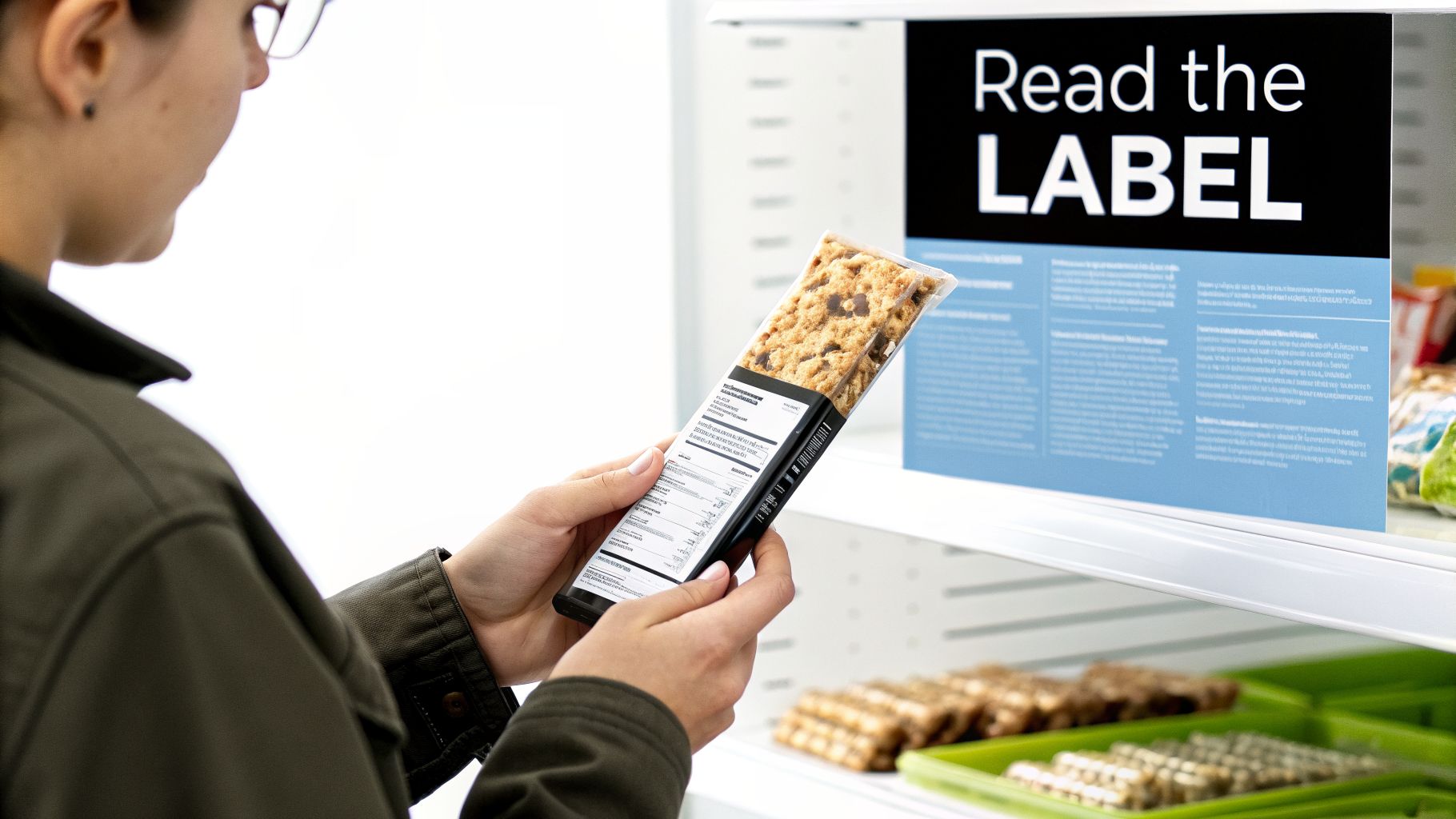
The market for protein bars has absolutely exploded, driven by people like us who want convenient, on-the-go nutrition. Many of these bars are specifically engineered to be efficient fuel. They often pack an energy density of around 288 kilocalories per 100 grams, which is why they’ve become a staple for serious athletes.
But with more choices comes more confusion. Flashy marketing slogans like "high protein" or "low carb" can be incredibly misleading. The only way to know for sure if a bar actually fits your goals is to look right past the hype on the front of the box and get into the data yourself.
Moving Beyond Marketing Hype
Think of the nutrition label as the bar's unfiltered biography. The front of the package tells you what the brand wants you to believe. The label, on the other hand, reveals the truth.
Learning to decode it empowers you to make decisions based on facts, not just slick advertising. This guide is going to walk you through that process, step-by-step, so you can feel confident in your choices.
Understanding the real impact of a nutrition bar means you have to interpret the label effectively. A great primer on this is learning how to read supplement labels like a pro.
Once you get the hang of this, you’ll be able to pick a bar that genuinely supports your specific needs. You'll go from feeling uncertain in the snack aisle to feeling totally in control, ensuring every snack is actually helping your wellness journey.
Building a Foundation for Smart Choices
My goal here is to turn that confusing panel of numbers into a tool you can use every day. We'll break down each part of the label, from serving size to micronutrients, so you know exactly what you’re putting in your body.
You’ll learn how to:
- Tell the difference between a truly balanced snack and a glorified candy bar.
- Match a bar’s nutritional profile to your specific fitness goals, whether that's muscle gain or weight management.
- Spot hidden sugars and other undesirable ingredients that can sabotage all your hard work.
Let’s get started. This is your first step toward making smarter, more informed choices every single time you reach for a quick snack.
Your Ground Zero: Serving Size and Calories
Before your eyes even glance at the protein or fat content, there are two numbers you absolutely have to check first: Serving Size and Calories. Getting these right is the foundation for understanding everything else on that label.
Think of the serving size as the ruler for the entire nutrition panel. Every single value—from sugar to sodium—is based on that specific amount. This is the number one spot where labels can trip you up.
The Serving Size Trap
It’s an old trick, but it still works. A bar might look like a single-serving snack, but when you flip it over, you discover the package actually contains two servings. If you eat the whole thing, you have to double everything on the label to know what you’re really putting in your body.
For example, a label might list "10g of sugar per serving," but the serving size is only "1/2 bar." If you finish the whole thing, you've just had 20g of sugar, not the 10g you thought. Always, always check the "Servings Per Container" line before you do anything else. It's a non-negotiable first step.
Calories Are Fuel, Not Foes
Once you've nailed down the serving size, you can look at the Calories. It's time we stopped thinking of this number as a score to beat and started seeing it for what it is: energy. Calories are simply the fuel your body needs to get through a workout, repair muscle tissue, and just plain function.
The "right" amount of calories depends entirely on what you need that bar to do for you.
- Looking for a serious pre-workout boost or a quick meal replacement? A bar with 250-350 calories makes sense.
- Just need a light snack to quiet your stomach between meals? Something in the 150-200 calorie range is a much better fit.
Thinking this way is how you make bar nutrition facts work for you, not against you. For a deeper dive into the basics, check out our complete guide on how to read nutrition labels.
You'll also see a % Daily Value (%DV) column. This is a handy shortcut from the FDA to tell you if a nutrient is "low" or "high" in that serving. A nutrient at 5% DV or less is considered low, while one at 20% DV or more is high. Just remember, this entire system is tied to the serving size, so you'll need to do the math if you eat more than one serving.
Breaking Down the Macros: Protein, Carbs, and Fats
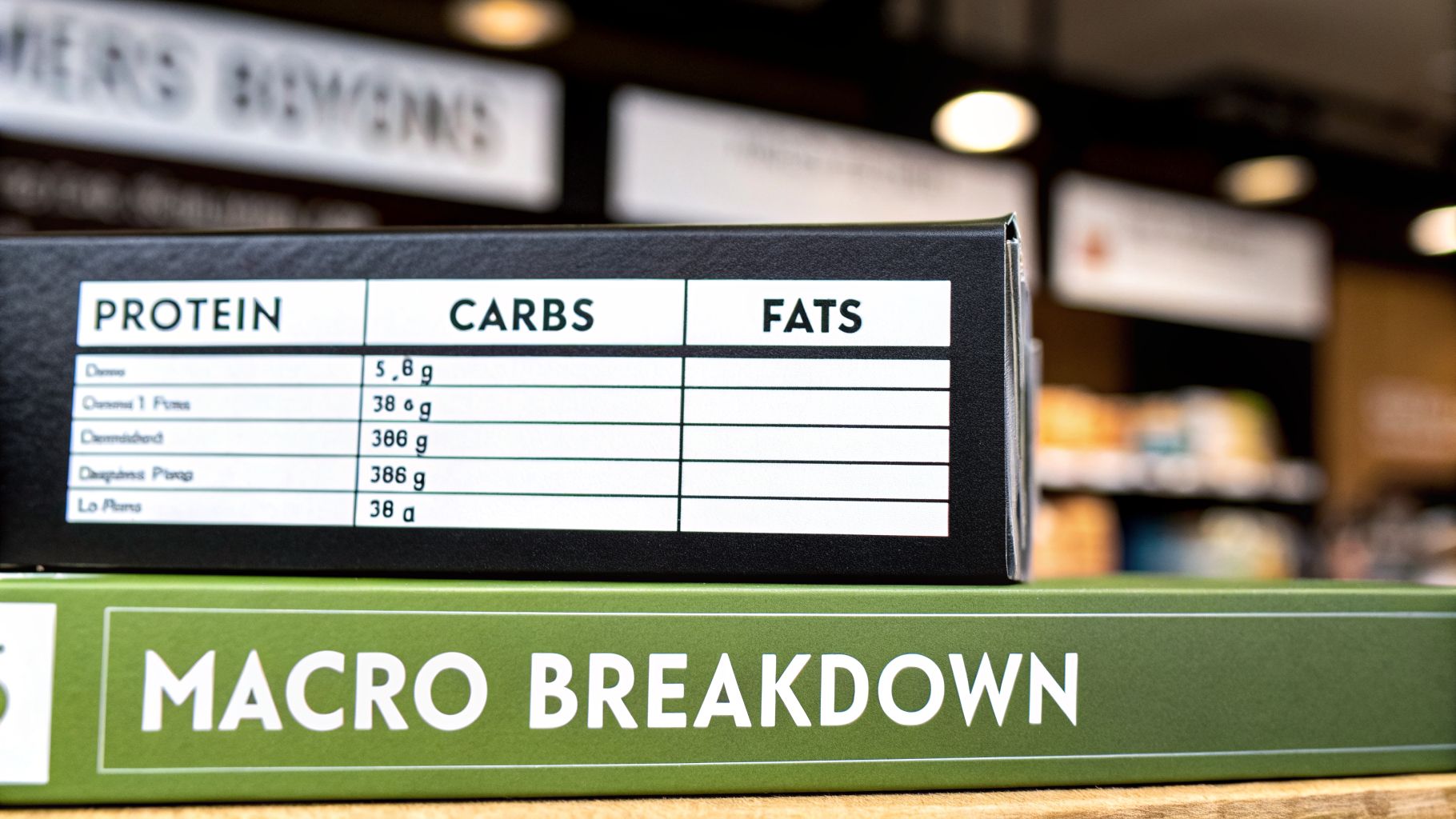
Alright, you’ve got the serving size down. Now we get to the heart of the matter: the "big three" nutrients that really define what a bar is all about. I’m talking about protein, carbohydrates, and fats. These are your macronutrients, and their ratio is the secret code that tells you if a bar is designed for muscle repair, quick energy, or just keeping you from getting hangry.
Think of these macros as a team of specialists. Protein is your repair crew, carbs are the immediate energy source, and fats are the long-haul fuel reserves. A truly effective bar brings the right balance of these players to the field for the specific job you need done.
Protein: The Muscle Builder and Satiety Signal
Protein is usually the first thing people look for on a label, and for good reason. It’s the raw material your body uses to rebuild muscle tissue after you’ve put it through a workout. But protein does more than that—it’s also brilliant at making you feel full and satisfied.
When you're scanning the bar nutrition facts, the protein grams tell a pretty clear story:
- For muscle recovery: If you’re eating a bar post-workout, you want to see 15g of protein or more. That’s a solid number to kickstart the muscle repair process.
- For hunger control: To crush a midday craving, a bar with at least 10g of protein will help send a fullness signal to your brain, holding you over until your next meal.
A bar with just 3g of protein? It's not going to do much for your recovery or keep you full for long. It’s simply not built for performance or serious satiety.
Carbohydrates: Fueling Your Body the Right Way
Carbohydrates get a bad rap sometimes, but they are your body’s go-to source for quick energy. The trick is to understand how carbs are presented on the nutrition label. You'll see "Total Carbohydrates," which is then broken down further into "Dietary Fiber" and "Total Sugars."
This is where you need to put on your detective hat. Dietary fiber is a fantastic component—it slows digestion, keeps your gut happy, and helps you feel fuller. As a rule of thumb, look for at least 3-5 grams of fiber.
"Total Sugars," on the other hand, needs a closer inspection. Pay attention to the "Includes Xg Added Sugars" line. While natural sugars from fruit are one thing, high amounts of added sugars can cause a sharp energy spike followed by an even sharper crash. That’s the opposite of what you want from a health-focused snack. To dig deeper into this, check out our guide on understanding macros for weight loss.
Want a pro tip? A simple way to estimate a bar's real impact is to calculate its "Net Carbs." Just subtract the Dietary Fiber from the Total Carbohydrates. This gives you a better picture of the carbs your body will actually digest and use for energy.
For a quick reference on what to look for, here's a cheat sheet to help you decipher the macro section of any snack bar.
Macronutrient Cheat Sheet for Snack Bars
| Macronutrient | What to Look For | Why It Matters | Ideal Range for Goal |
|---|---|---|---|
| Protein | High grams, quality sources (whey, casein, pea) | Muscle repair, growth, and satiety (feeling full). | 15g+ for post-workout; 10g+ for a filling snack. |
| Carbohydrates | High fiber, low added sugar. | Provides energy. Fiber slows digestion and aids gut health. | 3-5g+ fiber; Keep added sugars as low as possible. |
| Fats | Unsaturated fats from nuts/seeds. | Hormone production and sustained, slow-release energy. | Limit saturated fat to <10% DV; avoid trans fats entirely. |
This table makes it easy to quickly assess whether a bar's macros are working for you or against you.
Fats: The Good, The Bad, and The Unnecessary
Finally, let’s talk about fats. Just like carbs, fats have an undeservedly bad reputation. Your body actually needs high-quality fats for everything from hormone production to long-term energy. The key is to focus on the type of fat, not just the total amount. The label breaks this down into "Total Fat," "Saturated Fat," and sometimes "Trans Fat."
Here’s what you need to know:
- The Good: Look for bars that get their fats from whole food sources like nuts, seeds, and avocados. These are primarily unsaturated fats that support heart health.
- The Ones to Limit: Keep an eye on saturated fat. If a bar contains 20% or more of your Daily Value (DV), it's likely more of a treat than a functional snack.
- The Hard Pass: Trans fats are a non-negotiable "no." The label should always read 0g. Also, scan the ingredients for highly processed seed oils (like soybean, corn, or canola oil), which can contribute to inflammation.
By understanding this macro trio, you can instantly tell if a bar actually lines up with your goals. Is it a high-protein, high-fiber tool for recovery and fullness? Or is it just a candy bar masquerading as a health food? The label has all the answers.
How to Spot Hidden Sugars and Unwanted Ingredients
You've got the macros figured out, but that's only half the story. A bar can hit all the right protein and carb numbers and still be packed with ingredients that work against you. Learning to read between the lines is the real skill in picking a truly good-for-you bar.
Your first stop should always be the ingredients list. Think of it as the bar's confession. The front of the package is marketing, but the ingredients list is legally required to tell you the truth, listing everything from most to least by weight.
Here’s a simple rule I live by: go for a shorter, more recognizable ingredient list. If you’re staring at a paragraph of chemical names you can't pronounce, you’re likely holding a highly-processed science experiment, not a whole-food snack.
The Hunt for Hidden Sugars
Alright, let's track down the sugar. Look past the "Total Sugars" line and find the one that really matters: "Includes Added Sugars." This tells you exactly how much sugar was dumped in during manufacturing—the kind with zero nutritional value. These are the empty calories that send you on an energy roller coaster, a quick high followed by a massive crash.
A bar with 13g of added sugars can blow through over 25% of your recommended daily limit in a few bites. At that point, you're basically eating a candy bar, no matter how much protein is in it.
But don't stop there. Food manufacturers are clever, and they hide sugar under dozens of different names. Be on the lookout for these aliases in the ingredients list:
- High-fructose corn syrup
- Cane juice or evaporated cane juice
- Dextrose, fructose, maltose
- Agave nectar or rice syrup
If you see two, three, or even four of these listed, it's a common trick called "sugar-splitting." It allows brands to avoid listing sugar as the number one ingredient, even when it's the main component.
Decoding Sugar Alcohols
You'll often see sugar alcohols in bars marketed as "low sugar." These are sweeteners like erythritol, xylitol, sorbitol, and maltitol. They’re popular because they don’t spike your blood sugar like regular sugar does, but they come with a well-known trade-off.
For a lot of people, sugar alcohols are tough to digest. The result? Uncomfortable bloating, gas, and an upset stomach. If a bar is loaded with them to taste sweet, you might just be swapping a sugar crash for serious digestive distress.
Identifying Unwanted Fats and Fillers
Last but not least, do a quick scan for low-quality fats and fillers. The number one thing to check is trans fat, which should always, always be 0g.
Next, look through the ingredients for processed seed oils—think soybean, corn, canola, or palm oil. These are typically used as cheap fillers and are known to contribute to inflammation when consumed regularly.
A clean, high-quality bar (like the ones we make at Gym Snack) will be upfront about using fats from whole foods like nuts and seeds. It will also be explicit about having no seed oils. Once you learn to look at the entire label, you can finally see past the hype and choose a bar that actually fuels your body without all the junk.
Decoding Micronutrients and Allergen Information
It’s easy to get tunnel vision on protein, carbs, and fat when you're grabbing a bar. But the real story of a bar's quality often lies in the fine print—the micronutrients and allergen warnings that tell you if it truly supports your body.
Think of it like buying a car. The big numbers (macros) are the horsepower and MPG, but the micronutrients are the quality of the engine parts and the fluid levels. They determine if the whole system runs smoothly day in and day out.
What Micronutrients Reveal
These vitamins and minerals are the unsung heroes of your body's operating system, involved in everything from energy transfer to muscle contraction. When you're scanning a bar nutrition facts panel, keep an eye out for these three, especially if you’re active.
- Iron: This is your body's oxygen delivery service. Without enough iron, oxygen can't get to your muscles efficiently, leading to that drained, fatigued feeling and a drop in performance. A bar that offers a solid source of iron is a big win.
- Potassium: An essential electrolyte that helps you stay hydrated and keeps muscle cramps at bay. It works hand-in-hand with sodium, so it's a non-negotiable for anyone who breaks a sweat.
- Sodium: Another vital electrolyte, but this is one where less is often more. While you need some sodium to function, a bar with excessively high levels—think over 20% DV—is usually a red flag for heavy processing.
Looking at these numbers tells you whether you're holding a thoughtfully formulated bar or just a candy bar in disguise.
Navigating Allergens and Sensitivities
For anyone with dietary restrictions, this section of the label is the most important part. Food manufacturers are legally required to be upfront about major allergens, and they usually make it pretty easy to find.
The quickest check is to look for a bolded line right below the ingredients list that starts with "Contains:". It will list any major allergens like Milk, Peanuts, Soy, or Wheat, giving you a fast yes-or-no answer.
Even if you don’t have a diagnosed allergy, it pays to consider your own sensitivities. Common protein bar ingredients like whey, casein (both from dairy), and soy are notorious for causing bloating and digestive upset in a lot of people. If you have a sensitive stomach, you'll feel much better seeking out bars that are explicitly free from these.
This is especially true if you’re carefully managing your diet for fitness goals or using GLP-1 medications, where digestive comfort is paramount. For anyone with a nut allergy, finding a reliable bar is a serious challenge. If that's you, our guide to the best nut-free protein bars can help you find options that are both safe and effective.
Ultimately, making sure a bar works with your body is the final test. By checking the micronutrients and scanning the allergen info, you're choosing a snack that doesn't just fuel your goals but actually makes you feel great.
Choosing the Right Bar for Your Specific Goal
Alright, you’ve learned how to decode a nutrition label. Now for the fun part: putting that knowledge into practice to find a bar that actually works for you and your goals.
Not all bars are created equal, and the "perfect" bar really depends on what you need it to do. Think of it like a decision tree. You start with your main goal, then drill down into the macros, micronutrients, and ingredients that matter most.
This flowchart gives you a great visual for that process, showing you how to move from the big-picture numbers to the finer details.

As you can see, a quick glance isn't enough. A truly beneficial bar supports your health from every angle, and it’s worth taking a moment to make sure your choice lines up with your body’s needs.
For Building Muscle and Recovery
If you're hitting the gym hard, your post-workout bar has one main job: kickstart muscle repair. For that, protein is your non-negotiable priority.
- Protein: Look for a bar with at least 15-20 grams. This is the raw material your muscles are screaming for after being broken down during exercise.
- Carbohydrates: Don’t fear the carbs here! They’re crucial for replenishing your muscles' energy stores (glycogen). A ratio of around 2:1 or 3:1 carbs-to-protein is a solid target.
- Added Sugars: Keep them minimal. A massive sugar spike can cause an inflammatory response, which is the last thing you want when your body is trying to recover.
The mission is simple: give your body the essential building blocks to bounce back stronger and more efficiently.
For Weight Management and Satiety
When managing your weight is the goal, your bar needs to help you feel full and satisfied, not just provide a quick snack. Here, protein and fiber are your best friends.
For serious staying power, hunt for a bar with a powerful one-two punch: 10g or more of protein and at least 3-5g of fiber.
This combination works wonders by slowing down digestion, which helps crush hunger cravings and keeps you from reaching for another snack an hour later. Pay attention to the total calories, too. A bar in the 150-220 calorie range is a great sweet spot for a filling snack that fits neatly into your daily budget.
For Sustained Energy on a Busy Day
Need to power through an afternoon slump without the jitters and inevitable crash? You’re looking for a bar that offers a slow, steady release of fuel, not a quick hit of sugar.
The secret is a balanced mix of all three macros, with a special focus on fiber and healthy fats to regulate energy release. This is what keeps you feeling sharp and productive through that long meeting, rather than leaving you foggy and tired.
Some of today’s advanced formulas show just how sophisticated a bar can be. For instance, you might find a high-protein bar that packs in significant micronutrients like 930 milligrams of potassium (46% DV), 2.85 milligrams of zinc (28% DV), and 2.10 milligrams of iron (15% DV). Combine that with around 23 grams of carbohydrates and only 1.5 grams of sugar, and you have a powerhouse for both mind and body. You can even explore the full nutritional science behind these bars to see how they're engineered for performance.
For a snack that hits all the right notes for muscle support and satiety without the unwanted ingredients, Gym Snack offers a perfectly balanced, savory alternative. Our crunchy, plant-based snacks are packed with over 15g of clean pea protein, contain zero seed oils, and are designed to keep you full and fueled. Check out our bold, cheesy flavors and build your custom pack today at GymSnack.com.