

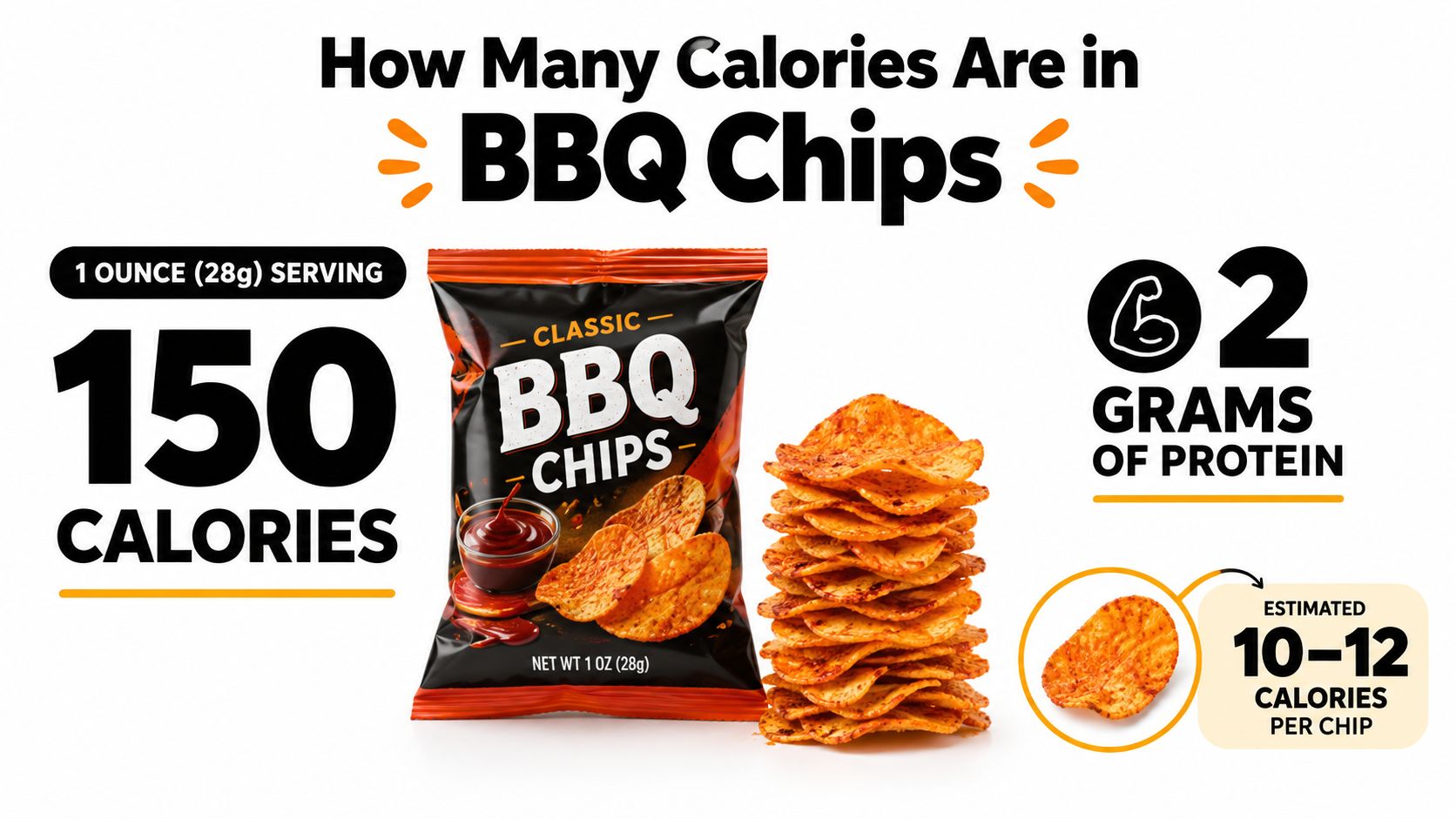
A 1-ounce (28 g) serving of typical BBQ potato chips contains about 150 calories and 2 g of protein. A single small bag can deliver 700–1,000 calories before satiety catches up.
That serving sounds modest because it is modest. One ounce is roughly 15–20 chips, not a full bowl, a generous handful, or the amount typical for a game night. The calorie question matters, but the more useful question is: how much did you pour out, and what did those calories provide?
For an active person tracking macros, BBQ chips are a flavor-first food. They bring crunch and fast energy, but very little protein for the calorie cost. Use the label as a measuring tool, not as permission to eat from the bag.
How Many Calories Are in BBQ Chips
The standard benchmark is straightforward: about 150 calories per 1-ounce serving, which equals approximately 28 g of BBQ-flavored potato chips. That serving commonly contains 2 g of protein, and the listed portion is usually around 15–20 chips, depending on chip size and shape. Hannaford's barbecue potato chip listing reflects the same general calorie pattern.
The problem is that one ounce is a small portion. A handful may be close to the label serving, or it may be substantially larger. Eating several handfuls turns a seemingly minor snack into a meaningful share of the day's calories without adding much protein.
Coach's rule: weigh the first portion once. Your eyes will usually overestimate how much 28 g actually looks like.
The front-of-pack number also hides the bag math. A 2-ounce portion is listed at 278 calories, while a 155 g portion is listed at 761 calories in the same BBQ potato chip category. Those figures show why “150 calories per serving” tells only half the story. The other half is the number of servings you consume.
If you want a broader comparison of crunchy snack labels, review this guide to tortilla chip nutrition. The practical lesson is the same: compare the weight you eat, not just the serving printed in bold.
The Macro Breakdown Behind the Calorie Total
BBQ chips are calorie-dense because their macro profile is dominated by fat and refined carbohydrate, while protein remains low. A representative 1-ounce serving clusters around 8–9 g of fat, 15–16 g of carbohydrate, and 2 g of protein, according to the label pattern documented for major-market BBQ chips. Trader Joe's BBQ Flavored Potato Chips nutrition listing shows this familiar serving structure.
The table below uses the verified label ranges rather than pretending every brand has identical nutrition.
Macronutrient Breakdown of a 1 oz Serving of BBQ Chips
| Macronutrient | Grams per 1 oz | Calories | % of Total Calories |
|---|---|---|---|
| Fat | About 8–9 g | Fat supplies most of the energy | Not specified consistently by brand |
| Carbohydrate | About 15–16 g | Carbohydrate supplies a substantial share | Not specified consistently by brand |
| Protein | About 2 g | Protein supplies a small share | Not specified consistently by brand |
The arithmetic explains the experience. Fat carries more calories per gram than carbohydrate or protein, and frying adds energy without creating much food volume. The seasoning creates the BBQ profile, but the oil and potato base do most of the calorie work.
That's why chips can feel easy to keep eating. You're getting a concentrated combination of crunch, salt, seasoning, and fat, but only 2 g of protein to help support fullness. Read this protein chips nutrition guide if you want to compare that macro structure with protein-forward crunchy snacks.
The coach's interpretation is blunt: BBQ chips aren't a protein snack that happens to contain calories. They're a calorie-dense snack with a small amount of protein attached.
Serving Sizes and How They Multiply Quickly
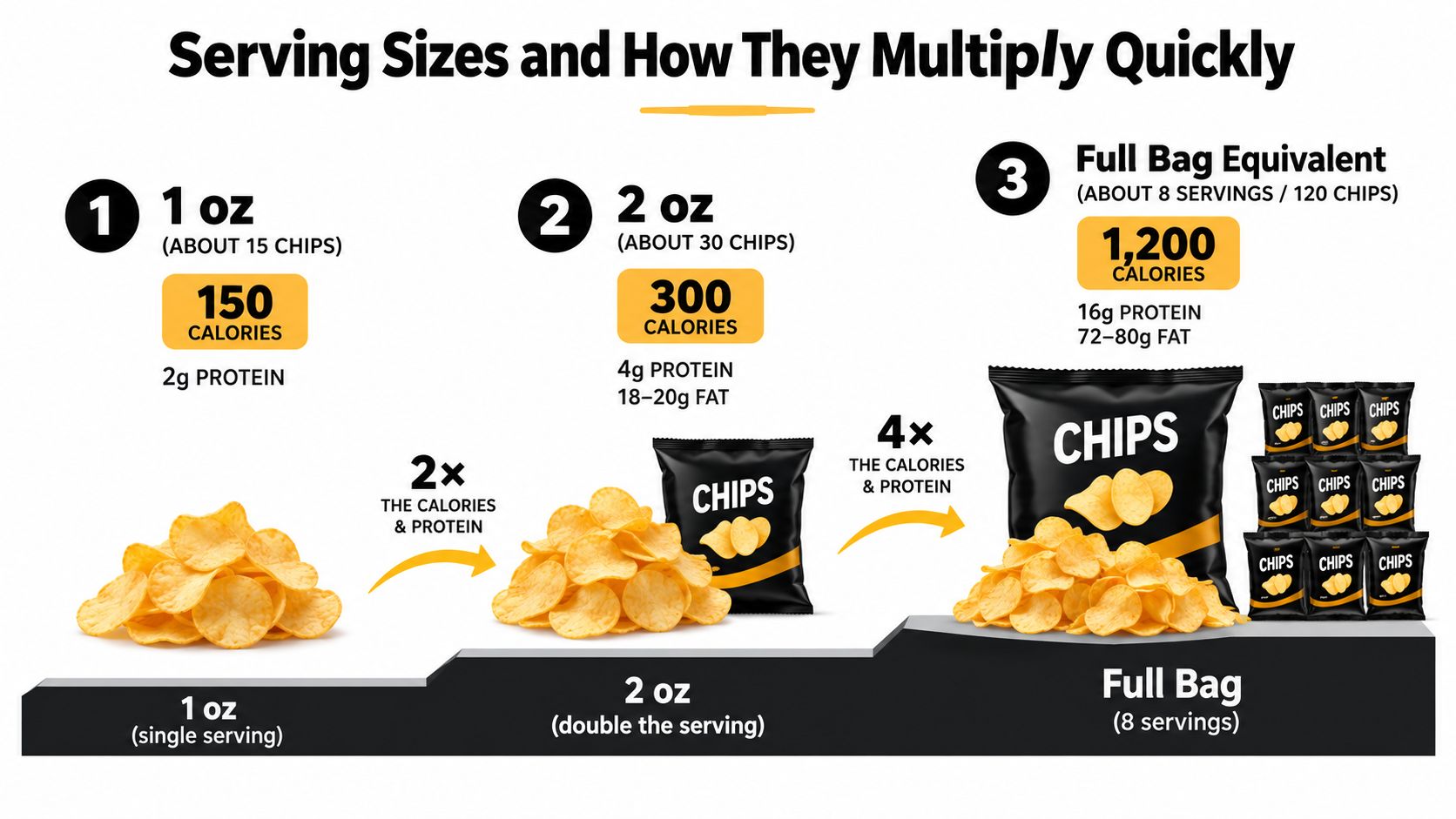
Start with the only number you need to remember: 1 ounce equals about 150 calories and 2 g of protein for a typical BBQ potato chip. From there, the math scales directly with weight. Double the portion, and you roughly double the calories and protein, but the protein remains too low to make the snack function like a meal.
A practical portion ladder looks like this:
| Portion | Calorie reference | Protein reference | What it may look like |
|---|---|---|---|
| 1 oz, 28 g | About 150 calories | About 2 g | A measured bowl portion |
| 2 oz | A listed example reaches 278 calories | Still only a small amount | A large handful or small bowl |
| 155 g | A listed example reaches 761 calories | Protein remains modest relative to calories | Several servings from a share bag |
| Larger bag | Varies by package weight and label | Depends on servings consumed | Eating directly from the package |
The 2-ounce example at 278 calories comes from the verified BBQ chip listing cited above. The 155 g example at 761 calories comes from the same category reference. Those numbers aren't theoretical dieting math. They're reminders that package size and actual intake matter more than the neat serving line on the label.
A label-reading habit prevents most mistakes: check the serving weight, then check the number of servings in the package. This guide to reading nutrition labels can help you translate the printed serving into the portion sitting in front of you.
If you eat from a mixing bowl, weigh the bowl's contents before you start. If you eat from the bag, assume your intake is difficult to estimate until you've practiced measuring it.
Why BBQ Chip Calories Vary by Brand and Recipe
The 150-calorie-per-ounce benchmark is useful, not universal. Verified retail listings place BBQ potato chips in a broader range of roughly 140–160 calories per ounce, with differences tied to fat content, sodium, serving density, and recipe design. Target's listing for Jay's Barbecue Potato Chips illustrates why you need to read the specific package rather than rely on the flavor name alone.
Brands can use different potato cuts, oil blends, cooking methods, and seasoning systems. A thicker or denser chip may deliver more food by weight in the same visual handful. A heavily coated chip may also differ from a lightly seasoned version even when both are labeled BBQ.
Calorie Variation by BBQ Chip Style and Brand Type
| Chip Style or Brand Type | Typical Calorie Pattern | Fat Pattern | Why It Differs |
|---|---|---|---|
| Standard fried BBQ chips | Often near the 150-calorie benchmark per ounce | Commonly about 8–9 g per ounce | Conventional frying and seasoning |
| Other major-market BBQ chips | Roughly 140–160 calories per ounce in verified listings | Varies by recipe | Oil, density, sodium, and formulation |
| Brand-specific or store-brand chips | Must be checked on the package | Must be checked on the package | Serving weight and ingredient formula differ |
I won't assign invented calorie ranges to baked, kettle-cooked, restaurant, or artisanal chips. The verified data doesn't establish those figures. Treat marketing language such as “kettle,” “baked,” or “light” as a reason to inspect the Nutrition Facts panel, not as proof that the product fits your macros better.
The fastest check is the ingredient list and the nutrition panel together. Look at serving weight, total fat, carbohydrate, protein, and the number of servings per bag. The BBQ label is a starting estimate, not a guarantee.
Beyond Calories, Sodium, Fat, and Fiber Considerations
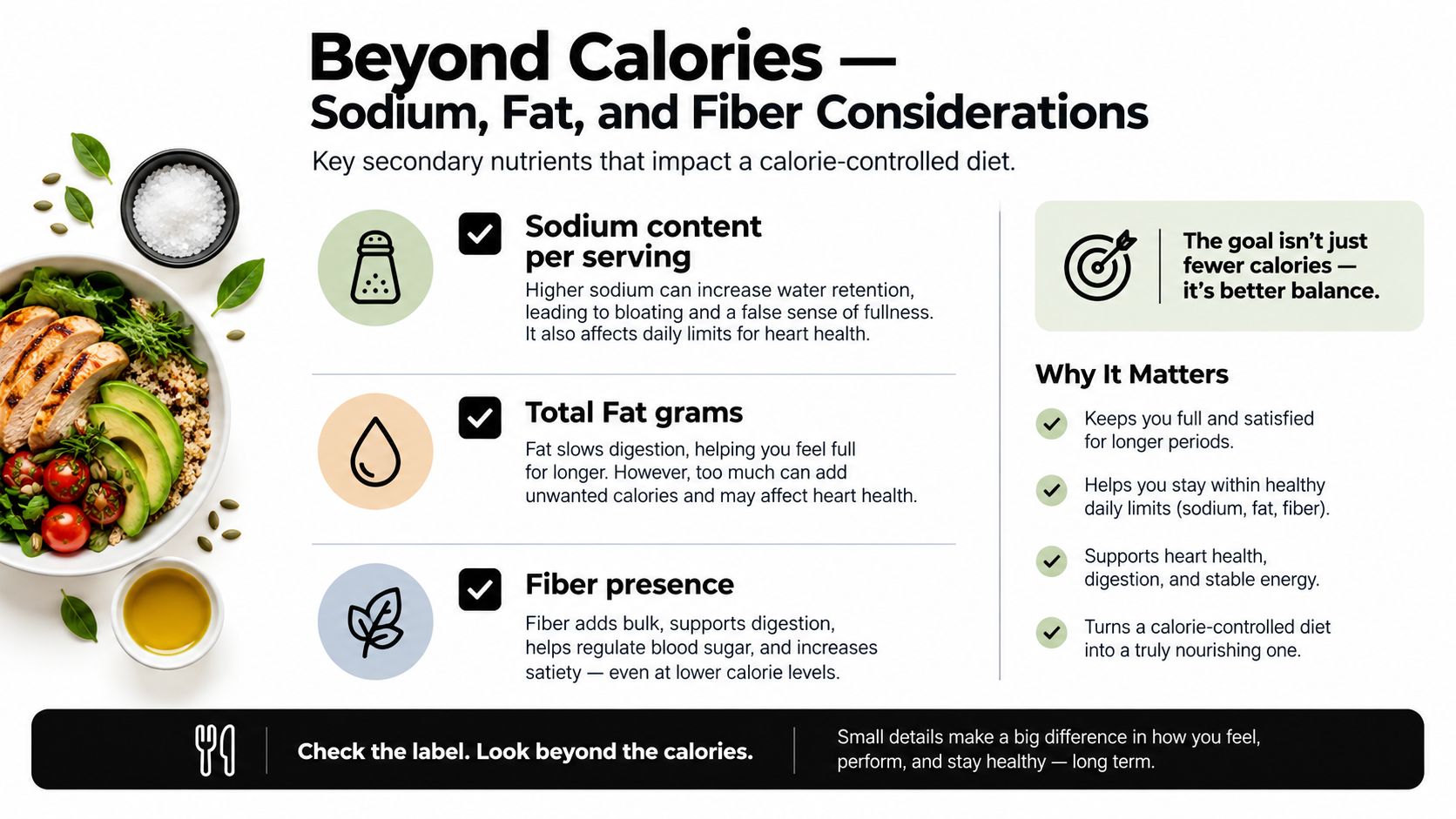
Calories decide whether a snack fits your energy budget, but they don't tell you how satisfying it will be. BBQ chips can fit a controlled day and still leave you wanting another snack because the serving offers little protein and limited fiber.
The verified data identifies fat as a major calorie driver, with representative labels showing roughly 9 g of total fat per 28 g serving and about 2 g of protein. It also notes that recipe variation can affect sodium and fiber, so a calorie-only comparison misses meaningful differences between bags.
Use three checks when you evaluate a BBQ chip:
- Sodium per serving: Compare the label across brands, especially if you tend to eat several servings.
- Fat per serving: Fat helps explain why a small weight of chips can carry a substantial calorie load.
- Fiber and protein: These nutrients help you judge whether the snack offers staying power or only delivers flavor and crunch.
BBQ seasoning can also affect how you experience the snack. Salty, strongly flavored foods may encourage continued eating and can increase thirst. That doesn't make the seasoning uniquely harmful, but it does make portioning more important.
My recommendation is simple. If chips are replacing a meal, they're a poor trade for most active people. If they're a measured side paired with a protein source, they can fit without taking over the day.
Comparing BBQ Chips to Higher-Protein Savory Snacks
BBQ chips have one clear advantage: they deliver the familiar potato-chip crunch. Their weakness is equally clear, 2 g of protein for about 150 calories. That makes them a poor default when your snack needs to support training, recovery, or appetite control.
The verified data doesn't provide nutrition figures for roasted chickpeas, edamame, jerky, turkey sticks, or protein popcorn, so I won't manufacture a comparison table of calorie and protein numbers. Instead, compare the packages using the same two questions: how many calories does the portion contain, and how many grams of protein does it provide?
BBQ Chips vs. Higher-Protein Savory Snacks Per 1 oz
| Snack | Calories per ounce | Protein | Fat | Fiber | Protein per 100 calories |
|---|---|---|---|---|---|
| BBQ potato chips | About 150 | About 2 g | About 8–9 g | Brand-dependent | About 1.3 g |
| Roasted chickpeas | Check package | Check package | Check package | Check package | Calculate from label |
| Dry-roasted edamame | Check package | Check package | Check package | Check package | Calculate from label |
| Beef jerky | Check package | Check package | Check package | Check package | Calculate from label |
| Turkey sticks | Check package | Check package | Check package | Check package | Calculate from label |
| Protein-forward popcorn | Check package | Check package | Check package | Check package | Calculate from label |
The useful comparison isn't whether another snack tastes exactly like BBQ chips. It won't. Jerky is chewier, edamame is denser, chickpeas have a firmer bite, and protein popcorn has a different texture. The useful comparison is whether you want crunch as entertainment or a snack that contributes meaningfully to protein intake.
For training days, choose a savory snack with a clearly higher protein number on the label. Keep BBQ chips for the occasions where the flavor and texture are the point, then portion them before eating. That turns them into a deliberate indulgence rather than an accidental protein-free meal.
Portion-Control Strategies That Actually Work
“Eat less” is weak advice for a highly palatable snack. Use a physical system instead.
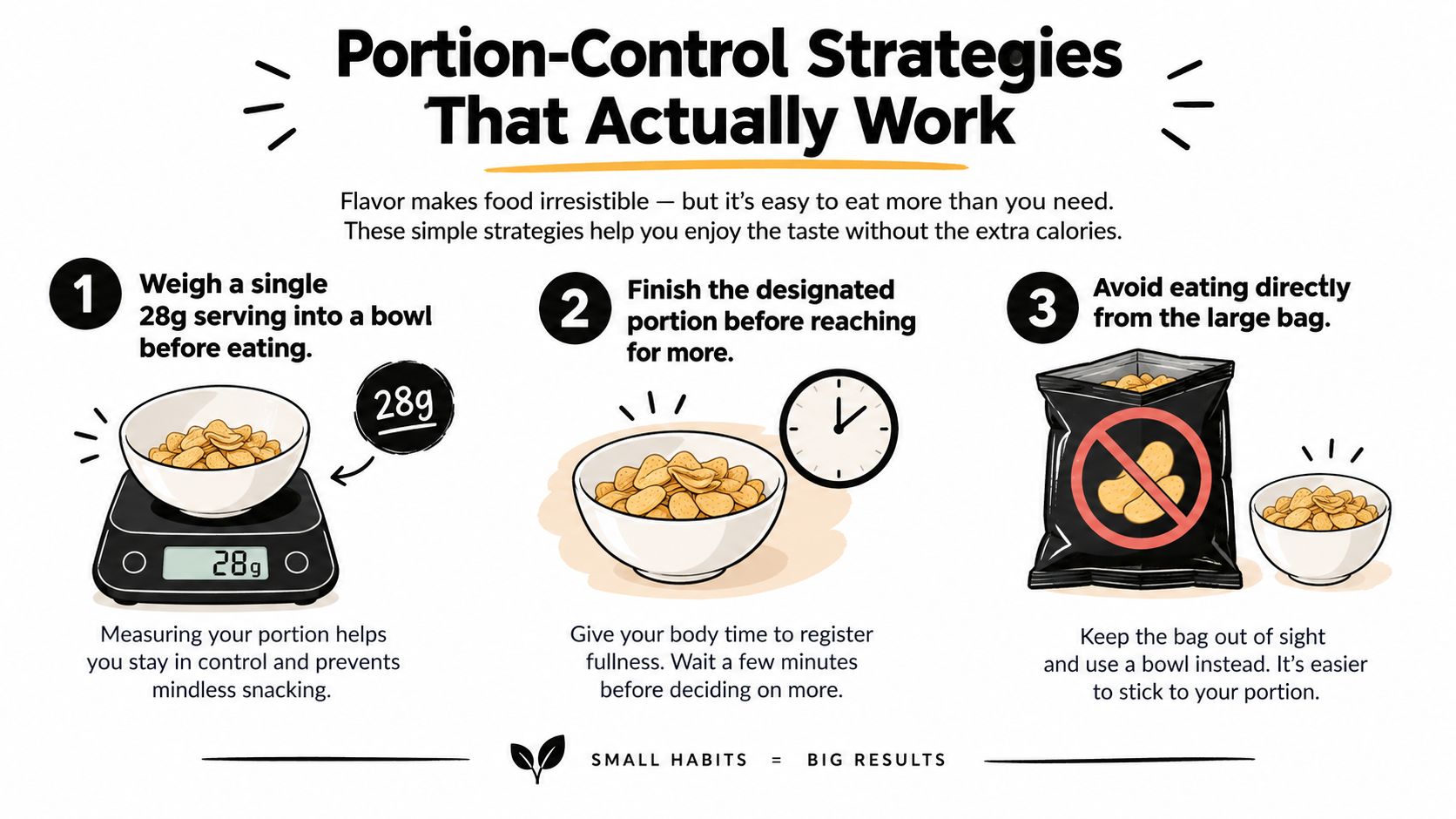
- Measure before opening the bag. Put a 28 g portion into a bowl, close the package, and eat only what you measured. A scale is more reliable than a visual estimate.
- Use a bowl, never the package. The bag hides how much you've eaten and makes every reach feel like the first one.
- Pair the chips with protein. Add a protein-rich food already in your plan, such as Greek yogurt, deli turkey, cottage cheese, eggs, or another option whose label fits your needs.
- Read servings per container. A label showing 150 calories may describe only one portion, while the package contains multiple portions.
- Buy a package size that matches your behavior. If you repeatedly finish large bags, choose a format that gives you a defined serving instead of relying on restraint after the bag is open.
A useful backup cue is your cupped hand, but treat it as an estimate, not a measurement. Chip size, hand size, and how tightly the chips settle all change the result.
Practical rule: portion the food while you're calm, not after you've started eating.
The Protein-Per-Calorie Mindset for Chip Lovers
Calorie tracking alone can make a low-calorie chip look like a smart fitness food. It isn't automatically smart just because the number is lower. If the product still provides very little protein, you may save calories while gaining little support for fullness or recovery.
The better metric is protein per 100 calories. For the standard BBQ chip benchmark, 2 g of protein per 150 calories works out to roughly 1.3 g of protein per 100 calories. That number is the reason I classify BBQ chips as a flavor food, not a protein food.
A protein-forward snack earns its place differently. It gives you a meaningful amount of protein while also satisfying the savory or crunchy craving. If you choose a baked, popped, or “lite” chip, check whether the protein improves. A smaller calorie number doesn't solve the core issue if the protein line remains minimal.
Use chips as an accessory:
- Put a measured serving beside a protein-centered meal.
- Add them to a lunch for crunch instead of eating a large portion as the lunch.
- Choose a higher-protein savory snack when you need something between training sessions.
This mindset doesn't ban BBQ chips. It gives them an honest category, which is more useful than calling them healthy or unhealthy.
When BBQ Chips Fit Into a Training Day
Timing changes the job the snack needs to perform. Before a workout, BBQ chips can provide carbohydrate and quick energy, but their fat content and low protein make them a limited performance tool. Test them before ordinary training rather than using an unfamiliar food immediately before an important session.
After training, the weakness becomes more obvious. Recovery nutrition generally benefits from a deliberate protein source, and BBQ chips contribute only about 2 g per standard serving. Pair them with a protein-centered meal or choose a different snack if post-workout recovery is the priority.
On a rest day, a measured portion can fit as a planned treat. Don't turn it into an automatic evening habit, especially if the bag remains within reach.
| Training Window | Calorie Fit for 1 oz | Protein | Verdict | Better Swap |
|---|---|---|---|---|
| Before training | About 150 calories | About 2 g | Optional fuel, weak recovery support | A snack with more protein |
| After training | About 150 calories | About 2 g | Poor standalone recovery choice | A protein-centered meal or snack |
| Rest-day treat | About 150 calories | About 2 g | Works when portioned | A higher-protein savory option if hungry |
| Social meal | Depends on the portion | Depends on the portion | Reasonable as a measured side | Add a protein-rich main food |
The same chips can fit one day and derail another. Your total intake, hunger, and training objective decide which role makes sense.
Quick-Reference Calorie and Macro Chart
Use this chart as a label-reading reference. The 1-ounce benchmark is the most consistent verified figure. Larger portions vary with brand, package weight, and how the manufacturer defines a serving.
BBQ Chips and Savory Snack Calorie and Macro Reference
| Portion | Calories | Fat | Carbs | Protein | Sodium |
|---|---|---|---|---|---|
| 1 oz, 28 g | About 150 | About 8–9 g | About 15–16 g | About 2 g | Brand-dependent |
| 2 oz | 278 in a listed example | Scales with brand | Scales with brand | Scales with brand | Brand-dependent |
| 155 g portion | 761 in a listed example | Brand-dependent | Brand-dependent | Brand-dependent | Brand-dependent |
| Larger bag | Multiply label calories by servings eaten | Multiply label fat by servings | Multiply label carbs by servings | Multiply label protein by servings | Multiply label sodium by servings |
For any snack comparison, write down the portion weight first. Then compare calories, protein, fat, fiber, and sodium from the actual package. The front label is marketing context. The Nutrition Facts panel is the information you use to make the decision.
Gym Snack offers plant-based savory protein snacks built around pea protein, with crunchy Cheddar Cheeze and Jalapeño Cheddar Cheeze options for people who want a more protein-focused alternative to ordinary chips. Visit Gym Snack to review the available snacks and bundles, then compare their labels with your usual BBQ chips before choosing your next training-day option.