

You're in the snack aisle after work, hungry enough to want something salty and crunchy, but not excited about blowing your protein goal on a handful of orange squares. The usual cheese flavored crackers still call your name. They're familiar, portable, and easy to eat in the car, at your desk, or after a workout when sweet protein bars sound exhausting.
That's where a lot of people get stuck. They assume they have to choose between comfort and nutrition, or between “fun snack” and “fitness food.” In practice, the better question is simpler. What else are you getting from that cracker besides flavor, and does it match what your body needs right now?
For people lifting regularly, trying to stay fuller between meals, following a plant-based diet, or using GLP-1 medications, that question matters even more. A snack that tastes good but leaves you hungry again soon can feel frustrating fast.
Reimagining the Classic Salty Snack
A lot of us first met cheese flavored crackers as lunchbox food. They were the crunchy side item next to a sandwich, the road-trip snack passed around in the front seat, or the thing you grabbed from the pantry because it always tasted good. That familiarity is part of why the category still matters.
It also isn't a tiny niche. The global cheese crackers market was estimated at USD 9.2 billion in 2024 and is projected to reach USD 14.6 billion by 2033, with a projected 5.3% CAGR, according to Growth Market Reports on the cheese crackers market. The same report identifies North America as the largest market. That tells you this snack has stayed relevant while eating habits have changed around it.
What's changed is the shopper. People still want crunch, salt, and that savory cheddar-style hit, but they're also scanning labels for protein, ingredient quality, and how a snack fits their day. Someone training in the morning may want recovery support. Someone on a GLP-1 may need a smaller snack that's satisfying instead of just easy to overeat. Someone who avoids dairy or gluten wants the same flavor profile without the usual tradeoffs.
Practical rule: A snack can be nostalgic and still deserve a modern label check.
If you usually group crackers under “just snacks,” it helps to think of them as part of the broader savory snack category. Once you do that, the comparison set changes. You're no longer asking only, “Which one tastes most like childhood?” You're asking, “Which one gives me the salty, cheesy crunch I want and still supports my goals?”
That shift matters. It turns cheese flavored crackers from an automatic grab into a deliberate choice.
What Exactly Makes a Cracker Cheese Flavored
The “cheesy” experience is more than one taste. It is often described as one flavor, but your brain is combining several signals at once. That's why one cracker can taste rich and satisfying while another tastes flat, dusty, or oddly sharp.
The four signals your brain reads as cheese
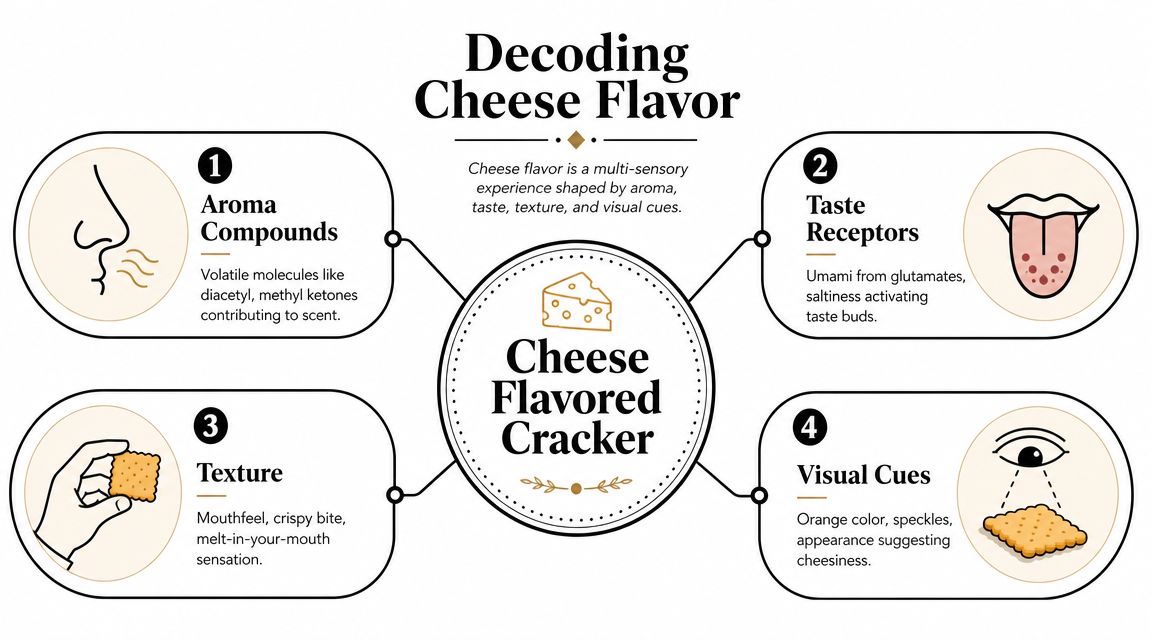
Start with umami. That's the savory depth people often notice first. Then add fat, which carries flavor and gives the mouth a richer, rounder feeling. Next comes salt, which makes the whole thing taste louder and more complete. Finally, there's aroma, the smell that reaches you before you even bite.
Take away any one of those and the illusion weakens. A cracker can be orange and still not taste convincingly cheesy. It can be salty and still miss that satisfying savory finish.
Here's where readers often get confused. A cracker doesn't always need visible cheese chunks or a dramatic ingredient name to deliver cheese flavor. Some products are made with actual cheese ingredients. Others rely on broader flavor systems that recreate the same sensory cues.
Why the category became so recognizable
A useful historical anchor is Cheez-It, launched in 1921. By 2022, the brand generated over USD 1.2 billion in U.S. retail sales and had developed more than 50 flavor and product variations, according to Snack and Bakery's feature on Cheez-It. That history matters because it shows how one cheddar-style baked cracker became a platform for endless flavor interpretation.
Cheese flavored crackers now range from classic baked squares to extra-toasty versions, spicy styles, sandwich formats, and high-protein reinterpretations. The basic promise stays the same. You want a dry, crisp bite that quickly releases salt, savory notes, and richness.
A good way to think about it is this:
- Aroma cues suggest cheddar, butteriness, or toastiness.
- Taste cues deliver salt and savory depth.
- Texture cues create the snap that makes the flavor feel snackable.
- Visual cues like orange color or seasoning speckles prime the brain before the first bite.
That same sensory logic shows up in many kid-friendly snack formats too, including baked cheesy breads and similar treats for children in Dubai, where smell, color, and softness or crunch work together to signal comfort food.

Cheese flavor isn't just an ingredient. It's a package of aroma, salt, fat, and texture working together.
Dairy vs Plant-Based Cheese Flavor Systems
If two crackers both taste cheesy, they may be getting there in very different ways. One uses a traditional dairy route. The other builds a similar experience from plant ingredients, seasonings, and food acids.
Comparing the two approaches
| Attribute | Dairy-Based System | Plant-Based System |
|---|---|---|
| Primary flavor source | Cheese powder, milk solids, butter-related ingredients | Nutritional yeast, spices, plant oils or fats, acids, savory seasonings |
| Flavor profile | Familiar cheddar-style richness, often round and creamy | Can range from sharp and tangy to nutty and savory |
| Allergen considerations | Includes dairy allergens and often wheat in the cracker base | Can be designed to avoid dairy and, in some products, other common allergens |
| Cholesterol | May contain cholesterol depending on ingredients | Often formulated without cholesterol when fully plant-based |
| Label style | Traditional and recognizable to many shoppers | Can feel newer, but often appeals to ingredient-conscious buyers |
| Best fit | People who want the classic cheese-cracker profile | People who want dairy-free, vegan, or macro-conscious options |
What dairy-based systems do well
Dairy ingredients give crackers a taste many people instantly recognize. Cheese powders and milk-derived ingredients can create that toasted-cheddar profile people associate with legacy brands. For someone who wants the exact classic flavor memory, this format often feels closest.
But there are tradeoffs. Dairy-based crackers won't work for someone avoiding milk proteins, following a vegan diet, or trying to simplify allergens in the pantry. Depending on the formulation, they can also lean heavily on flavor intensity without bringing much protein or fiber to the snack.
That's an important distinction. “Made with cheese” sounds nutritious to many shoppers, but it doesn't automatically make a cracker protein-forward.
How plant-based systems create a cheesy effect
Plant-based cheese flavor systems usually build from layers. Nutritional yeast often brings a savory, slightly nutty base. Spices can push the profile toward cheddar-style warmth. Acids help create a tangy edge. Salt and fat round everything out so the result tastes snacky instead of health-foody.
Some people expect plant-based savory snacks to taste like a compromise. That's outdated thinking. Good plant-based formulation focuses on the same sensory targets as classic cheese crackers: crunch, umami, salt, richness, and aroma.
For shoppers who want that profile without dairy, guides to dairy-free cheese snacks can help decode which products rely on whole-food-inspired flavor building and which ones swap one highly processed system for another.
Which one is better for you
That depends on your goal.
If your top priority is recreating the most traditional cracker flavor, dairy-based options may feel more familiar. If your priorities include plant-based eating, simpler allergen management, or better alignment with a macro-focused routine, a plant-based system may make more sense.
Use this quick decision filter:
- Choose dairy-based if you tolerate dairy well and want the most classic cheese note.
- Choose plant-based if you want a vegan option or a product built around broader dietary flexibility.
- Pause before buying if the front of pack says “cheese” but the nutrition panel doesn't support your actual needs.
A cheesy taste can come from different ingredient systems. What matters most is whether the full product fits your body, not whether the flavor comes from one traditional source.
A Nutrition Label Deep Dive for Modern Snackers
You grab a box because it looks like a lighter, smarter version of the crackers you grew up with. Then you get home, flip to the back panel, and realize the nutrition facts tell a different story. That moment matters more than the front-of-pack promise, especially if you care about protein, appetite control, or staying within your macros.
Cheese flavored crackers are a good example of why label reading matters. Two products can deliver the same salty crunch and familiar cheesy hit, yet act very differently in your day. One works like a flavor-first snack that disappears fast. Another gives you protein, some fiber, and a better shot at feeling satisfied after a small portion.
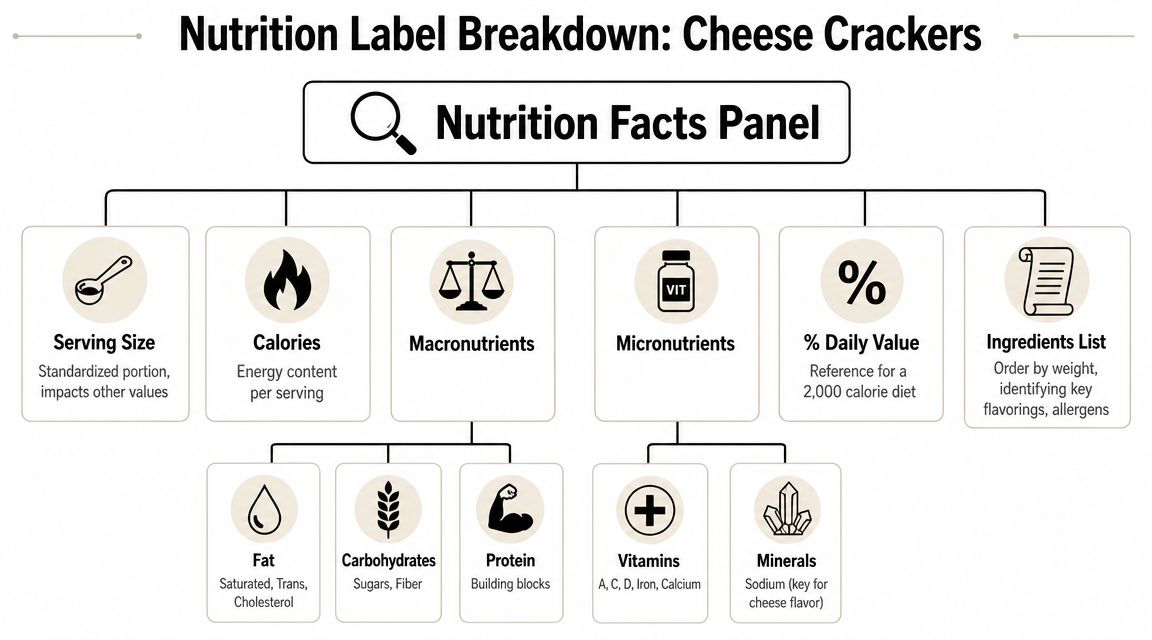
What to check first
Start with serving size. That number sets the stage for everything else, and cracker servings are often smaller than what someone would pour into a bowl without thinking.
Then look at these four items in order:
-
Protein
Protein changes the role of the snack. A cheese flavored cracker with only a small amount of protein may taste satisfying but do little for fullness or recovery. -
Fiber
Fiber slows the eating experience physiologically, not just mentally. It can help a crunchy snack feel more substantial. -
Sodium
Cheese flavored crackers often rely on salt to sharpen flavor. A bold taste in a small serving usually means sodium deserves a closer look. -
Ingredients list
This tells you whether the product is built from a clear food base or mostly from refined starches, oils, and flavor additions.
If labels still feel busy or hard to compare, this guide to reading nutrition labels gives a useful framework for sorting serving size, daily values, and ingredient order.
A good shortcut is to read the panel like a budget. You only have so much room in a snack. If most of that room goes to refined carbs, oil, and sodium, there is less space left for protein, fiber, and ingredients that support fullness.
Why this matters for fitness goals and GLP-1 use
For active people, crackers that are low in protein usually function as a side snack, not a meaningful part of recovery or macro planning. They can still fit. They just should not be mistaken for a protein-forward option because the box uses words like baked, wholesome, or made with real cheese flavor.
For GLP-1 users, the question is often even more practical. Appetite may be lower, portions may be smaller, and every bite may need to do more work. In that situation, a cracker that offers better protein and fiber density can be a smarter use of limited appetite than one built mainly for crunch and nostalgia.
That distinction is easy to miss in the aisle.
Sodium deserves context
Sodium is not automatically a red flag. Athletes who train hard and sweat a lot may tolerate it differently than someone who is looking for an everyday desk snack. The point is awareness.
A cheese flavored cracker can deliver a lot of salty impact because sodium amplifies the savory notes that people associate with cheese. If the product tastes intense but offers little protein or fiber, salt may be doing much of the heavy lifting. That is one reason some crackers are easy to overeat but not especially filling.
If you want a second plain-English resource on how to read nutrition labels, it can help clarify which numbers are worth comparing first.
Quick screen: A modern snack should give you more than a cheese-like flavor. Look for a label that supports fullness, macros, and portion realism, not just craveability.
How to Find a High-Protein Clean-Label Cracker
You are standing in the snack aisle after a workout, or trying to find something small that will still be worth eating on a lower-appetite day. Two boxes both promise cheesy flavor and better-for-you ingredients. One is mostly starch with seasoning. The other is built on a real protein source and uses flavor as support, not camouflage. That is the split to look for.
A useful shortcut is to ask one question first: what is this cracker made from? A high-protein cracker should show its foundation early in the ingredient list. That might be pea protein, chickpeas, lentils, edamame, seeds, or another legume-forward base. If the first several ingredients are refined flour, starch, oil, and flavoring, the product is still acting more like a classic cracker with a health halo.
Clean label matters here too, but it helps to define it in plain English. It does not mean perfect, and it does not mean every ingredient has to come from your own kitchen. It means the formula is easier to recognize and easier to explain. If a cheese flavored cracker uses a short list of foods and seasonings to get texture and taste, that is usually a better sign than a long chain of isolates, gums, and vague natural flavors doing all the work.
Here is the filter I give clients who want a savory snack that can support fitness goals:
- Look for a meaningful protein contribution. If protein is only a small add-on, the cracker is still mainly a crunchy side item. For training, macro planning, or GLP-1-friendly snacking, you want protein to be part of the product's structure.
- Check whether the base ingredient matches the front-of-box message. A lentil or chickpea cracker should be led by lentils or chickpeas, not mostly rice flour or starch.
- Read the seasoning separately from the base. Cheese flavor can come from dairy powders, nutritional yeast, spices, or natural flavor blends. That part affects taste and allergen fit, but it should not distract from a weak nutrition profile.
- Keep the serving realistic. If the nutrition panel looks good only because the serving is tiny, the snack may be less useful in real life.
- Match the product to your own limits. Dairy-free, gluten-free, soy-free, or seed-oil-conscious choices matter if those factors affect how you eat or feel.
The easiest way to avoid confusion is to separate two jobs. The base ingredients determine whether the cracker can satisfy you. The flavor system determines whether you will want to eat it again. You need both, but they are not equally important.
That distinction matters even more for people who are tired of sweet bars and shakes. A savory cracker with solid protein can fill a real gap because it gives you crunch and convenience without pushing you back toward dessert-style snacks. For GLP-1 users, that can be especially useful. Smaller portions need to count.
“Clean label” also depends on your goal. A plant-based athlete may prioritize legumes, seeds, and nutritional yeast. Someone else may prefer a simple dairy-based formula with fewer additives. Another shopper may care most about avoiding artificial colors or highly refined oils. A better label is the one that lines up with your body, your routine, and the reason you are buying the snack in the first place.
If a cracker is supposed to support fullness, recovery, or steadier eating, protein should be built in from the start, not sprinkled on as a marketing extra.
The best choice is rarely the loudest box. It is the cracker that does two things at once. It delivers the salty, cheesy satisfaction people want from this category, and it gives enough nutritional substance that the serving feels honest.
Quick DIY Seasoning and Smart Snack Pairings
If you love the cheesy flavor profile but don't want to bake crackers from scratch, seasoning is the easier win.
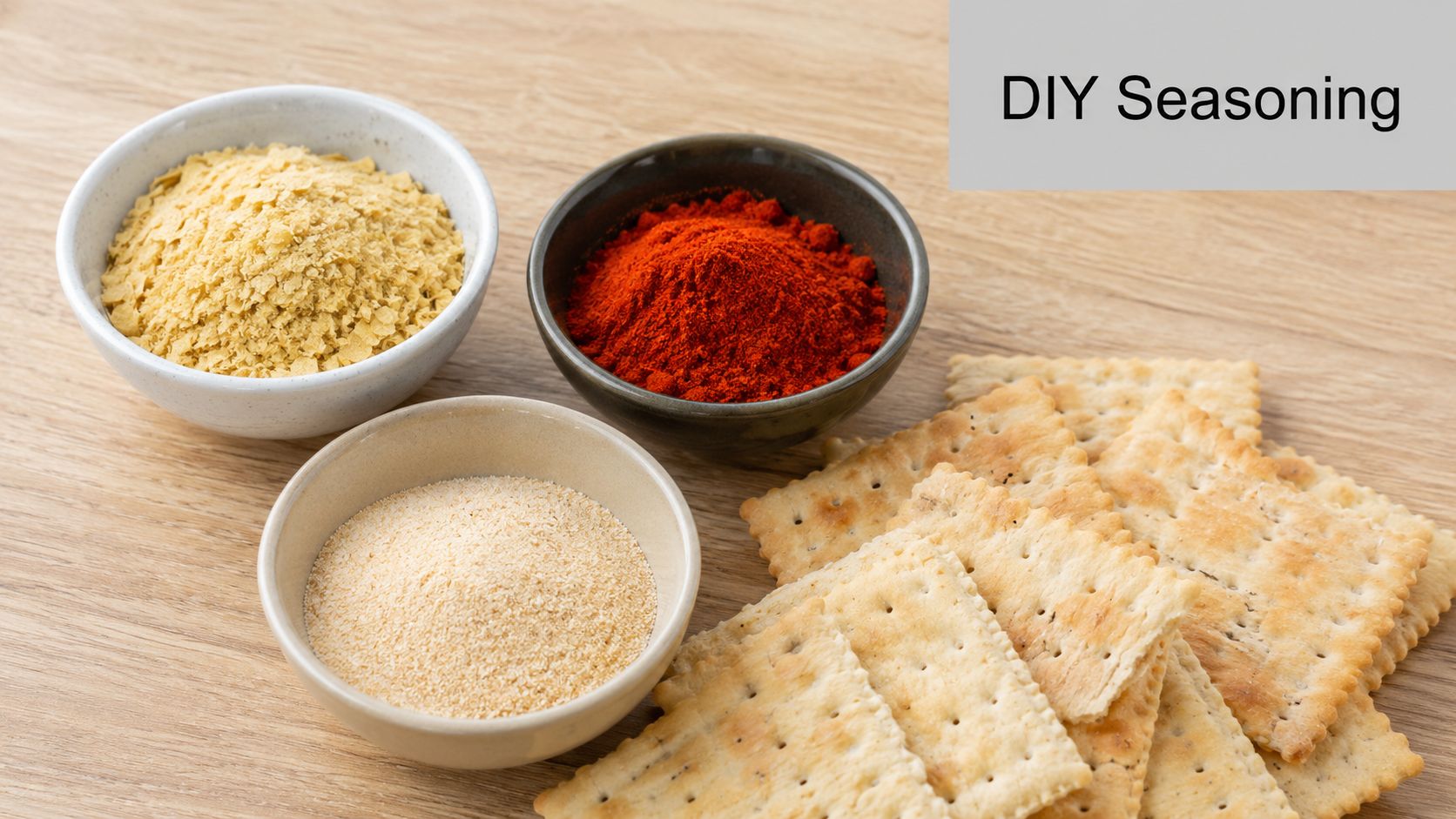
A fast vegan cheesy seasoning
Mix nutritional yeast with a little garlic powder, onion powder, paprika, and salt. Adjust the salt based on what you're putting it on. This works well on popcorn, roasted chickpeas, edamame, nuts, or plain high-protein crackers that need more personality.
The reason this works is simple. Nutritional yeast brings savory depth, the spices add warmth, and salt sharpens the whole blend. You get a cheese-adjacent effect without needing dairy.
Why seasoning beats homemade crackers for most busy people
Homemade crackers can be great, but crispness takes technique. According to the recipe guidance in One Hot Oven's cheese cracker method, good cracker snap depends on controlling moisture and fat, using cold ingredients, chilling dough for 30 to 45 minutes, rolling it thin, and baking at around 350 to 400°F. That's doable, but it's more effort than is commonly desired on a weekday.
Seasoning lets you skip the hardest part and still get the flavor payoff. You can put the cheesy profile onto foods that better match your nutrition goals.
Pair crackers so they act more like a mini-meal
Crackers alone often need backup. Pairing them with protein, fiber, or healthy fats makes the snack much more useful.
Try combinations like these:
- With hummus for extra staying power and a creamier contrast.
- With avocado when you want richness and a slower, more satisfying snack.
- With roasted edamame or chickpeas to add crunch plus more substance.
- With a bean dip if you want a savory snack that feels closer to a light meal.
Here's a visual walk-through if you want more ideas for savory prep and flavor layering:
The main idea is simple. Let the crackers provide crunch and flavor, then let the pairing improve the nutrition.
Conclusion: The Future of Savory Snacking is Functional
Cheese flavored crackers aren't going anywhere, and that's not a problem. The better opportunity is to stop treating them like nutrition-free nostalgia and start judging them by what they deliver.
Once you understand what creates cheese flavor, the aisle gets easier to read. You can tell the difference between a classic flavor system and a plant-based one. You can spot when a product is mostly starch and sodium. You can choose snacks that support training, appetite management, and energy instead of just scratching a craving for ten minutes.
That matters for active people, plant-based eaters, busy professionals, and GLP-1 users alike. Crunch still matters. Flavor still matters. But now they need to come with a reason to buy beyond habit.
Savory snacking is moving toward foods that do more. The best options still taste bold and satisfying, but they also respect your macros, your ingredient standards, and your real-life schedule. That's a much better future than settling for a snack that sounds healthy only because it says “cheese” on the box.
If you want a savory snack built for modern goals, take a look at Gym Snack. It offers chef-inspired, plant-based protein snacks with bold cheesy flavor, satisfying crunch, and a macro-friendly profile that fits training, busy days, and smarter snacking.