

You're in a grocery aisle after work, or maybe standing in your kitchen before a workout, wanting something crunchy that won't leave you sleepy, bloated, or hungry again in half an hour. You spot a bag that says gluten free, toss it in your cart, and assume you've made the smarter choice.
Sometimes you have. Sometimes you've just swapped wheat for refined starch.
That's why gluten free crunchy snacks deserve a closer look. For some people, gluten free starts as a medical need. For many others, it's now part of everyday snacking. Market reports reflect that shift. One 2026 report estimates the global gluten-free products market at USD 8.34 billion in 2025, with snacks and ready-to-eat products accounting for 24% of the market in 2024 and projected to grow fastest through 2030, while another report puts the gluten-free snacks market at USD 1.1 billion in 2024 and projects USD 2.6 billion by 2034, about a 9.2% compound annual growth rate over 2025 to 2034 (Fortune Business Insights gluten-free market report).
What matters to you as a shopper is simpler. Crunchy snacks are portable. They scratch the craving for chips and crackers. They fit gym bags, desk drawers, and car consoles. But a lot of them still miss on fullness.
This guide looks at gluten free crunchy snacks through a different lens. Not just “Does it avoid gluten?” but also “Will it keep me full?” “Does it support training?” and “Can I tell from the label if it's worth buying?”
Introduction to Gluten Free Crunchy Snacks That Actually Satisfy
A common scene goes like this. You need something fast between meetings, classes, or errands. You want a crunchy snack because it feels more satisfying than a soft bar or shake. You also want to avoid gluten, whether that's for sensitivity, preference, or household needs. So you grab crackers, puffs, or chips that look healthy on the front of the bag.
Then an hour later, you're hungry again.
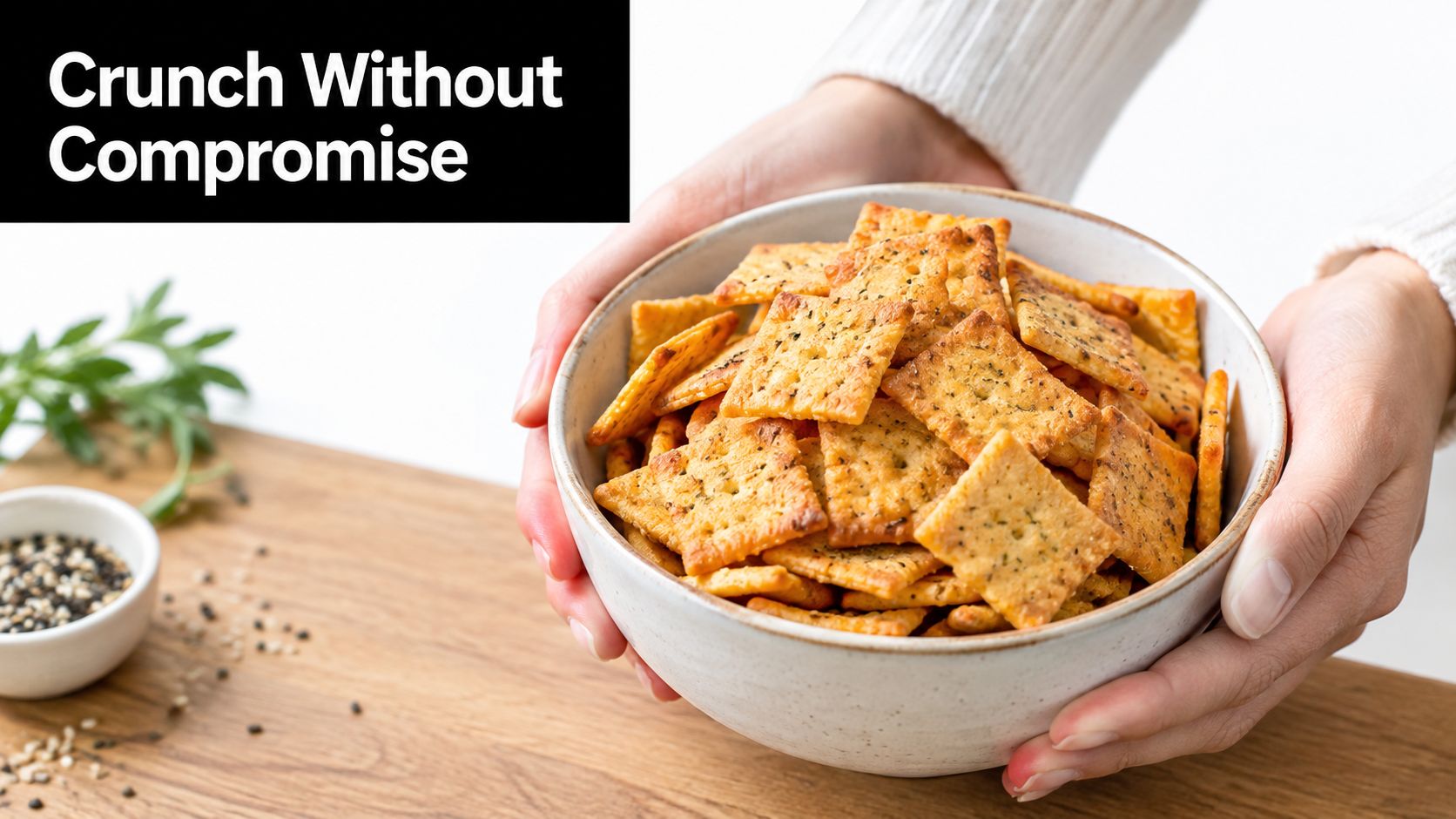
That happens because crunch and satisfaction aren't the same thing. A snack can be crispy, salty, and gluten free, but still light on the things that help you stay full. If it's mostly refined starch with flavor dust, it may feel fun to eat without doing much for appetite control.
Why the category keeps growing
Gluten free eating isn't a tiny niche anymore. A 2026 industry analysis estimates the global gluten-free food market at USD 12.9 billion in 2024 and expects it to reach USD 33 billion by 2034, a 9.9% CAGR. Another report places the market at USD 9.28 billion in 2025 and projects USD 14.42 billion by 2030, with Asia-Pacific as the largest region in 2025 and Western Europe as the fastest growing region (GM Insights gluten-free food market analysis).
That growth makes sense when you think about real life. People want snacks they can carry, eat one-handed, stash in a backpack, and enjoy without prep. They also expect gluten free versions to feel like “real snacks,” not a compromise.
Practical rule: If a crunchy snack only solves the gluten question, it's only doing half the job.
What smart snacking looks like
A better way to judge gluten free crunchy snacks is to use three filters:
- Texture that satisfies so the snack feels like a treat, not a substitute.
- Protein and fiber support so you're not chasing another snack right away.
- Simple label logic so you can sort helpful options from ultra-processed lookalikes.
That's where a protein-first approach fits naturally. Crunchy snacks can do more than replace crackers. They can help bridge meals, support training, and make gluten free eating easier without leaning sugary or dessert-like.
What Makes a Snack Both Gluten Free and Crunchy
If gluten gives many baked foods their chew and stretch, what creates crunch when gluten is missing?
The short answer is starch, heat, moisture, and trapped air.
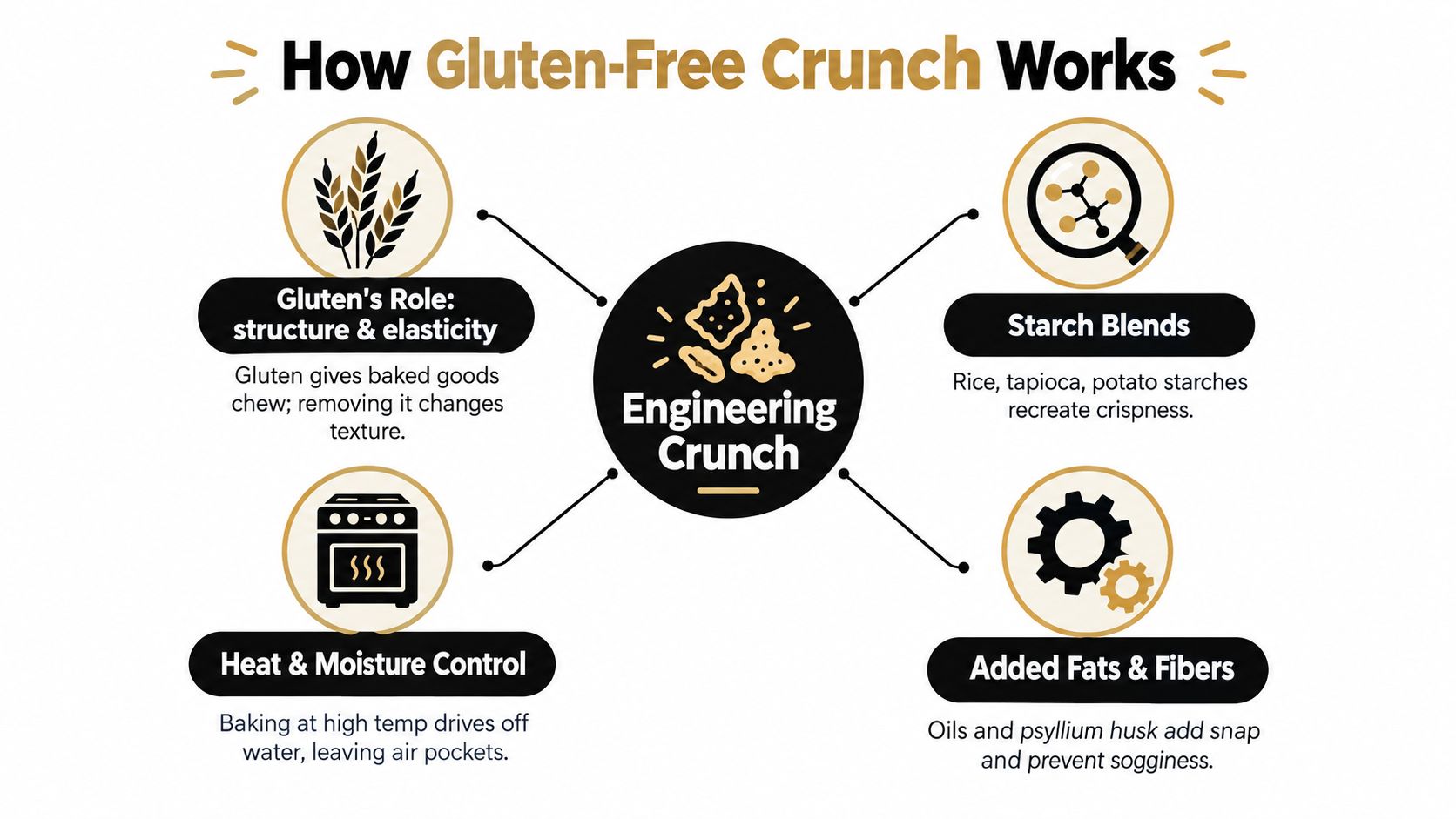
Think about popcorn. A kernel heats up, pressure builds, and when it bursts, steam expands and creates that airy structure. Many gluten free crunchy snacks use a similar idea through extrusion or baking. Starch gelatinizes, forms a soft melt, and then traps steam as it exits the machine or oven, creating little pockets that become crisp when moisture leaves.
Why some snacks puff and others turn dense
When a formula leans heavily on protein, fiber, fruit powders, or bean flours, the snack often expands less. Less expansion usually means a denser bite.
A technical review on gluten-free extrusion explains that starch must gelatinize and form a melt that traps steam as it exits the die, and that higher fruit, fiber, or protein additions reduce expansion and increase bulk density. The same guide notes that native starches alone often can't deliver strong crunch, while adding about 10% to 20% cold-water-swelling specialty starch can improve crispness, and insoluble fiber above about 30% can significantly suppress expansion (technical review on gluten-free snack extrusion).
A simple way to picture formulation
Picture a sponge versus a brick.
- A snack with enough workable starch and the right heat can puff more like a sponge.
- A snack overloaded with dense ingredients but no texture support can eat more like a brick.
- The sweet spot is getting enough protein or fiber to improve nutrition without flattening the crunch.
One study on gluten-free extruded snacks found the expansion ratio dropped from 3.55 to 1.55 as lentil flour and mung bean flour increased, while apparent density rose from 0.43 to 2.63 g/cm³. It also identified a formula with 25% lentil flour, 16% mung bean flour, and a 150°C barrel temperature as the best balance of expansion, intermediate hardness, and crispness (study on formulation and texture in gluten-free extruded snacks).
More protein and fiber can improve nutrition, but they often make crunch harder to achieve. That's why a good high-protein crisp is a food engineering job, not just a wheat-free swap.
What you can infer from the bag
You don't need a lab to make a decent guess.
If the first ingredients are mostly refined starches, the snack may be airy and crisp but not very filling. If the ingredient list jumps quickly into pea protein, lentils, chickpeas, or seed flours, expect a denser crunch unless the brand has balanced the formula well. Neither is automatically bad. The key is matching texture to what you want from the snack.
How to Read Labels and Spot Better Gluten Free Options
The front of the package is advertising. The side panel is where the truth lives.
That matters because a gluten free claim often appears on processed foods, not just simple whole foods. A 2024 review noted that gluten-free claims appear mostly on processed and ultra-processed foods, and Canadian research found about 1 in 6 prepackaged foods and beverages carried gluten-free claims, with those claims concentrated in processed categories rather than minimally processed foods (review on gluten-free claims and processing).
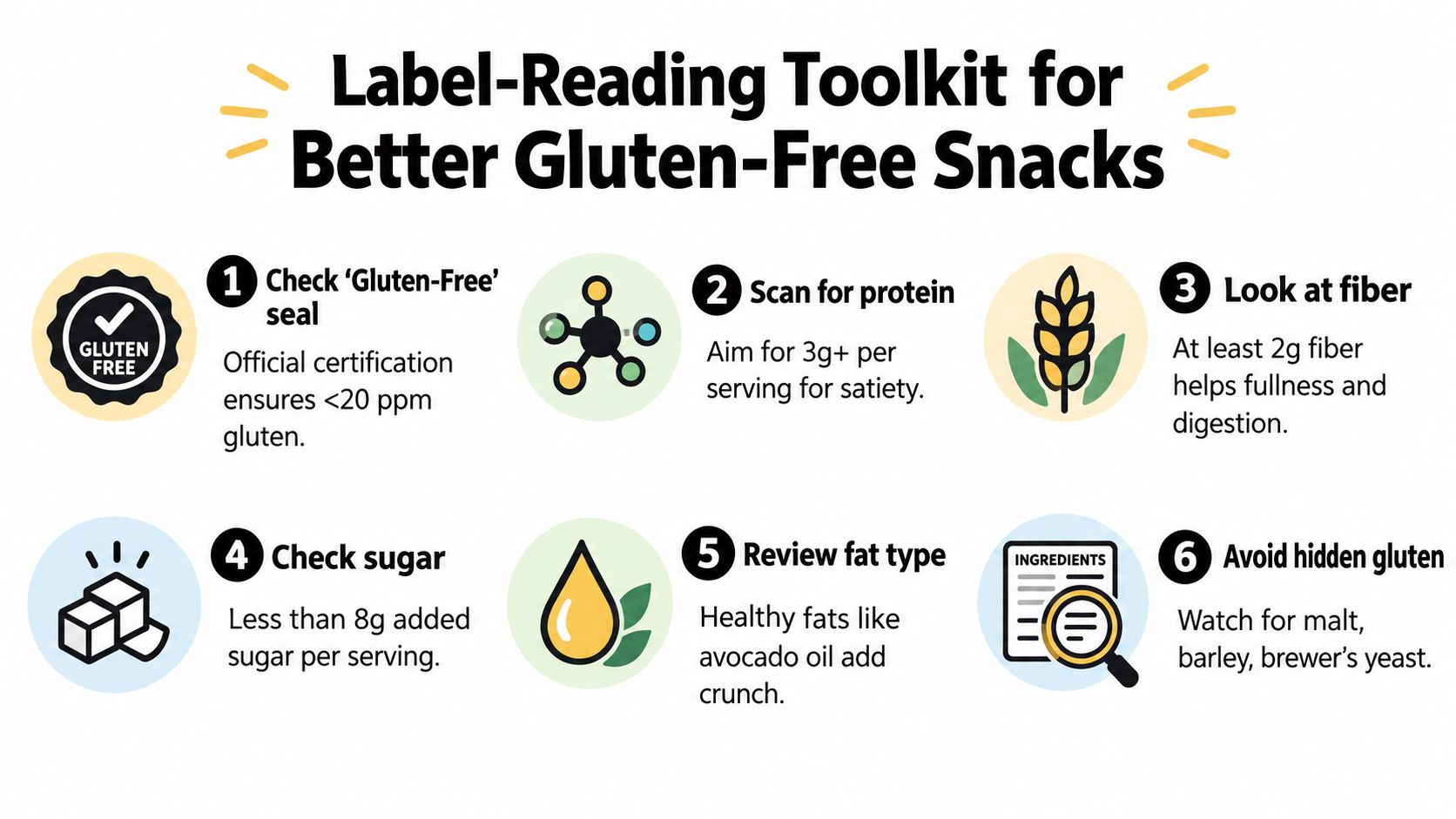
So when you read a label, don't stop at the gluten free stamp. Ask what replaced the gluten, and whether that replacement helps you.
A quick label reading sequence
Use this order so you don't get distracted by packaging claims:
- Start with the ingredient list. Look for what the snack is mostly made of. Rice flour, tapioca starch, potato starch, pea protein, chickpeas, lentils, nuts, and seeds all create very different eating experiences.
- Check the protein line next. If the snack has almost no protein, it may act more like a crunchy side item than a satisfying snack.
- Look at fiber and saturated fat. These help you predict fullness and overall balance.
- Scan sodium and flavor add-ins. Savory snacks can be useful, but very salty products can make you feel snacky rather than satisfied.
- Review allergen notes. If you're also avoiding dairy or soy, look for that clarity on pack.
If you want a deeper refresher on panels, serving sizes, and ingredients, this guide on how to read nutrition labels is a practical companion.
What tends to separate better options from weaker ones
Here's the pattern I see most often in store aisles:
- Better picks usually pair crunch with substance. They often use legumes, pea protein, seeds, or whole-food-style ingredients that give the snack more staying power.
- Weaker picks often rely on starch first and nutrition second. They can still taste good, but they're easier to overeat because they don't offer much fullness.
- Allergen-aware choices are easier to repeat. If a snack avoids gluten but also skips ingredients that bother your stomach, it's more likely to become a regular staple.
For a roundup that can help you compare certified gluten free snack options, Rip Van's guide is useful as a shopping reference. Just keep using your own label filter once you click through.
The label question isn't only “Is it gluten free?” It's “What kind of snack is this actually trying to be?”
Why Protein and Satiety Matter for Crunchy Snacking
A lot of crunchy snacks are built to be craveable. Fewer are built to keep you full.
That's the big difference between a snack that disappears into the background of your day and one that helps you stay steady between meals. Protein matters here because it tends to make a snack feel more substantial. In plain terms, a protein-forward snack usually gives your body a stronger “I'm fed” signal than a starch-only snack.
Fullness is about signals, not just calories
Many people are surprised by this. Two snacks can feel similar in size, but one leaves you satisfied and the other sends you back to the pantry. That's because fullness isn't only about volume or crunch. It's also about how the body responds after you eat.
Protein-rich foods can support fullness signals such as GLP-1 and PYY, which is one reason they often work better for appetite control than low-protein crackers or chips. You don't need to memorize hormone names to use the idea. Just remember this: when a snack has real protein behind the crunch, it's more likely to hold you over.
Crunchy snack nutrition at a glance
| Snack Type | Protein Profile | Best For |
|---|---|---|
| Starch-based chips or crackers | Usually low protein | Taste, quick crunch, party snacking |
| Popcorn-style savory snacks | Light to modest protein | Volume and light munching |
| Bean- or lentil-based crisps | Moderate protein | Midday snacking with better staying power |
| Pea-protein crunchy snacks | Higher protein | Training support, appetite control, longer gaps between meals |
A useful mental split is this:
- Low-protein crunch works when you just want texture.
- Moderate-protein crunch works better when lunch is far away.
- Higher-protein crunch makes the most sense when you want a snack to do a job, like helping with recovery, reducing random grazing, or keeping evening hunger calmer.
For more on how fullness works in day-to-day eating, this article on how to stay full longer is worth reading.
Why this matters for training
If you exercise regularly, snack choice stops being random. The right crunchy snack can help fill the gap before training, take the edge off after, or keep you from arriving at dinner ravenous.
That's one reason savory, protein-forward options stand out. They don't feel like dessert. They fit better for people who want something salty and crunchy that also supports gym goals.
When to Enjoy Crunchy Snacks for Workouts and Weight Management
Timing changes how a snack feels.
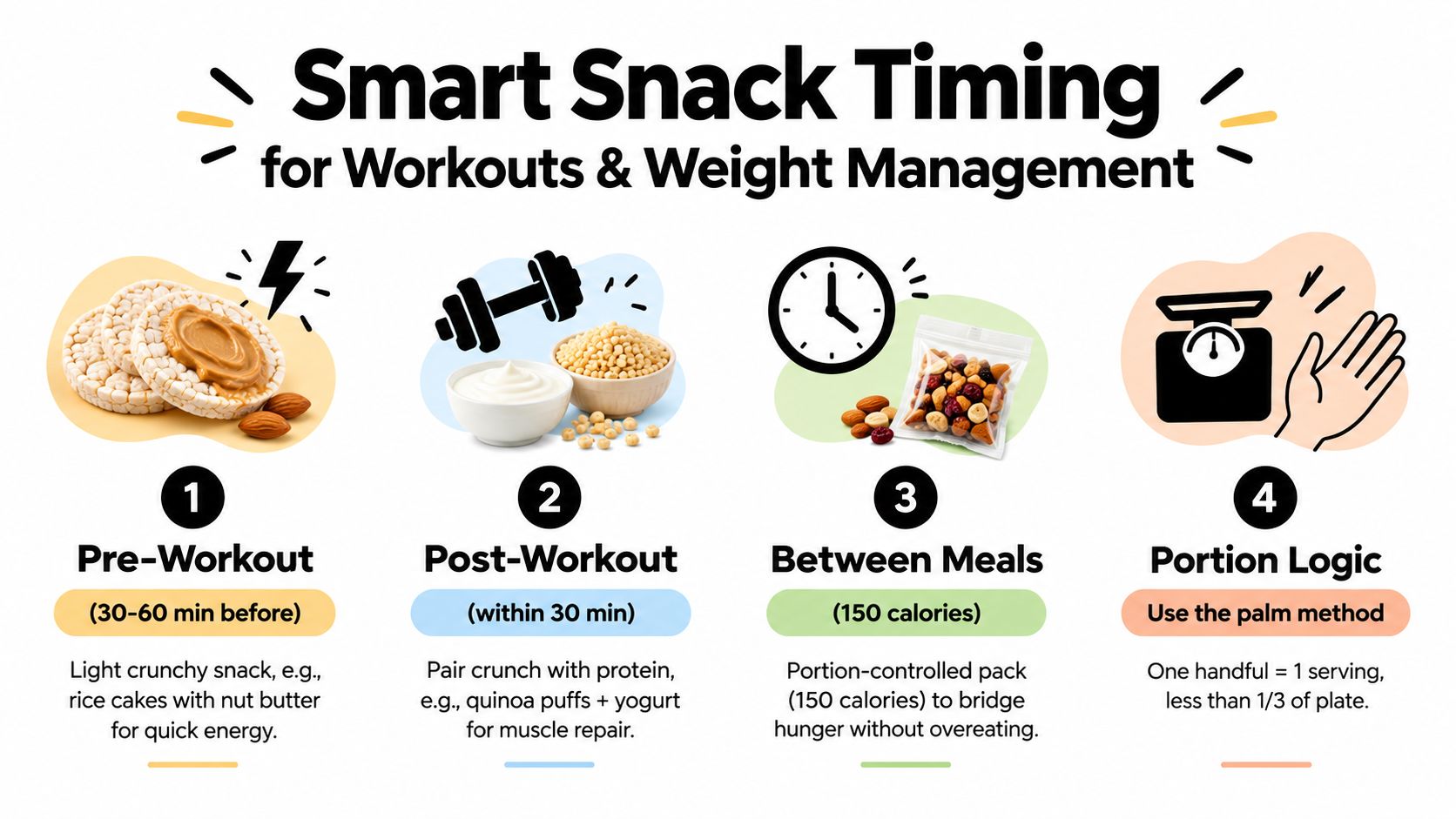
A light, crunchy snack before movement can feel energizing. The same snack after training may not be enough if you need more recovery support. And if you're focused on weight management, using crunchy snacks at the right time can be more helpful than trying to avoid them.
Before a workout
Keep it simple if training is coming up soon. You will do better with something easy to digest and not too heavy.
A few practical options:
- If you're hungry but not starving, go with a lighter crunchy snack plus water.
- If you need more staying power, pair a crunchy snack with fruit.
- If your stomach is sensitive, skip very greasy or very fiber-heavy choices right before exercise.
After a workout
Post-workout is where protein becomes more useful. Crunch alone may taste great, but pairing crunch with meaningful protein tends to make the snack more functional.
One option in this category is Gym Snack, which makes plant-based savory protein crisps that are naturally free of dairy, soy, and gluten, with 15g+ protein per serving and 30g+ per bag, plus low saturated fat and no cholesterol. That kind of profile fits well when you want a portable savory snack instead of a sweet bar or shake.
Workout shortcut: Before training, prioritize comfort. After training, prioritize recovery and satiety.
Between meals and for weight management
Crunchy snacks often shine. People who are trying to manage appetite usually don't need more “discipline.” They need snacks that reduce the urge to keep picking at food.
A few useful rules:
- Use crunch as a bridge, not a distraction. If lunch is two hours away, choose a snack with enough substance to carry you there.
- Pair when needed. Crunchy protein plus fruit, or a small crunchy snack with a yogurt alternative, can feel more complete than either one alone.
- Watch your eating speed. Crunch can slow you down a little, which helps some people notice fullness sooner.
- Respect gut comfort. If beans, dairy, soy, or certain fibers bother you, your best snack is the one your body handles well.
For people focused on GLP-1-style fullness, savory crunchy snacks can be especially useful because they feel snack-like without pushing you toward sugary, low-protein grazing.
Easy DIY Gluten Free Crunchy Snack Ideas to Try at Home
Store-bought snacks are convenient. Homemade snacks teach you what creates crunch.
That's helpful because once you understand texture, you stop following recipes blindly. You can tweak heat, moisture, starch, and seasoning to get closer to the bite you want.
Roasted chickpeas for everyday crunch
Roasted chickpeas are one of the easiest starting points. Dry them well, season them, and roast until crisp.
Try these flavor directions:
- Smoky savory with paprika, garlic powder, and salt
- Cheddar-style with a dairy-free cheesy seasoning blend
- Jalapeño-style with chili and a little tang
For better texture, let them cool fully before storing. If they soften overnight, a short return to the oven usually helps.
Seed crackers when you want a sturdier bite
Seed-based crackers feel more substantial than puffed snacks. They're good if you want crunch that holds up to dips or cheese alternatives.
A simple approach:
- Mix seeds with a gluten free binder.
- Spread the mixture thin.
- Bake until dry and crisp.
- Cool completely before breaking into pieces.
If you want a gluten free flour option for home experiments, products like Nestlé Expert Sinlac flour 250g can be useful as a pantry reference for gluten-free baking and snack trials.
Protein crisps for a more training-friendly snack
This is the trickiest homemade route, but also the most interesting. If you want a higher-protein crisp, you'll usually need a protein source plus some starch support so the result doesn't turn hard and flat.
A good test batch uses:
- pea protein or legume flour
- a starch component for crispness
- seasonings
- enough moisture to form a workable dough
Roll or shape thinly, then bake or air fry until dry and crisp. If your batch turns tough, that usually means too little starch support, too much thickness, or not enough moisture control.
If you want inspiration for this style, this protein chips recipe is a helpful starting point.
Homemade crunchy snacks reward patience. A few extra minutes of drying or cooling often matter more than extra seasoning.
Smart Shopping and On the Go Tips for Gluten Free Crunch
Shopping gets easier once you stop asking, “Which snack is healthiest?” and start asking, “Which snack fits the job I need done?”
That simple shift keeps you from expecting every gluten free crunchy snack to do everything. Some are for fun. Some are for convenience. Some are there to help you stay full through a long afternoon or support your training without needing refrigeration.
Build a fast aisle strategy
When you're in a store, move in this order:
- First, choose your role for the snack. Is this for desk snacking, gym bag backup, travel, or post-workout?
- Next, check whether the texture matches the use. Airy puffs work differently from dense crackers or protein crisps.
- Then, confirm the label supports the goal. For satiety, protein matters more than branding language.
This is also where mainstream “best snack” roundups can be a little misleading. Many over-focus on chips, popcorn, and crackers while giving less help on satiety or training use. That gap matters because market reports show strong growth in gluten-free demand while practical guidance on savory, functional snack choices still lags behind. One set of market estimates places the global gluten-free products market at roughly USD 8.5 billion in 2025 and USD 10.12 billion in 2026, with forecasts ranging to about USD 18.32 billion by 2033 and CAGR estimates around 9% to 10%. In Europe, the gluten-free foods and beverages market is expected to grow from USD 6.64 billion in 2025 to USD 7.12 billion in 2026 and USD 10.38 billion by 2031 (Grand View Research gluten-free products market overview).
Pack smarter when you're out all day
On-the-go success is usually about friction. If the snack is easy to carry and easy to enjoy, you'll use it. If it crumbles, melts, or leaves you unsatisfied, you'll keep searching.
A few reliable habits help:
- Keep one crunchy option in your gym bag for schedule changes.
- Pair a savory snack with water so thirst doesn't masquerade as hunger.
- Use shelf-stable options at work or in the car where refrigeration isn't realistic.
- Rotate textures and flavors so you don't burn out on one product.
What confidence looks like
A confident gluten free shopper doesn't assume every certified option is nourishing, and doesn't assume every crunchy snack is junk. You can like chips and still build a smarter snack routine.
The goal is balance. Choose some snacks for pleasure, some for portability, and some for fullness. When a product gives you crunch, clear ingredients, and enough protein to make a difference, it stops being just a substitute and starts becoming useful.
If you want a savory option that fits this protein-first approach, Gym Snack makes plant-based crunchy protein snacks with bold cheesy flavors, gluten-free ingredients, and a texture built for real snacking, not just label appeal. They're designed for people who want crunch that supports fullness and training without dairy, soy, or the usual junk. Explore the lineup at Gym Snack.