

Eat about 25 to 40 grams of protein per meal, spread across 3 to 4 meals per day, and aim for a daily total of about 1.2 to 1.6 grams of protein per kilogram of body weight if weight loss is your goal. If you're older, training hard, or dieting aggressively, that target can rise to 1.8 to 2.0 g/kg, with the same steady meal-by-meal approach helping you stay full and hold onto muscle.
If you're reading this, there's a good chance you're doing a lot right already. You're trying to eat better, maybe walking more, maybe lifting, maybe tracking calories, and yet your results feel slower than they should. A very common reason is that you're thinking about protein by the day, but not by the meal.
That matters more than is often appreciated. Protein isn't just another macro on an app screen. It changes how full you feel, how well you preserve lean mass during a calorie deficit, and how satisfying your meals are in real life. If your breakfast has almost none, lunch has a little, and dinner has a huge pile of it, your total might look decent on paper while your hunger, energy, and recovery still feel off.
The Missing Piece in Your Weight Loss Plan
A lot of people hit the same frustrating pattern. Breakfast is toast or oatmeal. Lunch is a salad with not much substance. By midafternoon, hunger is loud, cravings kick up, and dinner turns into the first filling meal of the day. Then they wonder why fat loss feels harder than expected.
The issue often isn't effort. It's protein distribution.
When meals are light on protein, they tend to leave you hungry sooner. They also do less to support the muscle tissue you want to keep while you're losing body fat. That combination can make a calorie deficit feel much harder than it needs to.
What most people miss
The practical target is simple. For weight loss, many people do well when each main meal contains 25 to 40 grams of protein, and those meals are spaced across the day instead of saved for one giant dinner. That gives your body repeated chances to get what it needs.
Consider feeding a campfire. If you toss in all the wood at night, you won't have much heat in the morning or afternoon. Smaller, steady additions keep the fire useful all day. Protein works similarly for fullness and muscle support.
Practical rule: If your meal doesn't have a clear protein anchor, it's probably not doing enough for weight loss.
That doesn't mean your meals need to be rigid or joyless. It means each one should start with a protein source, then build around it with produce, fiber-rich carbs, and fats that help the meal feel complete.
If you're also trying to clean up your overall eating pattern, this guide to your 2026 diet for wellness pairs well with a protein-first approach because it helps you think beyond calories alone.
Why this feels like an aha moment
Many weight loss plans focus almost entirely on "eat less." That can work for a while, but it often leaves out the question that shapes day-to-day success: what helps you stay satisfied while eating less?
Protein is one of the strongest answers. Once you understand how much protein per meal for weight loss looks like on a plate, your meals usually get easier to build and easier to stick with.
Why Protein Is Your Most Powerful Weight Loss Tool
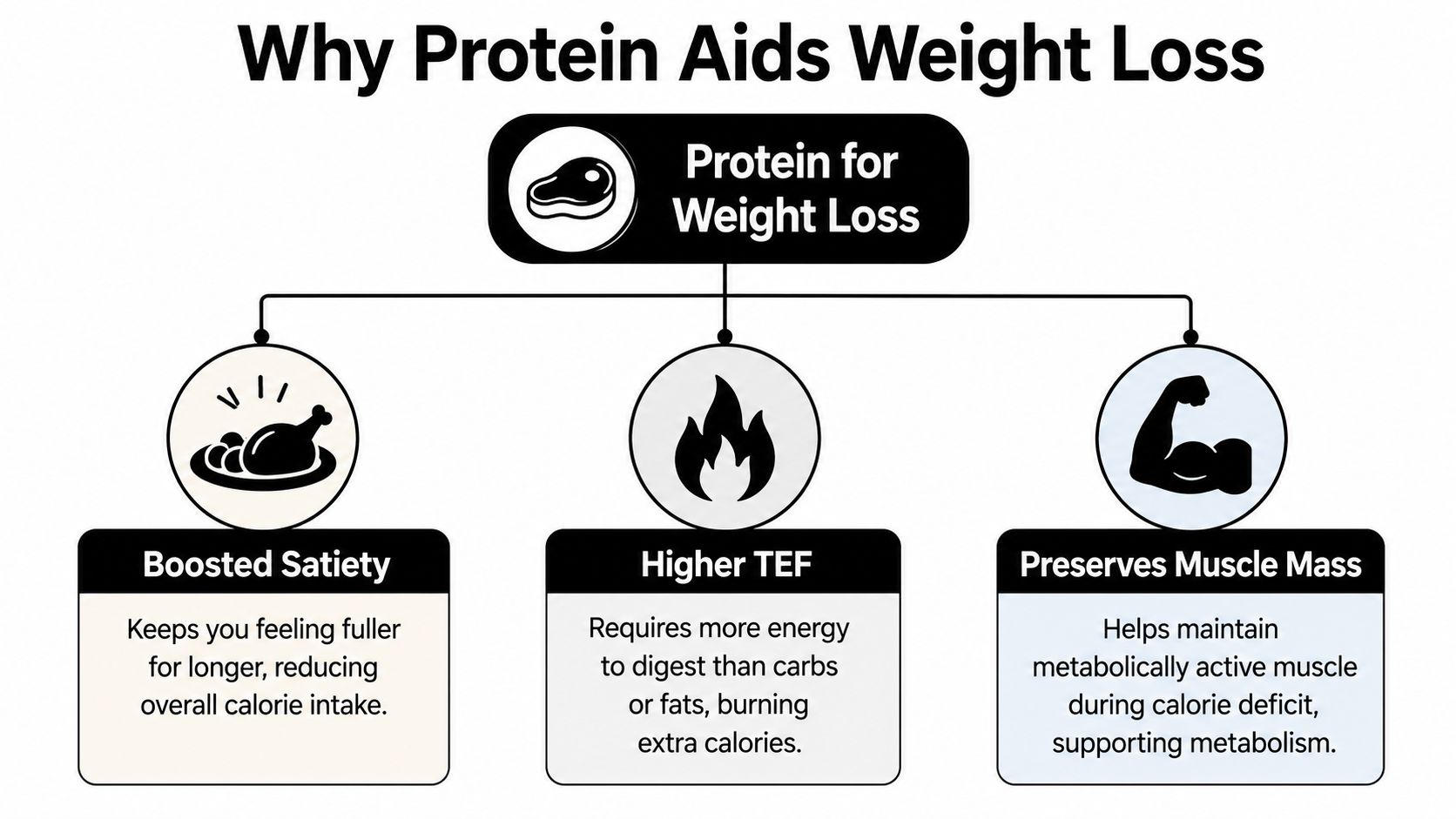
Protein helps with weight loss for three big reasons. It helps you feel full, it helps you protect muscle, and your body has to work harder to digest it than it does with carbs or fat.
Research summarized by Weight Loss Rankings on evidence-based protein intake for fat loss states that an effective daily target for weight loss is about 1.2 to 1.6 g/kg, rising to 1.8 to 2.0 g/kg for people in a steep calorie deficit, older adults, or resistance-trained individuals trying to preserve muscle. The same source recommends spreading that intake across 3 to 4 meals per day, with 25 to 40 grams per main meal, and notes that weight loss strategies often lean toward 30% of total daily calories from protein, which would equal about 600 calories or 150 grams on a 2,000-calorie diet.
Protein helps control hunger
Protein is the macro one often notices in real life. A protein-light breakfast can leave you scavenging by midmorning. A balanced breakfast with enough protein usually buys you more calm.
Part of that is mechanical. Protein-rich meals tend to feel more substantial. Part of it is biological. The same evidence summary notes that reaching the 25 to 40 gram meal threshold sends stronger fullness signals through hormones like GLP-1 and PYY.
That matters whether or not you're taking a GLP-1 medication. Your body already uses those signals to help regulate appetite. Meals with enough protein make those signals more useful.
Protein helps you keep muscle while losing fat
When you diet, your body doesn't automatically choose to lose only fat. If protein intake is too low, your body can also give up lean tissue. That's a problem because muscle is valuable during weight loss.
I like to call muscle your metabolic armor. It protects the quality of your weight loss. If the scale goes down but you lose too much muscle along the way, you often end up feeling weaker, flatter, and hungrier.
Protecting muscle during weight loss isn't just about appearance. It helps preserve the engine you're trying to keep.
That per-meal protein target matters because it helps trigger muscle protein synthesis, which is the body's process of repairing and building muscle tissue. You don't need to obsess over the term. Just think of it as sending your body a clear message: keep the useful stuff.
Protein has a higher digestion cost
Your body also spends more energy processing protein than it does digesting fat or carbs. That's called the thermic effect of food, or TEF.
You don't need to count that separately. The takeaway is simpler than the physiology. Protein does more work for you than most foods in the same calorie range. It helps you feel fuller and costs more energy to process.
Here are the three benefits in plain language:
- Better fullness: Meals built around protein are more likely to keep you satisfied.
- Better body composition: Protein supports muscle retention while you're in a deficit.
- Better calorie efficiency: Your body uses more energy digesting protein.
That combination is why protein isn't just helpful for weight loss. For many people, it's the macro that makes weight loss sustainable.
How to Calculate Your Personal Protein Targets
Generic advice gets people stuck. "Eat more protein" sounds useful until you're standing in the kitchen asking, "How much is more?"
A better approach is to calculate a daily range based on body weight, then convert that into a per-meal goal that fits how you eat.
Start with your daily range
The evidence-based weight loss target is 1.2 to 1.6 grams per kilogram of body weight. If you know your weight in kilograms, multiply by that range. If you know your weight in pounds, convert to kilograms first.
A worked example from Healthline's guide on protein and weight loss shows that a person weighing 180 lbs (82 kg) lands at about 87 to 131 grams per day, which comes out to roughly 29 to 44 grams per meal if eating three times daily. The same source notes that this lines up with aiming for 20% to 30% of calories from protein for weight loss.
If you want a deeper walkthrough on the math itself, use this guide on how to calculate daily protein needs.
Then divide by how many times you eat
Now, the advice becomes practical.
If you usually eat 4 times a day, your per-meal target can sit a bit lower because you have more chances to reach your total. If you usually eat 3 times a day, each meal needs to carry more of the load.
That explains why the broad target of 25 to 40 grams per meal works so well. It matches the math for a lot of adults trying to lose weight.
Sample per-meal protein targets for weight loss
| Body Weight | Daily Protein Goal (g) | Per-Meal Target (4 meals) | Per-Meal Target (3 meals) |
|---|---|---|---|
| 150 lbs | Qualitatively, this person would usually fall within the general weight-loss range when using 1.2 to 1.6 g/kg | Usually fits within the general 25 to 40 g framework | Often lands toward the middle to upper end of the general 25 to 40 g framework |
| 180 lbs | 87 to 131 | About 22 to 33 | About 29 to 44 |
| 220 lbs | Qualitatively, this person will often need the higher end of the standard meal target, and may need larger meals depending on total needs | Often near the upper end of the standard range | Often at the upper end, or above it if total intake is high |
I kept the non-180-pound rows qualitative on purpose. The verified data only gives a fully worked numerical example for 180 lbs, so it's better to stay accurate than pretend precision.
A simple way to personalize it
Use this decision guide:
- If you eat 3 meals a day, aim toward the middle or upper end of the standard meal range.
- If you eat 4 times a day, the lower end may work better.
- If you're very active, older, or in a hard cut, you'll often do better with more protein overall.
- If one meal is always tiny, make the other meals more intentional instead of hoping dinner fixes everything.
Your best target is the one you can hit consistently with normal meals, not the one that looks most impressive in a tracking app.
For most readers, the process is straightforward. Set a daily range. Divide it across your usual eating pattern. Then build meals around a visible protein source so your plan works at breakfast and lunch, not just dinner.
The Art of Protein Timing and Distribution
A lot of confusion comes from people asking the wrong timing question. They ask whether they need to slam protein right after a workout, when the bigger issue is often that they barely ate any earlier in the day.
For weight loss, distribution usually matters more than chasing one perfect moment.
Even spacing beats the all-at-once pattern
Compare these two days.
Person one eats a little protein at breakfast, a little at lunch, and a lot at dinner. Person two spreads protein more evenly from the first meal onward. The second pattern usually feels better. Hunger is steadier, meals are more satisfying, and the body gets repeated opportunities to support muscle retention.
Think of muscle protein synthesis like flipping on a light switch. You don't make the room brighter by hitting the same switch ten times at night. What helps is turning it on when you need light. Protein distributed across the day gives you multiple useful "on" signals.
A post-workout shake can be helpful, especially if training falls far from your last meal. If that fits your routine, this article on choosing a post-workout protein shake can help you think through convenience versus whole-food meals.
Breakfast is often the weak link
Many people accidentally backload protein. Breakfast is carb-heavy, lunch is moderate, dinner is massive. Then they wonder why evenings feel ravenous.
A better pattern looks more balanced:
- Morning meal: enough protein to make breakfast filling
- Midday meal: another solid serving so energy doesn-t crater
- Evening meal: protein again, but not as a rescue mission for the whole day
This doesn't mean every meal must be identical. It means each one should contribute.
One giant protein dinner can't fully make up for a low-protein day.
What matters most in real life
If your goal is weight loss, use timing to make your plan easier, not more stressful.
A useful rhythm looks like this:
- Lead with consistency: Eat protein at your first meal, not just your last one.
- Match your schedule: If your afternoons are where hunger hits, make lunch stronger or add a protein-containing bridge snack.
- Use workouts as a cue, not a rulebook: Training can shape meal timing, but it shouldn't distract you from the bigger pattern of eating enough protein across the day.
The best timing strategy is the one that reduces hunger, supports training, and fits your actual life on weekdays.
Adjusting Protein for Your Unique Needs
The standard protein advice is helpful, but it isn't complete. Some groups need a more specific approach. That's especially true for plant-based eaters, people using GLP-1 medications, and older adults trying to protect strength while losing weight.

Plant-based eaters may need a different lens
A lot of protein advice online assumes the meal is built around fast-digesting animal protein. That can create confusion for people eating mostly plants.
The summary from VitaLibrary on protein per meal for weight loss notes that the popular idea of a rigid 30 to 40 gram protein ceiling comes largely from animal-protein research. It also states that plant-based meals, because of slower digestion and different amino acid profiles, may effectively use 40 to 50 grams per meal in some cases, especially for active people trying to hit muscle-synthesis thresholds.
That's an important nuance. It doesn't mean plant protein is inferior. It means the same number doesn't always behave the same way in every meal context.
For plant-based eaters, a useful mindset is this:
- Favor the higher end: If a standard mixed-diet meal target is enough for some people, plant-based meals may work better toward the upper end.
- Build meals intentionally: Don't assume a grain bowl is high protein just because it contains some beans.
- Think in totals and quality: Reaching the daily target still matters, but each meal may need more planning.
GLP-1 users need protein density
People taking GLP-1 medications often eat less because appetite is lower. That can help with fat loss, but it can also create a new challenge. If you get full fast, every bite has to work harder.
Protein becomes a priority because it supports fullness and helps preserve muscle while total intake drops. In practical terms, GLP-1 users usually do better when they build meals around the most protein-dense item first, then add the rest.
A light meal that is mostly crackers, fruit, or a few bites of starch may be easy to tolerate, but it doesn't do much to protect lean mass. A smaller meal anchored by protein usually gives more nutritional value for the same appetite budget.
If your appetite is reduced, don't start with the least filling foods. Start with the foods that help you keep muscle and stay satisfied.
Older adults often need more precision
As people age, preserving muscle becomes more important and sometimes more difficult. That's one reason the evidence-based guidance places older adults among those who may benefit from the higher end of protein intake.
The challenge isn't only the daily total. It's making sure meals contain enough protein to matter. A breakfast of toast and fruit may be pleasant, but it won't do much for muscle retention on its own.
For older adults, the most useful habit is often simple: make sure each main meal includes a real protein anchor instead of treating protein as a side note.
Putting It All Together A Day of High-Protein Eating
Theory helps. Meals change behavior.
A good high-protein day for weight loss doesn't need to be complicated or joyless. It needs structure. Each eating moment should have a job. Main meals keep you full and support muscle. Snacks, if you use them, should bridge gaps instead of creating more grazing.
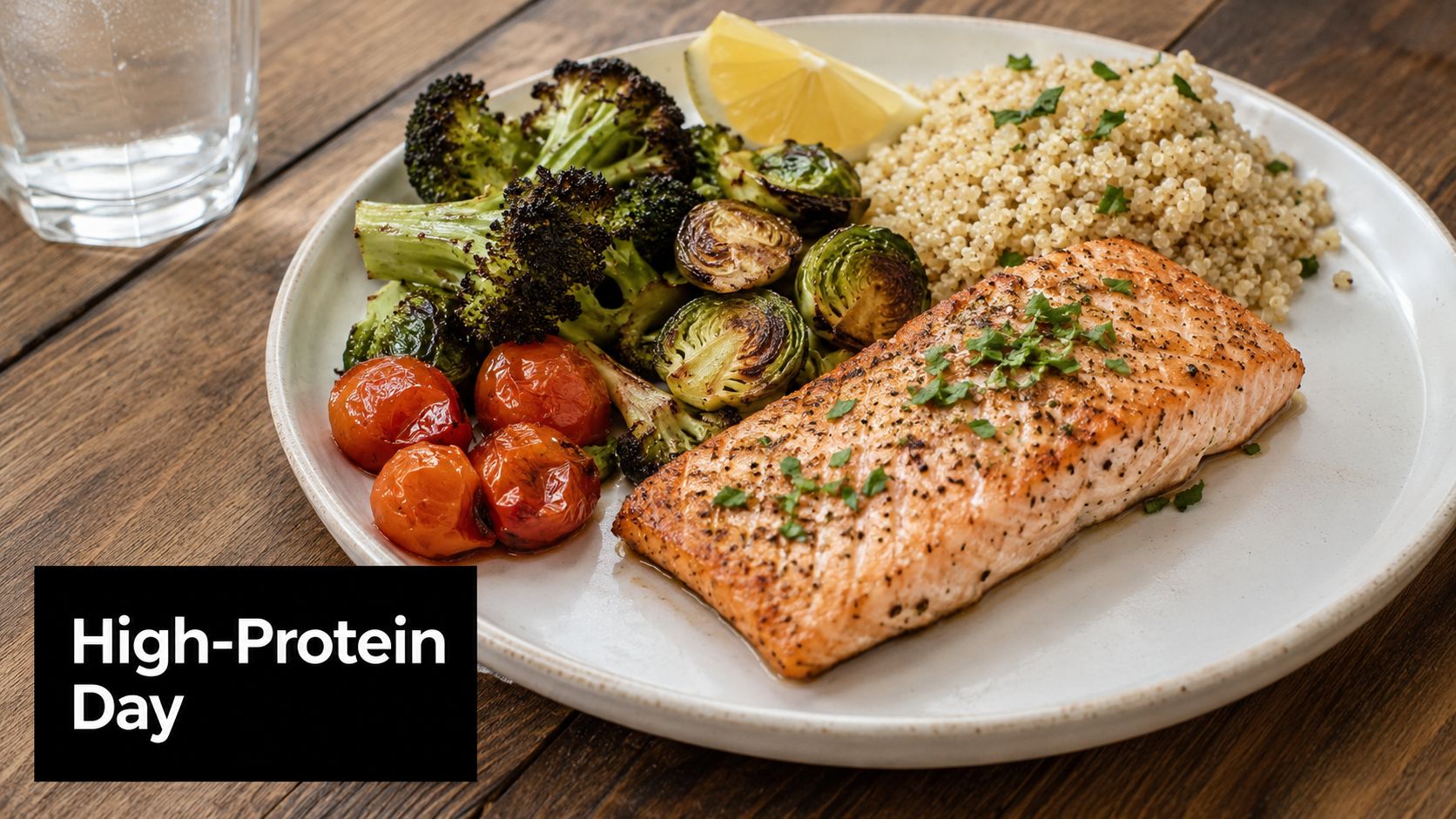
A realistic day on your plate
Breakfast could be Greek yogurt or a tofu scramble built to satisfy you. Lunch might be a chicken bowl, lentil pasta meal, or a large salad that includes a serious protein portion instead of just a sprinkle. Dinner could center on fish, tofu, tempeh, turkey, or another primary protein with vegetables and a smart carb on the side.
Notice the pattern. Each meal starts with protein, not as an afterthought but as the anchor.
A day like that usually feels different from a low-protein day in ways you can notice quickly:
- Less afternoon drift: You're not hunting for random snacks because lunch did its job.
- Better portion control at dinner: You arrive hungry, not desperate.
- More stable recovery: Training days feel easier to support.
Where snacks fit
Snacks aren't mandatory. They're useful when your schedule creates a long gap between meals or when appetite makes large meals unrealistic.
A protein snack should solve a problem. It can top up your day if your meals came in a little light. It can also act as a bridge so you don't hit dinner overly hungry and blow past comfortable portions.
For example, a 15g protein snack in the afternoon can be a practical middle ground. It's enough to support your total intake and curb the kind of hunger that turns "I'll wait for dinner" into overeating an hour later.
If planning this all out feels messy during the workweek, a guide on how to meal prep for weight loss can make the routine more automatic.
A short visual can help bring the plate-building idea to life:
Keep the goal practical
You don't need perfect macro symmetry. You need a repeatable pattern.
A strong weight-loss day usually looks like this:
- Main meals do the heavy lifting: They contain enough protein to be filling.
- Snacks stay purposeful: They support the plan instead of replacing meals.
- Your first meal counts: Don't wait until dinner to get serious.
If you're trying to figure out how much protein per meal for weight loss, that's the most useful takeaway. Build meals around a protein anchor, spread intake across the day, and adjust upward if your age, training, eating style, or medication use makes the standard range too low.
If you want an easy way to bridge meals with a savory plant-based option, Gym Snack offers chef-inspired pea protein crisps that fit neatly into a protein-first routine. They're especially handy for busy workdays, post-gym afternoons, or any stretch when you need a satisfying protein boost without turning to another sweet bar or shake.