

You finish a workout, open the fridge, and grab a shake that says kosher on the label. A second later, a question hits you. Does that mean it's dairy-free? Vegan? Cleaner? Better for recovery? Or does it just mean it follows Jewish dietary law?
A lot of gym-goers get stuck right there. Protein labels already feel crowded with claims like “clean,” “isolate,” “plant-based,” and “easy to digest.” Add kosher symbols and dairy markings, and the shopping trip gets more confusing than it should be.
That confusion matters because this isn't a tiny corner of the supplement world. The global kosher supplements market reached USD 2.58 billion in 2024 and is projected to reach USD 4.89 billion by 2033 at a CAGR of 7.4%, according to Research Intelo's kosher supplements market report. People aren't only buying kosher products for religious reasons. Many also associate certification with tighter oversight and more careful production.
If you've ever stood in the supplement aisle comparing a whey tub with an OU-D symbol to a vegan pea protein with another kosher mark, this guide is for you.
Your Guide to Navigating Kosher Protein Shakes
You finish training, reach for a protein shake, and see a kosher symbol on the label. That feels reassuring until the fine print raises new questions. Is it dairy? Is it vegan? Could shared equipment matter? Could the ingredients be kosher but still be a poor fit for your stomach or your goals?
That mix-up leads to very practical mistakes. A strength athlete may pass over a perfectly suitable kosher whey because they assume kosher and dairy-free mean the same thing. A vegan shopper may grab a certified product that is fully kosher yet still made from milk. The word on the front of the container gives only part of the answer.
The useful skill is label reading, not brand memorization.
A protein tub works a bit like a map with symbols. The big word on the front tells you the general category. The smaller marks tell you the route. If you only read "kosher," you can miss the details that decide whether the shake matches your training plan, digestion, and dietary rules.
That is why this topic creates so much confusion for gym-goers. Kosher certification can signal careful oversight, but it does not automatically mean plant-based, lactose-free, or free from quality concerns such as heavy metal contamination. A shake can be kosher and still call for closer inspection, especially if it contains cocoa, plant proteins, mineral blends, or a long flavor system.
If you also snack between workouts, this guide to kosher protein bars uses the same label-reading approach.
Practical rule: Do not judge a protein shake by the word “kosher” alone. Read the certification symbol, any dairy marking, the protein source, and the ingredient list as a set.
By the end of this guide, you should be able to pick up a shake and read it with much more confidence. You will know how to tell Kosher-Dairy from vegan, how to spot ingredient and processing clues, and why safety checks such as heavy metal screening belong in the conversation too.
What Kosher Certification Really Means for Your Protein
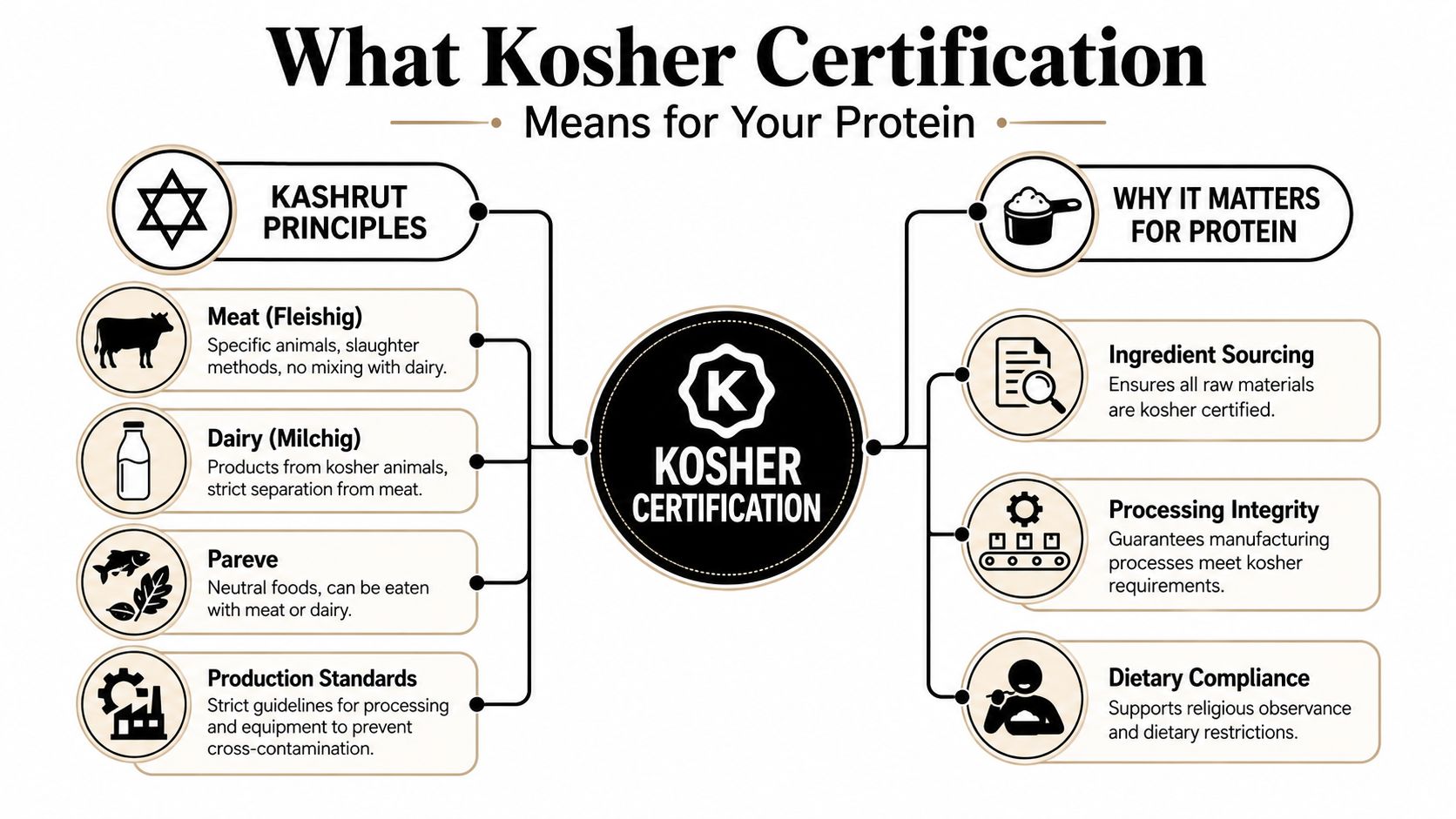
Kosher certification isn't just a religious sticker placed at the end of production. It's closer to a strict audit of ingredients, equipment, and processing steps. For protein products, that matters because powders and ready-to-drink shakes often involve multiple ingredients, flavor systems, and shared manufacturing equipment.
Here's the visual version first.
Think of kosher as process control
When people hear “kosher,” they often think only about whether an ingredient is allowed. That's only part of it. Kashrut also cares about how the food is produced, what equipment touches it, and whether anything non-kosher entered the process along the way.
For protein, that distinction is huge. A simple label like “whey isolate” sounds straightforward, but whey comes from dairy processing. Once you start tracing that back, the kosher question isn't just about milk. It includes enzymes, cultures, vats, and supervision.
Why whey is the best example
Whey protein shows how detailed kosher certification can get. According to OU Kosher's explanation of whey and its kashrus, every enzyme and culture used in production must be certified kosher, and cheese vat temperatures must be controlled to prevent non-kosher fats from entering the whey stream, with these concerns tied to Jewish law in Yoreh Deah 115:2.
That means a kosher whey protein shake isn't “milk, but approved.” It reflects supervision across several stages that most shoppers never see.
A helpful way to picture it is this:
| Production question | Why it matters for kosher protein |
|---|---|
| What are the ingredients? | Enzymes, cultures, flavorings, and additives must all be acceptable. |
| What touched the product? | Shared equipment can affect status if it was used for non-kosher material. |
| How was it processed? | Temperature and manufacturing conditions can affect whether whey remains kosher. |
What the symbol tells you
A kosher symbol tells you someone checked what most consumers can't check on their own. It doesn't mean the product is automatically healthier, lower in sugar, or better tasting. It means the product met a defined standard for ingredient sourcing and production oversight.
A kosher mark is less like a marketing slogan and more like a compliance signal.
For gym-goers, that's useful because protein products are rarely single-ingredient foods. They're systems. The symbol helps you trust the system, not just the front-of-package claims.
Decoding Kosher Symbols on Protein Labels
Once you know kosher certification is about more than ingredients, the next skill is reading the symbol correctly. Small label details can rapidly alter the interpretation.
A plain kosher mark answers one question. The letters attached to it often answer the question you care about, especially if you're trying to avoid dairy.
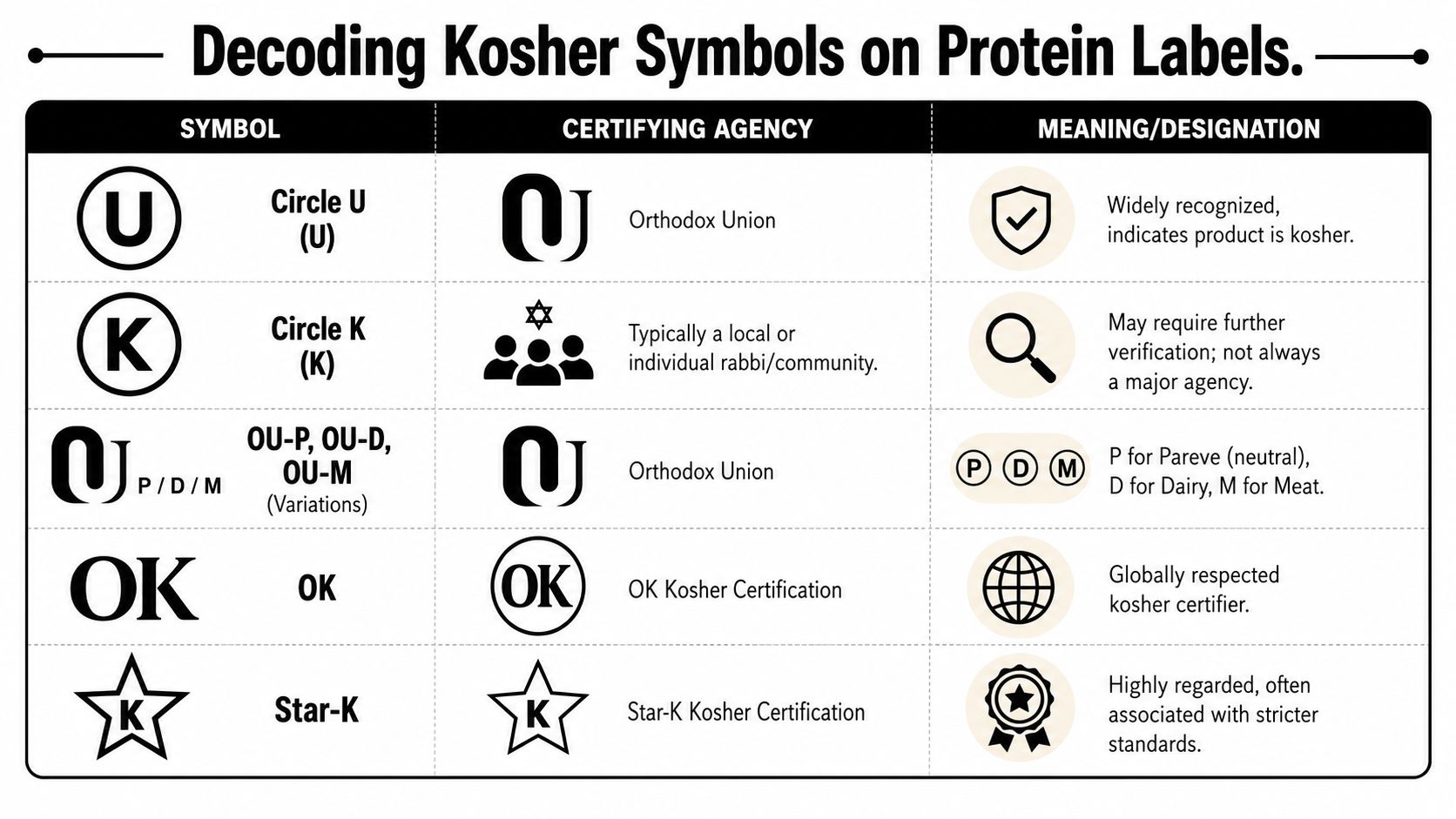
Read the symbol first, then the suffix
Most shoppers glance at the logo and stop there. Don't. The small extra letter is often the most important part.
Use this quick field guide:
-
OU or another kosher mark with no dairy note visible
This generally signals the product is kosher, but you still need to read the ingredient list and surrounding label details carefully. -
OU-D or another dairy designation
This means the product is kosher-dairy. For protein shakes, that usually lines up with whey, milk protein, or dairy-containing flavor systems. -
Pareve designation
This indicates a neutral status under kosher law. For many gym-goers, this is the marking that often aligns better with dairy-free goals, but you should still verify the ingredient list. -
Meat designation
You're unlikely to see this on standard protein shakes, but it exists in kosher labeling and is worth recognizing.
Which marks do you commonly see
You'll often find symbols from agencies such as OU, Star-K, and OK on packaged foods and supplements. Some symbols are broadly recognized across North America. Others may come from local certifiers and can require more familiarity.
That's one reason broad nutrition literacy matters. If you want a stronger general system for evaluating packaging claims beyond kosher status, this guide on how to read nutrition labels is a useful companion.
A fast label scan that works in stores
When you pick up a tub or bottle, follow this order:
- Find the kosher symbol near the ingredient panel or lower edge of the package.
- Check for a letter such as D.
- Look at the protein source. Whey, milk protein, pea protein, and rice protein tell different stories.
- Confirm with ingredients so the symbol and formula agree.
Store test: If you only have five seconds, don't read the front. Flip to the side panel and inspect the kosher mark and ingredients together.
That habit saves you from the classic mistake of assuming kosher means vegan or dairy-free.
Ingredient Red Flags in Non-Certified Shakes
When a protein powder has no kosher certification, the ingredient list becomes more important, not less. You can still learn a lot from the label, but there are limits. Some ingredients have obvious names. Others hide behind broad terms that don't tell you enough about sourcing.
This matters most with flavored powders, meal-replacement shakes, and “dessert” formulas that contain stabilizers, colors, and texture enhancers.
Ingredients that deserve a closer look
Some ingredients can be kosher. Some can also come from non-kosher sources. Without certification, the label may not tell you which applies.
-
Gelatin
In many food products, gelatin can come from animal sources that may not meet kosher standards. If a shake, pudding-style protein product, or chewable supplement includes it, that's a major question mark. -
Carmine or cochineal extract
This red coloring comes from insects. That creates an immediate kosher concern for many shoppers. -
Mono- and diglycerides
These can be plant-derived or animal-derived. The problem isn't the name itself. The problem is that the package often doesn't clarify the origin. -
Natural flavors
This category can cover many things. Sometimes that's harmless. Sometimes it makes it hard to know whether dairy, animal derivatives, or non-kosher processing aids were involved. -
Enzymes and cultures
These are especially relevant in dairy-based protein products. As covered earlier with whey, their sourcing can be central to kosher status.
Why uncertified labels create uncertainty
A non-certified shake might still be acceptable for some consumers, but it asks you to make assumptions. That's not ideal when your goal is confidence.
Here's the practical difference:
| Label situation | What you can know |
|---|---|
| Certified kosher product | A certifier reviewed ingredients and production standards. |
| Non-certified product with simple ingredients | You can make an educated guess, but not verify hidden sourcing details. |
| Non-certified product with flavors, colors, and additives | Uncertainty rises fast. |
A smarter way to inspect the tub
When there's no symbol, use a “risk ladder” mindset.
Start with the base protein. A plain single-source protein with minimal additives is easier to evaluate than a cookies-and-cream formula with a long ingredient deck. Then scan for the watch-list items above. If the label includes several vague additives, your confidence should drop.
The more engineered the flavor system, the harder it is to infer kosher status without certification.
That's why certification offers peace of mind. It covers the parts of the supply chain that the ingredient panel can't fully explain.
Kosher and Vegan Are Not the Same Thing
This is the mistake I see most often. Someone spots a kosher symbol and assumes the product is safe for a vegan diet or at least dairy-free. That's not how kosher law works.
A food can be completely kosher and still contain milk. In fact, many protein shakes do.
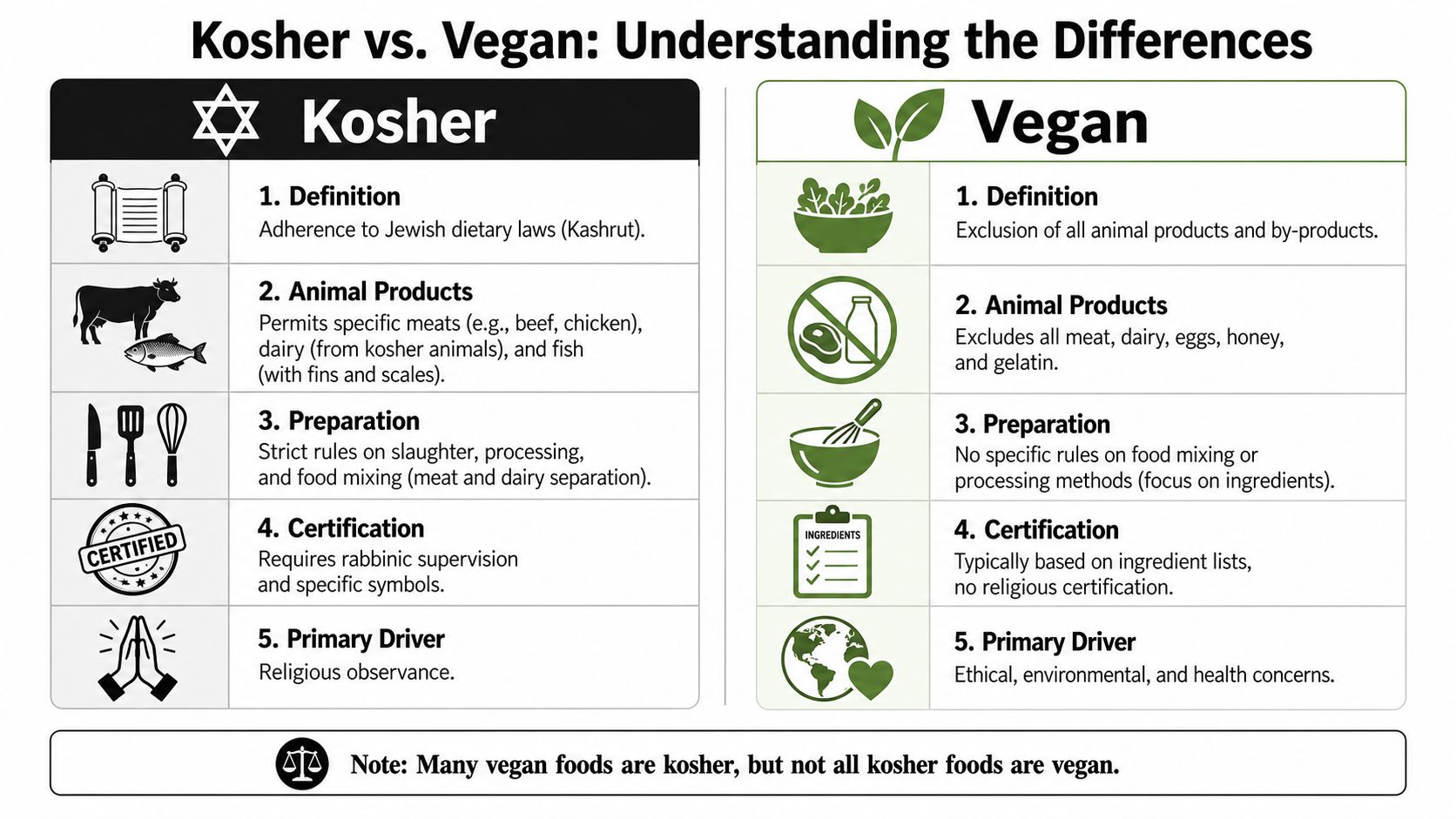
Why the terms overlap but don't match
Kosher is about compliance with Jewish dietary law. Vegan excludes animal products and by-products. Those are different systems with different goals.
A vegan protein powder may often fit comfortably into kosher rules if it uses acceptable ingredients and processing. But the reverse doesn't hold. A kosher product may contain dairy, eggs, fish, or meat and still be fully kosher.
According to Premier Nutrition's FAQ page hosted on ObesityHelp, many popular kosher shakes such as Premier Protein are certified OU-D and contain milk proteins, which means they are not suitable for vegans or for people who need a dairy-free option.
The label mistake people make
A gym-goer sees a kosher symbol and thinks, “Great, this should be clean and non-dairy.” Then they get home and realize the product is whey-based.
That's why the dairy designation matters so much. If your priority is avoiding milk, you need to look for a kosher product that is clearly compatible with that goal, often through a plant-based formula and a label that doesn't carry a dairy designation.
If you're weighing plant-based against dairy protein from a training perspective, this comparison of plant-based protein powder vs whey gives a broader performance-focused view.
Keep these examples straight
-
Kosher whey shake with OU-D
Kosher? Yes.
Vegan? No.
Dairy-free? No. -
Kosher pea protein shake
Often a better fit for vegan and dairy-free needs, assuming the full ingredient list and certification support that. -
Vegan shake without kosher certification
Vegan? Possibly yes.
Kosher? Not automatically.
Bottom line: “Kosher” answers a religious compliance question. “Vegan” answers an animal-ingredient question. You need both answers if both matter to you.
Once you separate those terms in your mind, protein shopping gets much easier.
How to Choose the Best Kosher Protein Shake
You are standing in front of the protein shelf after a workout. Two bottles both look promising. Both say “high protein.” One has a kosher symbol. The other says plant-based. The right choice depends on what you need the shake to do, and whether the label supports that goal.
Start with your body and your routine. Then use the label like a checklist.
If you recover well with dairy and want a familiar post-workout option, a kosher whey isolate may fit. If dairy gives you trouble, or you want a shake that also fits vegan eating, a kosher-certified plant protein usually makes more sense. The key is to match the protein type, the kosher designation, and the ingredient list. A shake only works if all three line up.
Match the protein source to the job
Protein works like building material. Different forms can still build muscle, but they arrive in different packages.
Whey is milk-based, so it suits people who tolerate dairy and want a simple recovery shake. Plant proteins, such as pea protein, are often easier for people avoiding dairy and can offer a shorter allergen list. That does not make one universally better. It means each solves a different problem.
Shoppers often misunderstand the roles of these labels. A kosher symbol answers one question. The protein source answers another. If you need a dairy-free shake, scan the front of the package, then confirm it on the side panel. “Kosher” by itself does not tell you that.
Add a safety screen
Macros matter, but ingredient quality matters too.
According to the verified data, Consumer Reports found heavy metals in many protein powders, and concern about contamination has pushed more shoppers to look beyond grams of protein alone. That is a smart habit. Protein powder is a concentrated product, so small problems in sourcing or processing can become bigger ones in the final scoop.
Look for brands that clearly discuss testing, sourcing, and quality control. If a label gives you protein grams but says nothing about testing, you still have an unanswered question.
Use this label-reading checklist
Use this order every time you shop:
-
Find a kosher certification symbol
No symbol means you are relying on the brand's wording instead of third-party certification. -
Check the dairy status
If the symbol includes a dairy designation, the product is not dairy-free, even if the front label sounds “clean” or “light.” -
Identify the actual protein source
Whey, casein, pea, soy, and blends all behave a little differently in digestion and in your overall diet. -
Read the full ingredient list
Watch for milk derivatives, gelatin, and flavor systems that make a non-certified product harder to judge. -
Look for testing or transparency language
Brands that explain how they test for contaminants make it easier to assess quality.
A good protein shake is less like a flashy ad and more like a clear map. The front label gets your attention. The side panel tells you where you are really going.
Choose the shake that fits your training goal, your digestion, your kosher requirements, and your comfort with the ingredient list. That is usually the best option.
Simple DIY Kosher Protein Shakes
You get home from training, toss fruit into the blender, add protein powder, and hit start. It feels simple until one question shows up. Did every part of that shake match your kosher standards?
Homemade shakes help because you can check each piece one by one. The powder matters, but so do the milk, nut butter, cocoa, and any add-ins. A DIY shake works like building with labeled ingredients instead of trusting a finished product with a long ingredient panel. That makes it easier to keep the recipe aligned with both your nutrition goals and your kosher requirements.
It also helps with safety and tolerance. A short recipe is easier to read, easier to digest, and easier to troubleshoot if something upsets your stomach or raises questions about sourcing. If you are also watching for contaminants such as heavy metals, starting with a protein powder from a brand that explains its testing practices gives you more control than relying on a mystery blend.
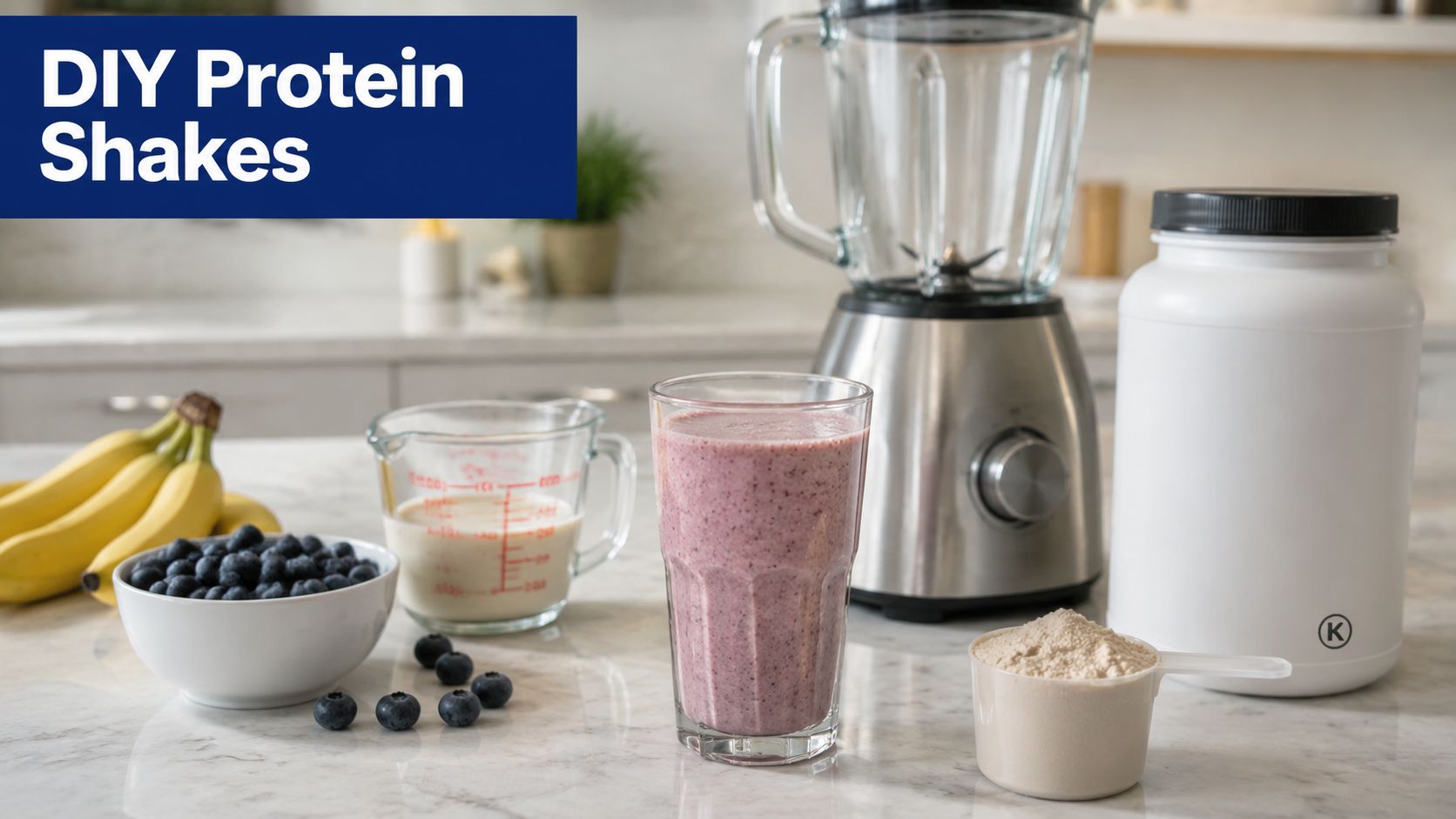
Creamy whey recovery shake
Choose a kosher-certified whey isolate if dairy fits your diet and digestion.
- Base: cold milk or a kosher-certified dairy beverage
- Protein: one scoop kosher-certified whey isolate
- Carb source: banana
- Flavor: cinnamon, plus a little cocoa powder if desired
- Blend: until smooth
This is a practical post-workout option because it keeps the formula easy to read. If the powder is marked kosher dairy, the whole shake stays in that lane once you add milk. That sounds obvious, but it is exactly the kind of detail that gets missed when people focus only on the front of the tub.
Dairy-free berry pea shake
Choose a kosher-certified pea protein if you want a plant-based option. Pea protein has become a more common choice in protein drinks, which helps explain why more athletes now compare kosher-dairy powders with kosher-certified vegan ones.
Try this combination:
- Liquid: unsweetened almond milk or another kosher-certified dairy-free milk
- Protein: one scoop kosher-certified pea protein
- Fruit: frozen blueberries
- Creaminess: half a banana
- Optional add-in: a spoonful of nut butter if it fits your diet
This recipe helps if you want to avoid the confusion that happens when people treat kosher and vegan as if they mean the same thing. A pea protein can be both, but only if the certification and the rest of the ingredient list support that.
DIY rules that prevent label headaches
- Start with certified basics. If the powder is kosher-certified but the add-ins are vague or unlabeled, the final shake is harder to judge.
- Keep the ingredient list short. Fewer moving parts means fewer hidden flavor systems, milk derivatives, or stabilizers to sort through.
- Match the protein to your actual needs. Whey may suit recovery well for someone who uses dairy. Pea protein may fit better for dairy-free, vegan, or allergen-conscious eating.
- Check quality signals before you buy. Look for brands that explain sourcing and contaminant testing, especially for powders used every day.
A homemade shake will not answer every nutrition question. It does make the important questions easier to see.
If you want a savory, protein-first option between meals or around training, Gym Snack makes chef-inspired plant-based protein snacks built around clean pea protein, with bold cheesy flavors and a label designed for people who care about both nutrition and ingredients.