

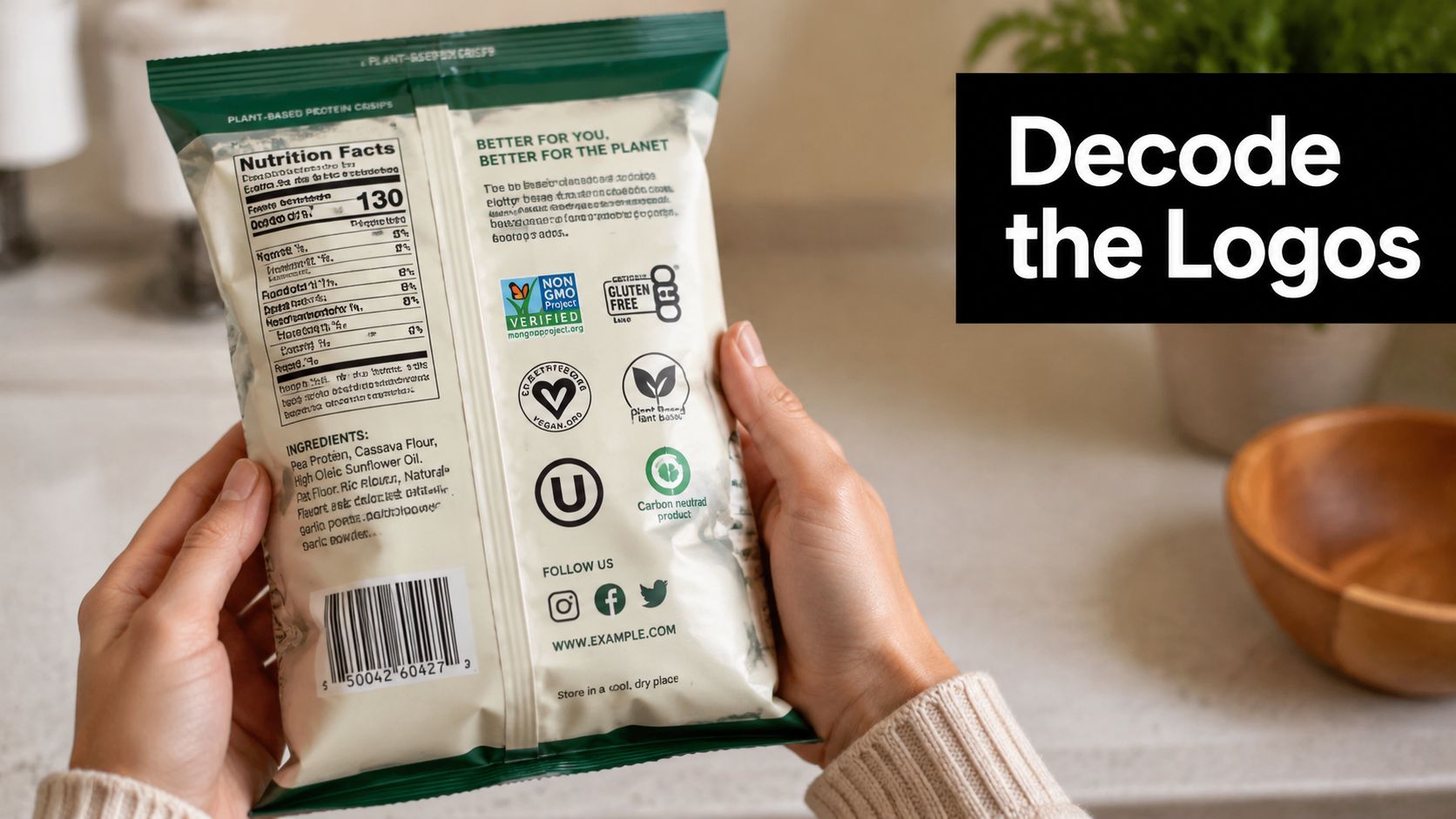
You've just bought a bag of plant-based protein crisps after training. The front promises a high-protein snack, while the back displays logos for GMP, HACCP, ISO, or SQF. You may recognize the words, but it's less obvious what each certification says about the way that snack was made.
That question matters for both shoppers and founders. A snack can have an appealing nutrition panel and still depend on weak controls for allergens, ingredients, moisture, packaging, or traceability. Manufacturing standards turn those risks into documented procedures that people can follow, test, audit, and improve.
Why Manufacturing Standards Matter for Every Snack You Eat
A certification logo is meant to represent more than a polished package. It should point to a working system behind the bag, including controlled purchasing, hygienic facility practices, trained employees, documented production steps, testing, and procedures for handling problems.
For a plant-based protein crisp, those controls begin before the ingredients reach the mixer. A manufacturer needs to know what arrived, whether the material matches its specification, how it was stored, and whether it could have contacted an allergen or other contaminant. The business also needs a reliable way to connect finished products to production records if an investigation becomes necessary.
What happens without a controlled system
Without clear standards, different shifts may weigh ingredients differently, clean equipment in inconsistent ways, or release products without the same checks. Those failures can affect safety, texture, shelf stability, and the accuracy of the information consumers rely on.
A recall is the obvious concern, but quality problems can appear much earlier. One batch may be crisp and dry, while another is softer because moisture control wasn't consistent. A label may promise a particular formulation, yet the records don't adequately demonstrate that the correct ingredients were used.
Practical rule: A standard should make the right action repeatable, not merely make the facility look compliant during an audit.
Consumers who want simpler ingredient choices can also use a brand's manufacturing transparency as one part of their evaluation. Gym Snack's clean-label snack guidance is relevant because a clean ingredient list only has value when the manufacturer can control the ingredients and process behind it.
Manufacturing standards therefore serve two audiences. They help companies build dependable operations, and they give buyers a basis for asking whether safety and quality claims are supported by a real system rather than a marketing phrase.
What Manufacturing Standards Actually Are
Manufacturing standards are documented systems and procedures that govern how products are made, tested, released, and corrected. They can address facility hygiene, equipment, employees, suppliers, production controls, records, complaints, traceability, and continual improvement.
A useful way to understand them is to separate three questions:
- What could go wrong? This is the hazard and risk question.
- How will the facility prevent or detect it? This is the control question.
- How will the company prove that the control worked? This is the evidence question.
A standard doesn't replace judgment. It gives the company a disciplined structure for applying judgment consistently.
From final inspection to process control
The modern quality-management system was strongly influenced by Britain's BS 5750. The UK's Ministry of Defence helped drive an approach focused on managing manufacturing processes, rather than relying only on inspection of finished goods. That distinction is important for food production: testing a finished snack may find a problem, but it can't restore consumer confidence or undo a preventable contamination event.
In 1987, the International Organization for Standardization adopted BS 5750 as an international standard and named it ISO 9001, creating a globally recognized quality-management framework. In 2000, ISO 9001 was consolidated into a single standard, replacing ISO 9000, 9001, 9002, 9003, and 9004. The consolidation simplified supplier qualification and process control. (BSI's history of ISO 9001)
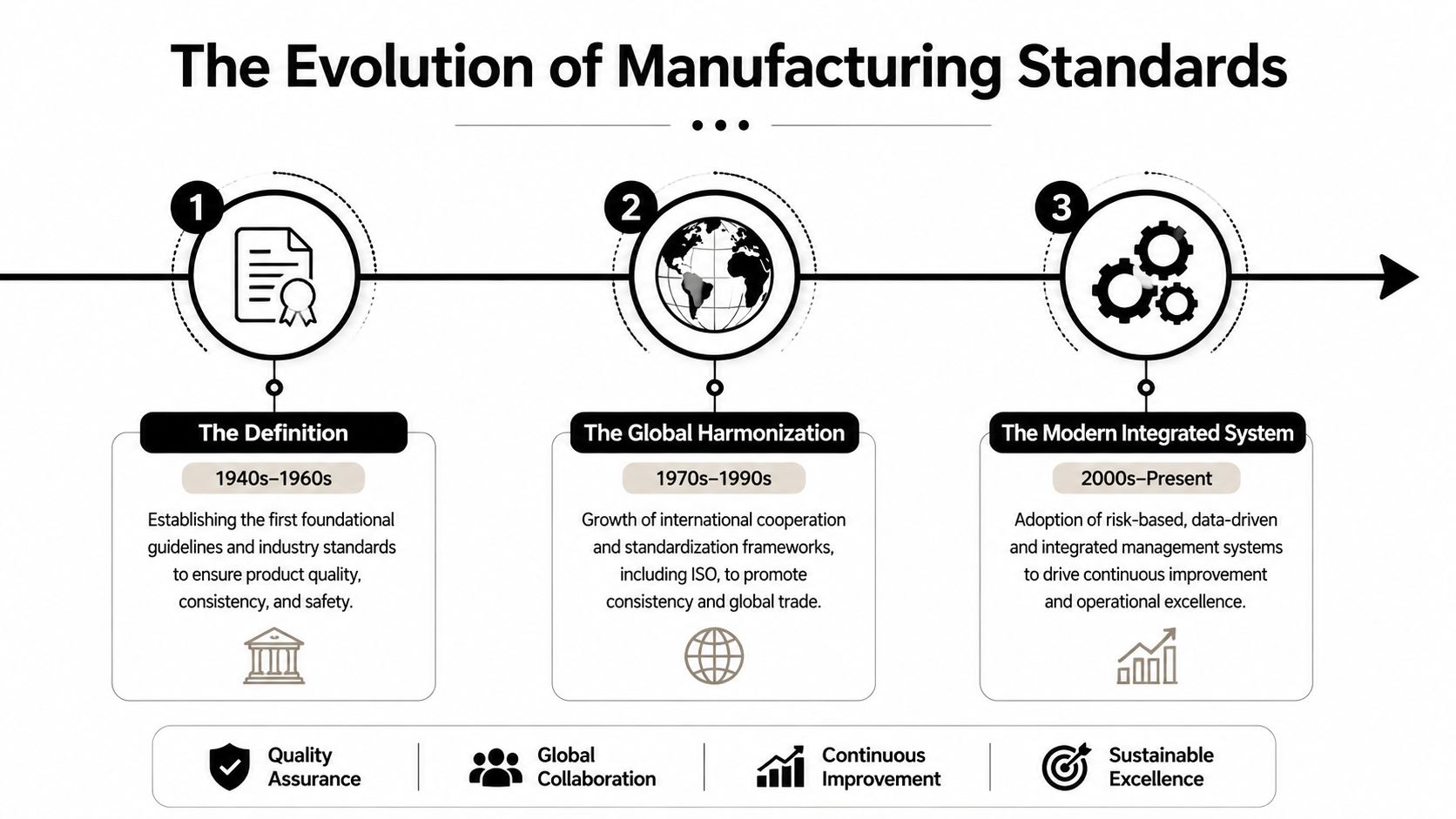
The result was a lasting philosophical shift. Quality became something a company builds into purchasing, production, documentation, and corrective action, not something it checks only at the end of the line.
Why the history helps a startup
A growing snack brand might view procedures as administrative work that slows production. The historical lesson points in the opposite direction. A process-based system helps a team answer practical questions when people, suppliers, equipment, or production volumes change.
That might mean defining how pea protein is received, setting criteria for packaging release, recording sanitation verification, or investigating why a batch failed a texture check. For technical context outside food production, Forge Reliability's ISO 20816, 10816, and 7919 guide shows how standards can organize equipment condition and measurement practices.
The ISO 9000 series later underwent major revisions in 1994, 2000, 2008, and 2015, reflecting the movement from national quality controls toward process-based, risk-aware global systems. (ISO 9000 history and revisions)
The Major Food and Manufacturing Standards Compared
The terms on a package often overlap, but they don't all do the same job. GMP establishes foundational conditions, HACCP analyzes hazards and controls them, ISO 9001 manages quality across the organization, and food-safety schemes combine several elements into an audit-ready certification structure.
The main frameworks
Good Manufacturing Practices, or GMP, cover the baseline conditions needed for controlled food production. They typically address hygiene, facility maintenance, equipment, employee practices, storage, sanitation, and production procedures. GMP is the floor, not a complete answer to every food-safety question.
HACCP, or Hazard Analysis Critical Control Points, is a preventive method. The team identifies biological, chemical, and physical hazards, determines where control is essential, sets monitoring procedures, and defines what happens when a limit or requirement isn't met. A dry snack producer might examine raw-material contamination, allergen contact, foreign material, and packaging failure.
ISO 9001 focuses on the broader quality-management system. It can cover customer requirements, supplier controls, documented processes, nonconforming products, corrective action, and improvement. It isn't specifically a food-safety standard, so a snack company may need a food-focused framework alongside it.
ISO 22000 is a certifiable food-safety management system standard that applies across the entire food chain, including food manufacturing. It integrates HACCP principles with prerequisite programs. The current edition is ISO 22000:2018 with Amendment 1:2024, making it a benchmark for an auditable food-safety system rather than a simple facility checklist. (ISO's ISO 22000 explanation)
How the standards differ
| Standard | Primary Focus | Scope | Who Requires It |
|---|---|---|---|
| GMP | Foundational hygiene and operating conditions | Facility, personnel, equipment, storage, sanitation | Regulators, customers, and internal quality programs |
| HACCP | Hazard prevention and critical controls | Product and process safety plan | Regulators, retailers, and food-service customers |
| ISO 9001 | Organization-wide quality management | Processes, suppliers, customers, records, improvement | Commercial customers and supply-chain partners |
| ISO 22000 | Certifiable food-safety management | Entire food chain, including manufacturing | Customers, retailers, and international supply chains |
| SQF, BRC, and FSSC 22000 | Comprehensive, audit-ready food safety | Food-safety systems plus scheme-specific requirements | Retailers, distributors, and major commercial buyers |
Traceability deserves separate attention because it connects purchasing records, production lots, packaging, distribution, and complaints. A practical supply chain traceability guide can help founders think beyond a lot code and map how information moves through the business.
A logo alone doesn't tell you the full scope of an audit. Ask whether the certification covers the actual facility, product category, production activity, and current certificate period.
How Standards Apply to Plant-Based Protein Snacks
Plant-based snacks create a distinctive control problem. The formula may avoid dairy, soy, or gluten, but that claim depends on more than the ingredient list. It depends on supplier approval, receiving controls, storage, line practices, cleaning, labeling, and verification.
A brand producing pea protein crisps should begin with a product-specific hazard analysis. The team examines the protein ingredient, seasonings, oils or fats, processing conditions, water activity or moisture concerns, equipment, and packaging. Dry ingredients can still carry contamination risks, and a crunchy product can lose its intended quality if moisture enters during processing or sealing.
Allergen-conscious production
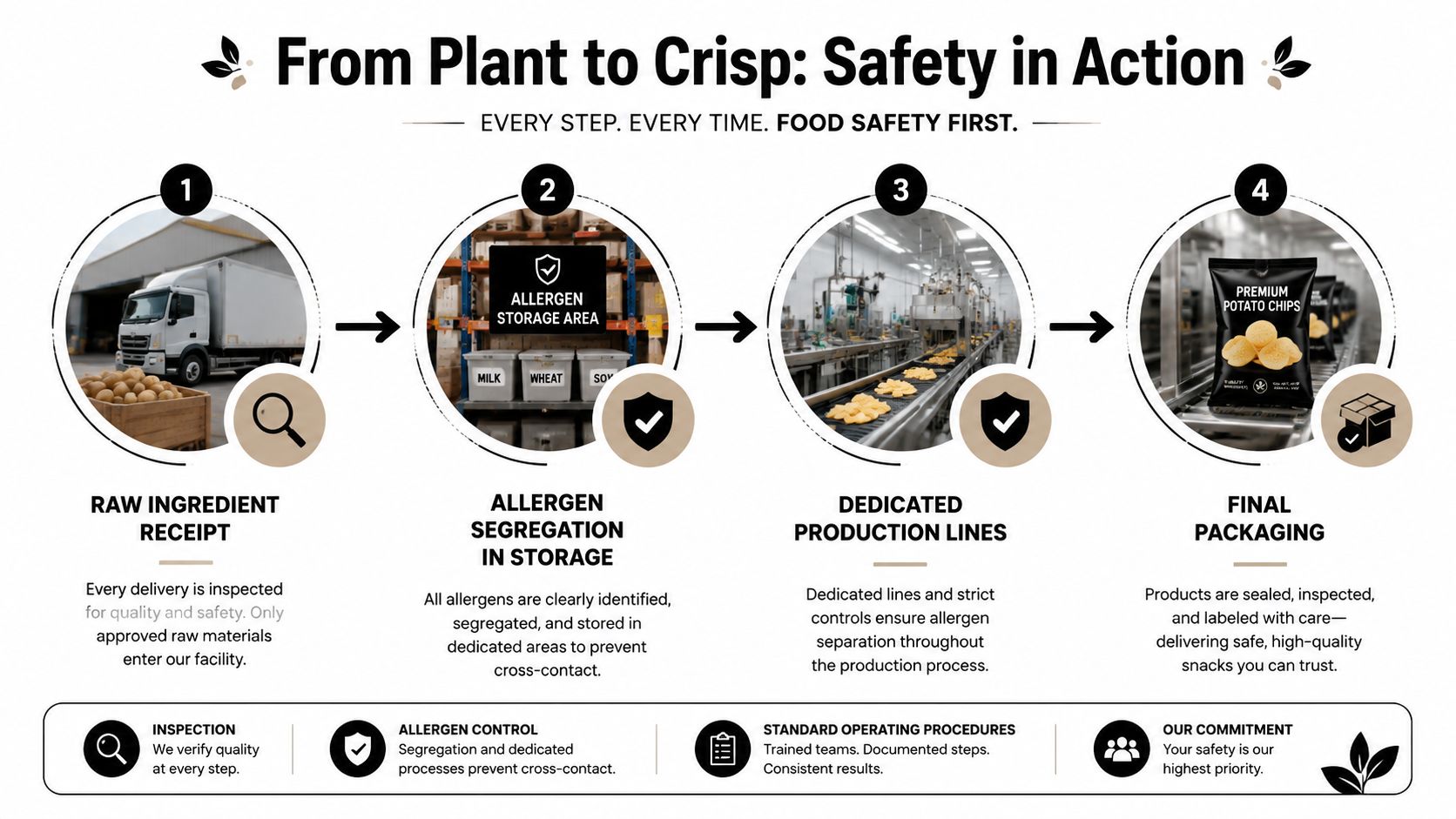
A facility may handle multiple product families, so “plant-based” doesn't automatically mean allergen-free. Dairy, soy, and gluten can enter through shared equipment, rework, seasoning systems, transport containers, or supplier materials. The manufacturer needs a written allergen policy that defines segregation, scheduling, cleaning, labeling review, and verification.
A cheddar-flavored plant-based crisp illustrates the point. The flavor may be designed without dairy, but the company still has to control flavor-component specifications, supplier declarations, storage locations, and label approval. A traditional dairy snack manufacturer would face a different sanitation and segregation profile because dairy is part of its ingredient system.
From raw material to sealed bag
A practical control sequence might include:
- Receiving: Confirm supplier approval, packaging condition, lot identity, and required documentation before ingredients enter storage.
- Storage: Separate materials according to allergen status and protect powders from moisture, damage, and mix-ups.
- Processing: Control weighing, blending, forming, cooking, seasoning, and equipment settings through approved procedures.
- Packaging: Check the correct film, label, seal, and coding so the finished product matches the approved specification.
- Release: Review records, test results, deviations, and corrective actions before authorizing distribution.
The nutrition label creates another quality responsibility. If a brand makes a protein-per-serving claim, its formulation, weighing controls, serving definition, and label review should support that claim. The same principle applies to statements about seed oils, sugar alcohols, artificial sweeteners, or ingredient sourcing.
For readers evaluating pea-based products, Gym Snack's explanation of pea protein isolate provides useful ingredient context. The manufacturing system still has to connect that ingredient choice to controlled purchasing, handling, processing, and labeling.
The Verification and Certification Process Explained
Certification starts with choosing the right scheme, not with printing a logo. A local snack company selling through a limited channel may need a different certification route from a brand supplying large retailers or international customers.
A realistic certification path
Select an accredited certification body. The body should be competent for the selected standard and the relevant food or manufacturing scope. The company should confirm what the certificate will cover before signing an agreement.
Conduct a gap analysis. An internal team or consultant compares current practices with the standard. The review should include the factory floor, records, supplier files, sanitation program, training records, traceability exercise, complaints, and corrective actions.
Build the system. The business writes or formalizes procedures for receiving, storage, production, sanitation, allergen control, maintenance, calibration, testing, product release, withdrawal, and document control. Procedures need owners and records, not just attractive binders.
Implement and audit internally. Employees must use the procedures in real work. Internal auditors then test whether records reflect what people do. A mismatch between a written cleaning procedure and observed practice is a finding waiting to happen.
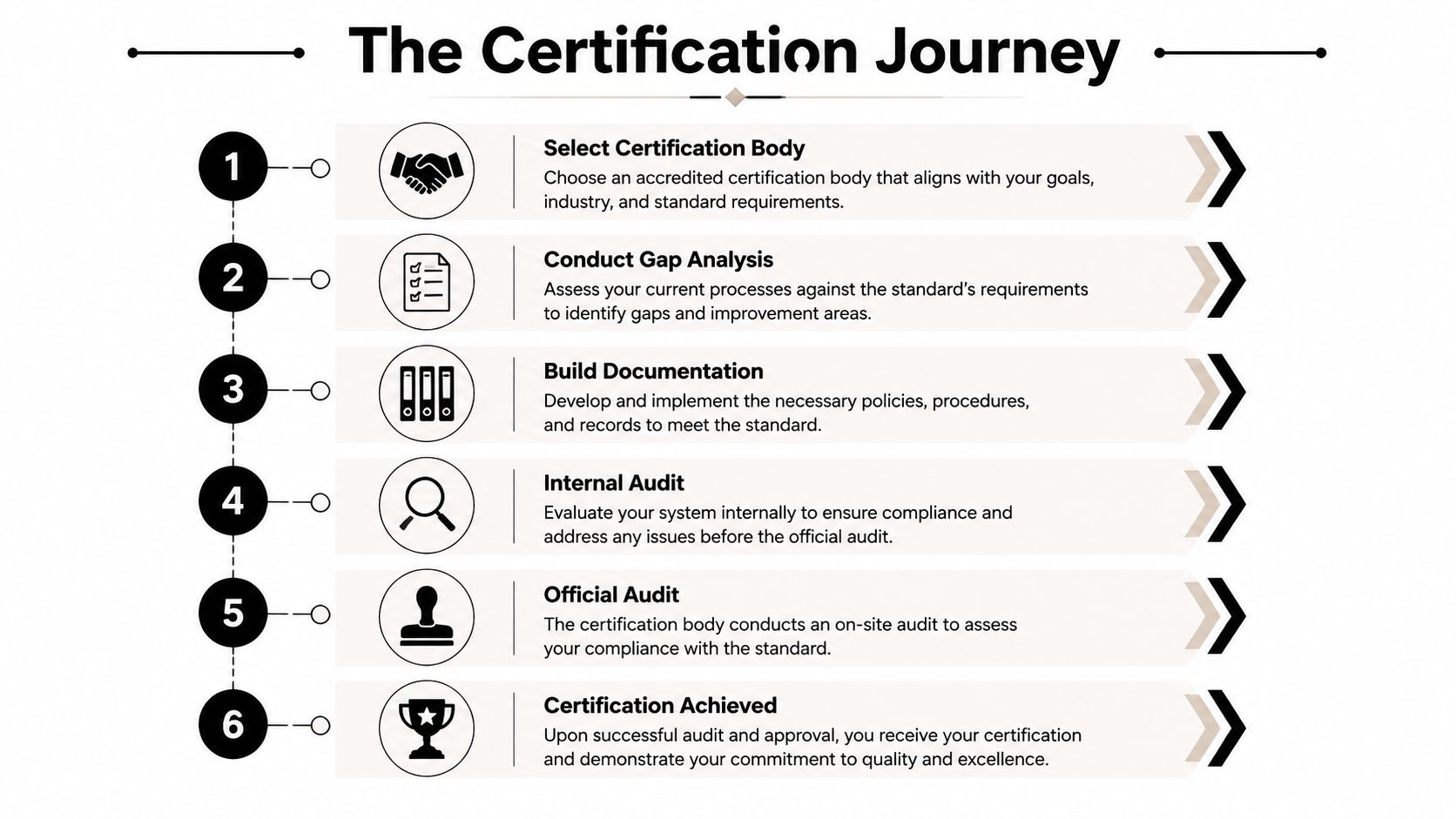
Complete the official audit. Auditors review documents, interview employees, observe production, examine records, and follow evidence through the operation. They may ask an operator to explain a check, then compare that explanation with the completed record and the approved procedure.
What happens after the certificate
An audit finding isn't automatically a failure of the entire business. It identifies a requirement or control that needs correction. The company must determine the root cause, define corrective action, assign responsibility, and provide evidence that the issue was addressed.
Certification also creates an ongoing obligation. The business must maintain records, review performance, investigate deviations, train new employees, and prepare for follow-up audits. A certificate can't compensate for a quality system that becomes inactive once the audit team leaves.
A brand considering an allergen-conscious protein product can use a non-GMO protein bar example as a reminder that formulation language and manufacturing controls need to support each other. The label claim is consumer-facing, but the evidence lives inside supplier files, batch records, specifications, and verification activities.
A Practical Checklist for Brands and Questions Consumers Should Ask
A founder doesn't need to master every clause before building a responsible facility. The first task is to create a system that connects the product specification to daily work.
A working checklist for brands
- Define the product: Record ingredients, allergens, processing steps, packaging, storage conditions, intended shelf life, and label claims.
- Approve suppliers: Set requirements for specifications, allergen information, certificates, change notification, and lot identification.
- Build prerequisite programs: Cover hygiene, sanitation, pest control, maintenance, calibration, waste, water, employee practices, and storage.
- Write usable SOPs: Keep instructions specific enough that a trained operator can follow them without guessing.
- Train and verify: Document training, observe performance, and retrain when procedures or equipment change.
- Create traceability: Connect incoming lots to production records, finished packages, customers, complaints, and withdrawal actions.
- Choose the scheme: Match the certification to the market, customer requirements, product risk, and desired recognition.
- Test the system: Run internal audits, mock traceability exercises, sanitation reviews, and corrective-action checks before an external audit.
- Protect the records: Control revisions so employees don't use obsolete procedures or forms.
Questions consumers can ask
A certification mark deserves closer attention when the brand explains its scope. Look for the name of the certification scheme, the certified site or manufacturer, and information that makes the claim verifiable.
Ask:
- Who made the product? Is the manufacturer named, or does the brand provide a clear explanation of its production partner?
- What does the certification cover? Does it address food safety, quality management, organic production, allergens, or another specific claim?
- Is the certificate third-party audited? A self-declared GMP program isn't equivalent to an accredited audit against a detailed scheme.
- How does the brand handle allergens? Vague “made in a facility” language doesn't explain segregation, cleaning, or label controls.
- Can the company explain its ingredients? Clear sourcing and formulation information should align with the nutrition and allergen statements.
- What happens when something goes wrong? A mature brand should have a process for complaints, investigations, withdrawals, and corrections.
For a protein crisp, the most useful evidence is specific. A company that can explain its manufacturing partner, allergen controls, certification scope, and claim substantiation gives consumers more to evaluate than a collection of unexplained logos.
Where Manufacturing Standards Fall Short and What Comes Next
Standards give a facility structure, but they do not create consistent quality by themselves. A company may follow a recognized framework poorly, treat audits as isolated events, or issue procedures employees cannot apply on the production floor. For plant-based protein snacks, certification must work alongside training, accurate records, honest deviation reporting, and ongoing improvement. A pea protein crisp still depends on disciplined controls for allergens, formulation, cooking, seasoning, packaging, and release.
The limits become clearer as manufacturing technology changes. The 2023 ANSI/America Makes roadmap identified 141 standardization gaps across the additive-manufacturing lifecycle, including 54 high-priority gaps. According to the report's findings, it identified 91 cases where pre-standardization research and development was still needed. (ANSI and America Makes progress report)
A published standard may still leave test methods, qualification routes, simulation benchmarks, or data packages insufficiently mature for routine cross-vendor production. New processes often require validated methods before certification can provide the confidence buyers expect.
Digital factories create a different challenge
Standards increasingly address how systems exchange information, not only physical tolerances. ISA updated ISA-95 Part 1 in April 2025 to better describe integration between logistics and manufacturing control systems. China's Ministry of Industry and Information Technology also issued 2024-edition smart-manufacturing standard-system guidelines in April 2025, aiming to develop 100 standards by 2026 across safety and workforce, equipment and supply chain, and sector-specific application layers. (ISA-95 update)
For a snack producer, the practical question is whether data remains trustworthy. Recipe versions, supplier records, production settings, packaging details, and release decisions must pass between systems without confusion, cybersecurity exposure, or dependence on one vendor's format.
Treat certification as a floor, not a ceiling. Examine what the standard covers, then assess how the facility uses it. Gym Snack makes plant-based savory protein snacks with pea protein, transparent ingredients, and macro-focused nutrition for training, busy days, and on-the-go eating. Visit Gym Snack to explore available cheddar-style flavors.