

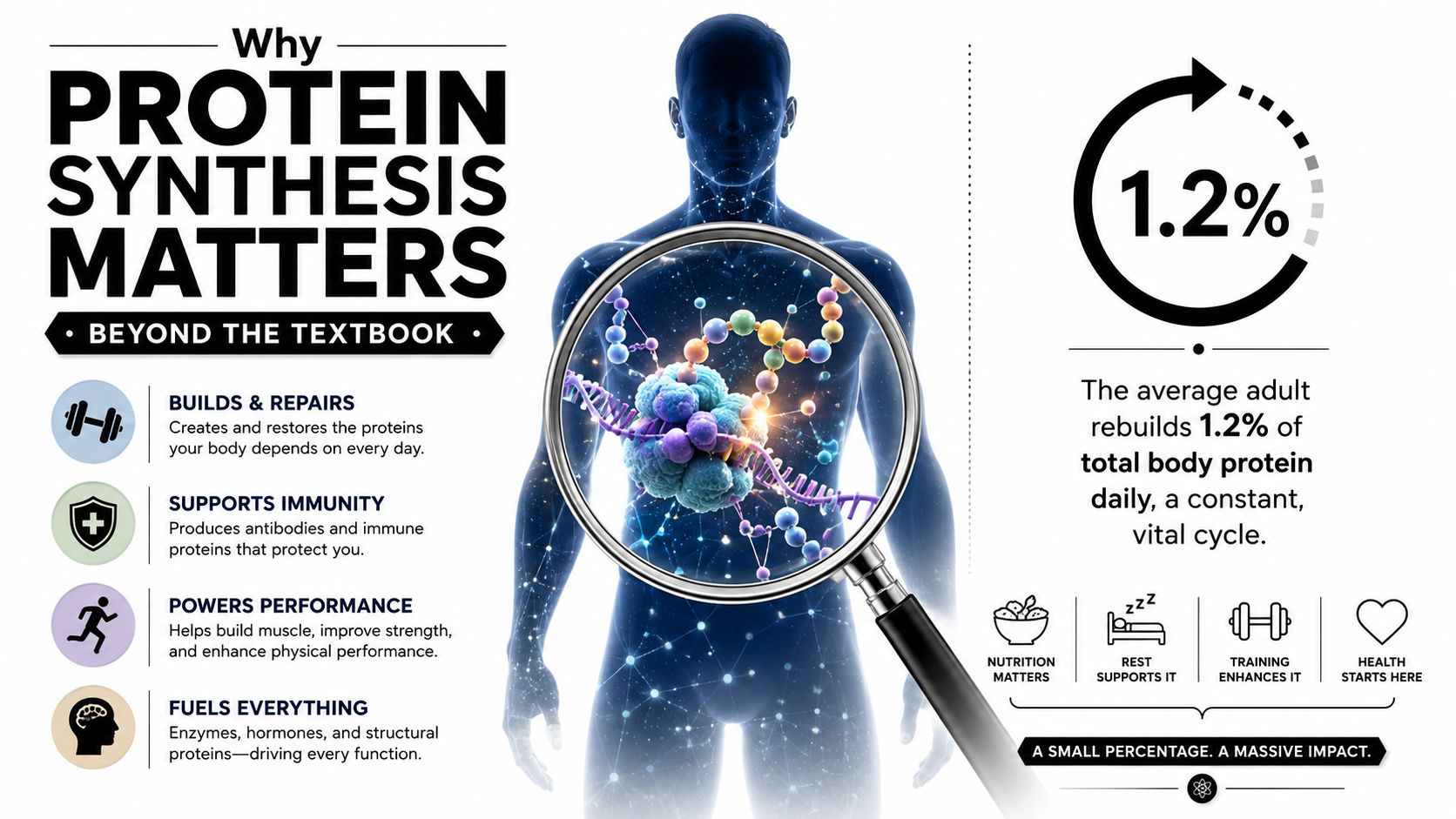
Skeletal muscle proteins turn over at about 1.2% per day in healthy, recreationally active adults, which means your body is constantly dismantling old proteins and building new ones. That single figure turns protein synthesis explained from a classroom topic into a daily practical question: how does a cell turn information into protein, and how can training and food help muscle keep more of what it builds?
The answer starts with DNA, but it doesn't end there. You need to understand messenger RNA, ribosomes, amino acids, folding, leucine, mTOR signaling, training status, and the difference between having enough total protein and triggering a strong muscle-building response.
Why Protein Synthesis Matters Beyond the Textbook
Your body continually replaces proteins. Each day, cells build structural proteins, enzymes, transport proteins, and repair materials while breaking down molecules that are worn out or no longer needed. Protein synthesis is the rebuilding side of that cycle, while protein breakdown supplies part of the recycling work.
For someone trying to build or keep muscle, this changes the question from “How much protein is in a meal?” to “What helps muscle add or preserve useful tissue?” Food provides amino acids, and resistance training gives muscle a reason to adapt. The result depends on both the raw materials and the cellular instructions that direct their use.
The recipe analogy
DNA works like a master cookbook stored in a manager's office. It contains instructions for many dishes, but the kitchen does not carry the whole book to the workbench for every order. The cell copies only the instructions it needs into a portable message.
That message is messenger RNA, or mRNA. A ribosome reads it and joins amino acids in a specified order, much like a cook follows a recipe one ingredient at a time. The first product is a chain called a polypeptide. It must then fold into the right shape and may receive chemical adjustments before it functions as a protein.
The analogy also separates two terms that students and lifters sometimes blend together:
- Transcription copies information from DNA into mRNA.
- Translation reads mRNA and links amino acids into a protein chain.
For a closer look at how biological chains are produced, see this resource on peptide synthesis explained. The practical takeaway is simple: muscle remodeling requires an instruction signal and adequate amino-acid materials. Training creates the demand for adaptation, while meals supply building blocks and help support the signals that guide rebuilding.
The Core Flow From DNA to Functional Protein
The central flow is easier to remember as a working chain:
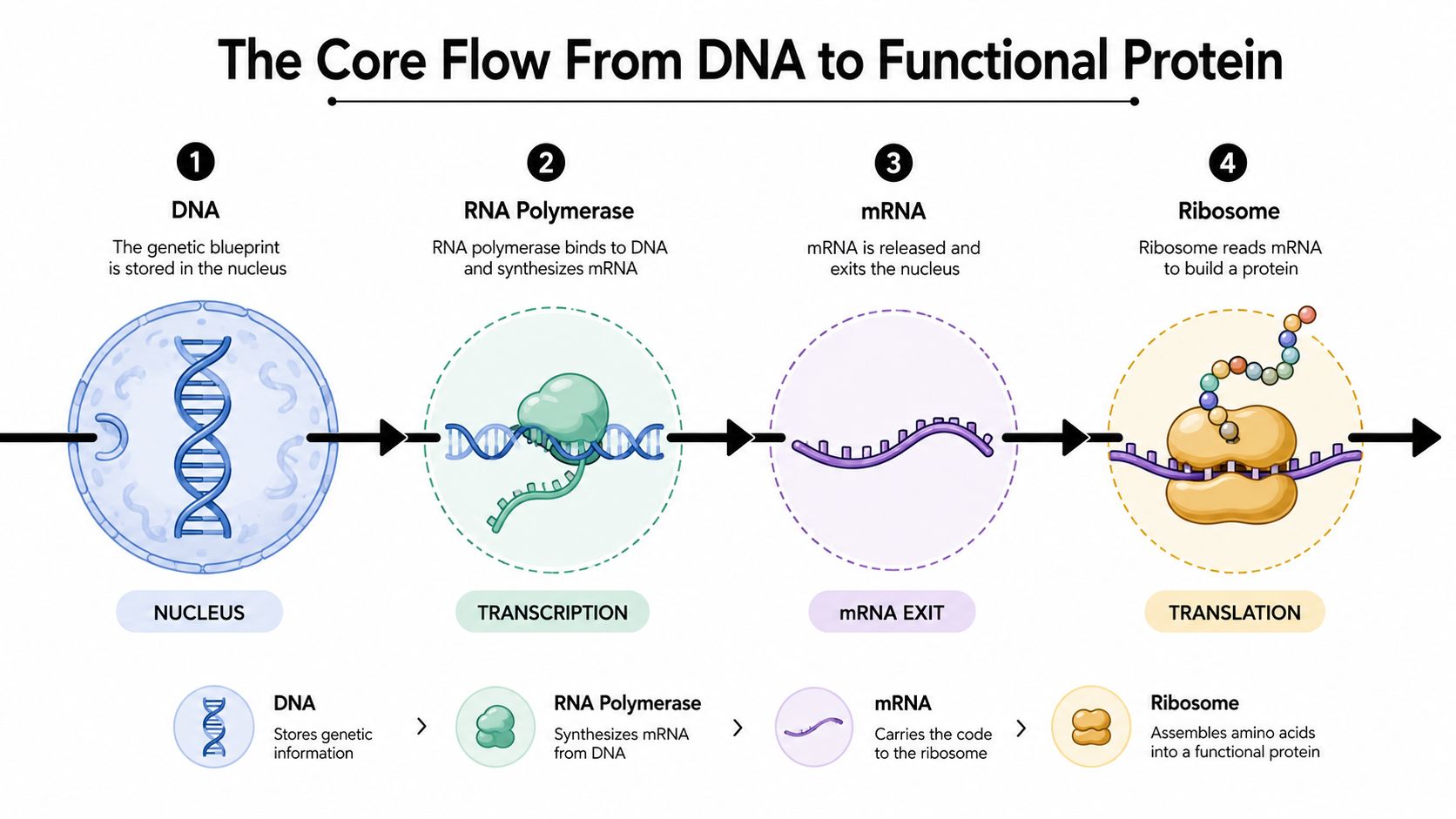
DNA → mRNA → ribosome → polypeptide → functional protein
DNA remains in the nucleus of a human cell. When the cell needs a particular protein, RNA polymerase uses one DNA strand as a template and builds a complementary RNA sequence. The initial RNA transcript is processed before mature mRNA leaves the nucleus, so the message that reaches the cytoplasm is ready for the translation machinery.
Three jobs, one result
mRNA carries the instructions. It's the photocopy of the recipe that travels from the office to the kitchen. The cell can produce many copies of a message when it needs more of a particular protein, allowing protein production to respond to changing conditions.
The ribosome performs translation. It attaches to mRNA and moves along the sequence, reading groups of three bases called codons. It doesn't read the entire mRNA as protein. The coding region between a start codon and a stop codon supplies the sequence that becomes the polypeptide, while untranslated regions at the ends help regulate the message without becoming part of the finished protein.
Transfer RNA, or tRNA, delivers amino acids. Each tRNA carries an amino acid and uses its anticodon to pair with the matching codon on mRNA. The ribosome checks the pairing and links the arriving amino acids together with peptide bonds.
The genetic code uses 64 possible codons, with 61 codons specifying amino acids and 3 serving as stop signals, as described in this NCBI overview of translation and the genetic code. Those codons specify the 20 amino acids used to build proteins, with more than one codon often representing the same amino acid.
For a lifter, the takeaway is that dietary protein doesn't travel into muscle as an intact steak or shake. Digestion releases amino acids, and cells use those amino acids according to instructions delivered through mRNA and interpreted by ribosomes.
What Happens After the Ribosome Finishes
A polypeptide leaving the ribosome isn't automatically a finished, useful protein. It's more like a sheet of paper that has just come out of a printer. The letters are present, but the sheet still needs to fold into the correct shape before it can perform its job.
Folding gives the chain a working shape
A protein's amino-acid sequence influences how the chain bends, twists, and packs into a three-dimensional structure. Some proteins fold while they're still being translated, so the ribosome and the emerging chain are already involved in shaping the final product before synthesis ends.
Other proteins need assistance from molecular chaperones. Hsp70, for example, can help protect newly forming chains from inappropriate interactions while they fold. Chaperones don't replace the protein's instructions. They create conditions that make correct folding more likely.
Chemical changes add control
Cells may also modify proteins during or after translation. Common examples include phosphorylation, glycosylation, and proteolytic cleavage. These changes can alter a protein's activity, location, stability, or ability to interact with other molecules.
A protein can also assemble with other proteins as it is being made. That co-translational assembly helps explain why the factory-line cartoon is incomplete. Biological effects can begin before the polypeptide reaches its final length, as discussed in this overview of translation misconceptions and newer ribosome biology.
If folding fails, the cell may refold the chain, modify its handling, or send it for degradation. Misfolded proteins can also accumulate or clump, which is why “the ribosome made a chain” isn't the same as “the cell made a functional protein.” For muscle, the practical point is that building tissue depends on the whole sequence, from amino-acid availability through translation, folding, and integration into a working cellular structure.
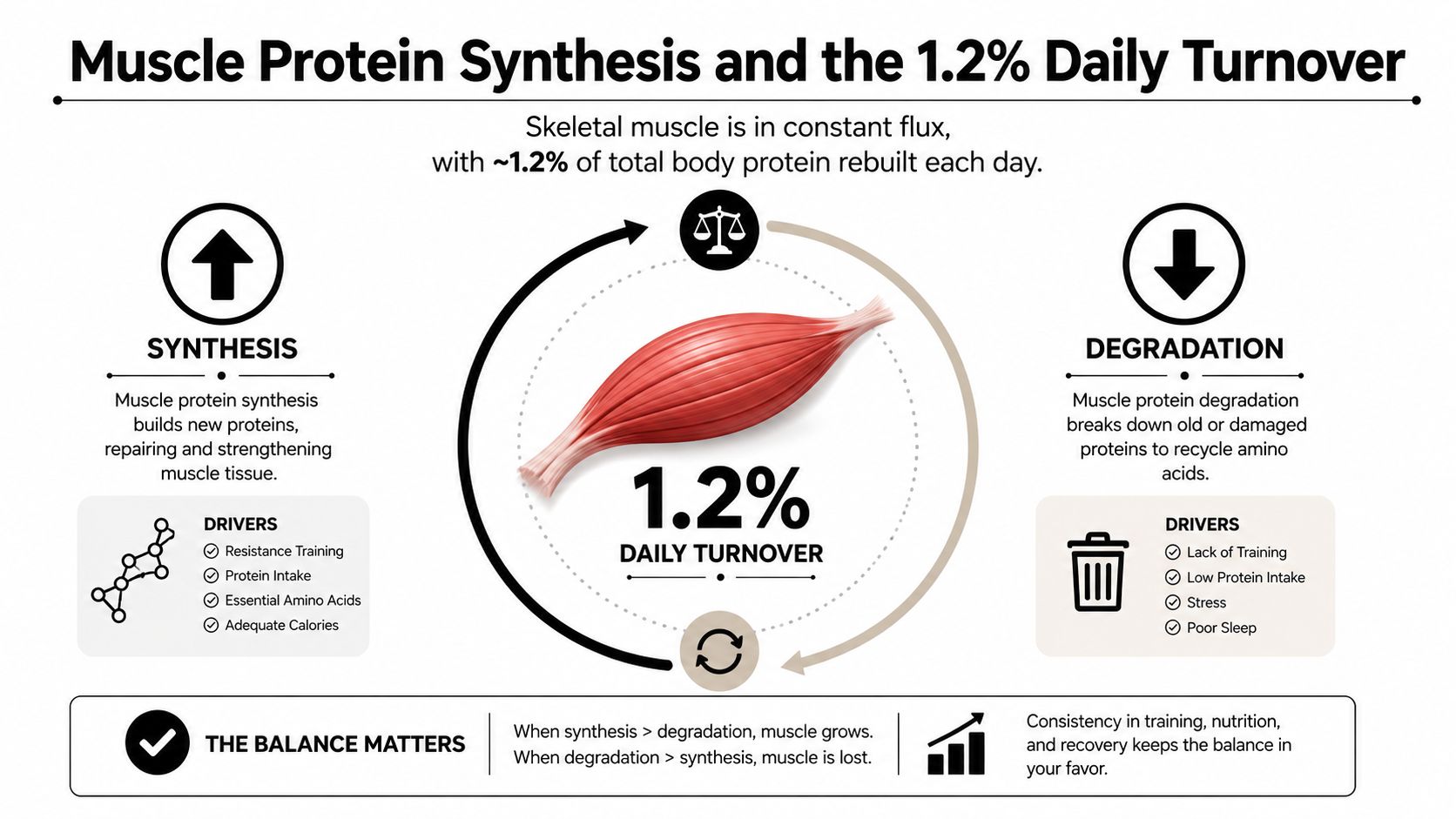
Muscle Protein Synthesis and the 1.2% Daily Turnover
Muscle protein synthesis, or MPS, is the process of adding new amino acids to muscle proteins. The ribosome performs the translation, but MPS describes that activity in living muscle tissue. The distinction matters: a protein can be built at the molecular level, while the muscle's overall balance still depends on breakdown, feeding, training, and recovery.
Skeletal muscle is always balancing MPS against muscle protein breakdown, or MPB. During fasting, breakdown tends to exceed synthesis. Eating protein shifts the balance toward synthesis, as described in this review of protein feeding and muscle protein balance. The meal supplies the bricks, while the cell decides when and where to use them.
Why training changes the equation
Resistance training gives muscle a reason to adapt. That mechanical signal works alongside amino-acid availability, energy status, recovery, and the muscle's condition before food arrives. Training therefore changes the context in which a protein-rich meal is used, rather than acting as a separate switch.
MPS rises and falls throughout the day. MPB changes too, with feeding, fasting, activity, and recovery all influencing the balance. A muscle-building phase requires that balance to favor new tissue over time, not merely a short-lived increase after one workout.
Practical rule: Training provides the adaptation signal. Protein supplies amino acids and helps shift the daily balance toward synthesis.
The turnover figure is a reminder to value consistency over one perfect meal. One serving cannot determine the whole result, and one missed serving will not erase a week of adequate intake. To build or preserve muscle, train regularly, eat enough protein across the day, and keep protein in your plan on rest days.
For planning, compare this protein intake for muscle gain with your body size, training demands, dietary pattern, and appetite. Gym Snack's daily protein needs calculator guide offers another practical starting point. Training and feeding work together. Neither replaces the other.
Leucine, mTOR, and the Protein Dose Response
Leucine acts like a molecular ignition key. Amino acids activate the mTOR pathway, and leucine is repeatedly identified as the most potent single amino-acid signal for starting this protein-synthesis machinery. The pathway helps the cell decide that amino acids are available and that building new protein is worthwhile.
Human and animal research shows that leucine-enriched essential amino acids can rapidly increase mTOR signaling and mixed muscle protein synthesis after resistance exercise. The important qualification is that leucine alone isn't enough to build the complete structure. The cell still needs the other essential amino acids that supply the remaining parts of the protein chain.
What the dose response means
Evidence summarized in this Nutrition Reviews discussion of leucine and muscle protein synthesis indicates that about 1 gram of leucine can raise post-exercise MPS above placebo, while roughly 2 to 3 grams produces the maximal synthetic response in the cited studies. These figures describe leucine's signaling response, not a recommendation to consume leucine as a stand-alone replacement for complete dietary protein.
A useful mental model looks like a dimmer switch rather than a light switch:
- A small leucine signal can raise the response.
- A stronger signal can move the response closer to its peak.
- More leucine doesn't supply the other amino acids required for construction.
This is why a meal's total protein and amino-acid profile matter. A product with added leucine may help improve the signal, but it still needs a complete supply of essential amino acids to support actual protein assembly.
The gym myth to avoid
People often reduce the conversation to a magic number per meal or assume that every gram beyond a narrow serving is wasted. That conclusion doesn't follow from leucine research. A signaling response can reach a plateau under particular experimental conditions, while the body still digests, uses, stores, and reallocates amino acids for different purposes.
Your practical priority should be adequate daily protein, sensible distribution across meals, and a protein source that supplies essential amino acids. Put a leucine-rich food at the center of meals, especially when training regularly, but don't confuse a trigger with the entire construction project.
Plant-Based Protein and the Leucine Threshold
Animal protein isn't automatically superior in every real-world diet. The relevant question is whether the overall eating pattern supplies enough total protein and essential amino acids in a form the person can eat consistently.
A recent review using deuterium oxide methods reports that longer-term MPS may improve in older adults at protein intakes above 1.2 grams per kilogram per day, with higher-quality proteins or leucine enrichment able to increase synthesis further. Separately, 2025 reporting on controlled strength-training studies found that vegan protein can match meat for muscle growth when total intake is sufficient and protein is consumed within whole meals, as described in this PubMed review.
Build the meal, not just the ingredient list
Plant proteins can differ in amino-acid composition and digestibility. A single source may provide plenty of protein while contributing less of a particular essential amino acid, so variety and meal composition become useful tools.
A plant-based lifter can use a simple checklist:
- Combine complementary foods: Pair legumes with grains or seeds across the day so the overall pattern supplies a broader amino-acid mix.
- Choose concentrated sources: Tofu, tempeh, soy foods, seitan, legumes, pea protein, and blended products can make a high-protein diet easier to manage.
- Inspect the label: Total protein matters, but leucine per serving can tell you more about whether a realistic portion supplies a strong anabolic signal.
- Think in meals: A protein-rich bowl with beans, grains, and seeds may be more useful than treating one isolated ingredient as a complete muscle-building strategy.
Plant-based diets can require more deliberate planning because protein density, amino-acid balance, and digestibility vary between foods. That doesn't make them incompatible with muscle growth. It means the shopper and cook need to evaluate the whole meal rather than asking whether one food wins a simplistic animal-versus-plant contest.
For meal ideas and product comparisons, see this guide to the best plant protein for muscle gain. The practical implication is clear: select foods you can eat repeatedly, combine sources intelligently, and judge success by total intake and training progress rather than by the category printed on the package.
Putting It Together for Training, Recovery, and Everyday Eating
A useful protein-synthesis plan has three parts: give muscle a training signal, provide amino acids regularly, and recover well enough for the cell to act on those signals. No single shake, food, or timing trick can compensate for consistently inadequate eating or poorly structured training.
Start with the training signal
Resistance exercise creates the demand for adaptation. Use movements that produce meaningful mechanical tension, train close enough to fatigue to challenge the target muscles, and repeat the stimulus often enough to practice and progress. You don't need every workout to be maximal, but you do need a pattern that gives muscle a reason to become more capable.
Recovery supports the same process. Eat protein across three or four meals, include carbohydrate and fat according to your energy needs, stay hydrated, and protect sleep. On rest days, the rebuilding process hasn't stopped, so removing protein because you're not lifting misses the point of daily turnover.
Make the food plan realistic
Use animal proteins, plant proteins, or a combination according to preference, tolerance, ethics, and convenience. For plant-based meals, blends and complementary foods can help cover amino-acid needs, while animal-based meals may offer a concentrated source with less planning.
A practical example can use a target of 1.8 grams of protein per kilogram per day, divided across four feedings. If each meal contains one quarter of the daily target, a person weighing 70 kilograms would need to distribute 126 grams of protein across the day, or about 31.5 grams per feeding. Those calculations are arithmetic examples based on the stated target, not universal prescriptions, and individual needs vary.
Common traps are easy to recognize:
- Post-workout tunnel vision: A shake can be convenient, but the meal before training and the rest of the day still count.
- Rest-day underfeeding: Muscle remodeling continues outside the gym, so protein shouldn't disappear on non-training days.
- Powder stacking: Multiple scoops may add protein, but whole foods bring texture, micronutrients, and a more satisfying meal experience.
- Single-meal perfectionism: Weekly consistency matters more than turning one dinner into a biochemical exam.
For people who want professional help matching training to recovery, an overview of Empire Athletics best trainers can help you think through coaching options. For portable meal ideas, this guide on how to increase protein intake offers practical ways to add protein without rebuilding your entire routine.
A savory option such as Gym Snack can fit between meals or around training when you need a portable plant-based protein food rather than a sweet bar or shake. Track your intake over several days, watch your training performance and recovery, and adjust the pattern instead of chasing a flawless single serving.
Gym Snack makes chef-inspired, plant-based savory protein snacks with clean pea protein, bold cheesy flavors, and a crunchy format for busy training days. If you want a convenient way to add protein between meals without relying on dessert-style bars or shakes, visit Gym Snack and choose a snack option that fits your routine.