

You're standing in the kitchen with a gym bag half packed, a lunchbox open on the counter, and one question running in the background, what snack can go with you without turning into a guessing game? For some people, that means avoiding tree nuts because of allergy risk. For others, it means choosing something that won't sit like a brick before a workout, or something that still makes sense on a lower-appetite day. Tree nut free snacks sit right at that intersection, and the label on the front of the package is only part of the story.
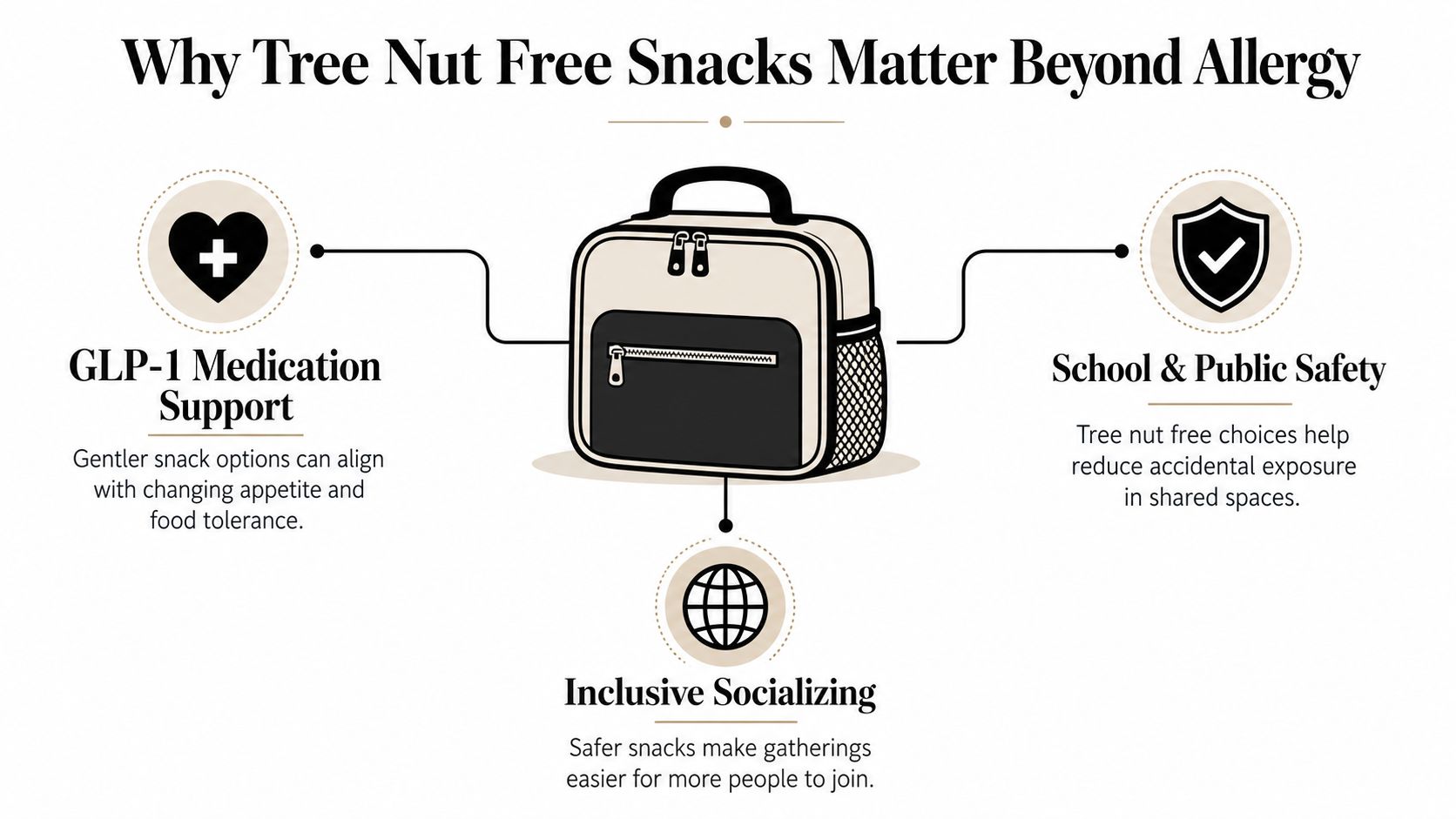
Why Tree Nut Free Snacks Matter Beyond Allergy
A lot of people meet this category in a very ordinary moment. You are packing for a school day, a road trip, or a lift session, and you want one snack that does not trigger worry for the person with allergies, does not crash your energy, and does not turn into dessert in disguise. That is why this shelf is no longer a niche corner. It is part of how families, athletes, and people managing appetite think about everyday food choices.
Tree nut allergy is a real safety issue, not a fussy preference. A 2018 review reported prevalence that varied by region and age, with rates from about 0.05% to 7.3%, and tree nuts accounted for 18% to 40% of anaphylaxis cases. The same review also reported challenge-confirmed prevalence up to 4.3%, and 12% of patients with one tree nut allergy had at least one additional tree nut allergy. Those patterns help explain why broad tree nut free positioning matters, because people often need to avoid the whole category rather than only one nut. Review on tree nut allergy prevalence and anaphylaxis
The audience is broader than allergy households
Another reason this category keeps growing in relevance is that snack choice now sits at the intersection of safety, fullness, and convenience. Some shoppers want simpler, more predictable snacks for training days. Others are looking for protein-dense options that support fullness, especially when appetite is lower. That is why savory, crunchy snacks often win over sweet bars, since they feel more like food and less like a treat.
Practical rule: if one snack has to work for school pickup, the car, and the locker room, it needs to do more than avoid tree nuts. It also has to be easy to trust and easy to eat.
The commercial angle matters too. A Canadian Food Inspection Agency survey of about 1,000 pre-packaged food samples found only one confirmed almond positive, at 0.7 ppm, and the agency described undeclared tree nut allergens in that survey as “almost absent.” That is not a promise that every snack is safe, but it does show that strong allergen controls can make a significant difference in practice.
The useful takeaway is simple. Tree nut free snacks are about ingredient avoidance, yes, but they are also about confidence, convenience, and whether a food can safely travel from shelf to school, gym, desk, or airport gate.
What Counts as a Tree Nut and What Does Not
The label conversation gets messy fast because everyday speech and food regulation don't use the same map. A “nut” in the botanical sense isn't always a “tree nut” in the allergen sense, and that's where shoppers get tripped up. If you've ever wondered why one snack says nut free while another says peanut free, you're already running into that difference.
The FDA list is the one that matters on packaging
The FDA's tree nut list includes almond, cashew, walnut, pecan, pistachio, hazelnut, macadamia, Brazil nut, chestnut, pine nut, and shea. That list is the practical one for label reading, because it's the category manufacturers must account for in allergen controls and statements.
Peanuts are different. They're legumes, not tree nuts. Coconut also sits outside the tree nut list for labeling purposes, even though people sometimes assume it behaves like a nut in the pantry. Seeds such as sunflower and pumpkin are also separate, which is why many snack brands lean on seed-based or pea-protein formulations when they want to stay outside the tree nut lane.
| Category | Examples | Why it matters |
|---|---|---|
| Tree nuts | Almond, cashew, walnut, pecan, pistachio, hazelnut, macadamia, Brazil nut, chestnut, pine nut, shea | The main category that triggers tree nut allergen checks |
| Not tree nuts | Peanuts, coconut, sunflower seeds, pumpkin seeds | Still important to verify, but not the same allergen class |
A family-tree analogy helps here. Tree nuts are the cousins in one branch, peanuts are in another branch entirely, and seeds are on a different limb. They can show up in the same pantry, but they don't belong to the same allergen category.
Why the distinction matters before you buy anything
A peanut-free snack is not automatically tree nut free, and tree nut free does not automatically mean peanut free. That sounds obvious once you say it out loud, but many shoppers still miss it because front-of-pack marketing compresses everything into one friendly badge.
A clean ingredient list only tells you what was intentionally added. It does not tell you which ingredients shared a line, a scoop, or a facility.
That's the reason to learn the vocabulary before you start building a snack stash. Once you know what counts as a tree nut, the rest of the label becomes much easier to read.
Reading Tree Nut Free Labels the Right Way
A bag can look reassuring and still leave one big question unanswered, what happened before it reached the shelf? For tree nut free snacks, the front of the package is only the starting point. The job is reading the label the way a coach reads a training plan, line by line, and with an eye for weak spots.
Rank the claims, don't just read them
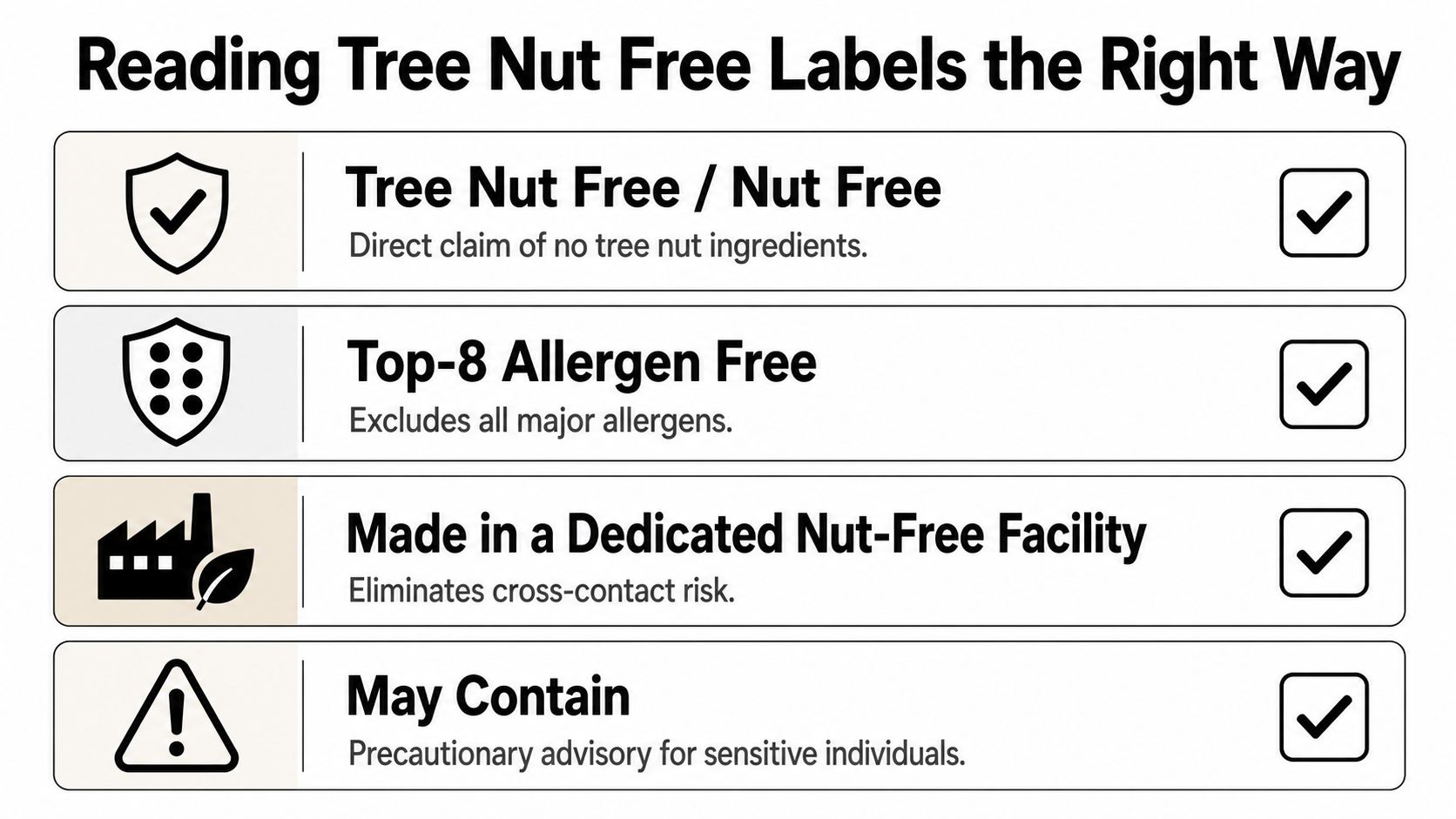
Start with the strongest wording first. A statement like “made in a dedicated nut-free facility” carries more weight than a decorative badge because it points to a specific production setup. A direct tree nut free or nut free claim still helps, but it is only part of the picture. Labels that say “top-8 allergen free” can also be useful in school or camp settings, yet they still do not explain every detail of how the product was handled.
Precautionary language deserves the most caution. Phrases such as “may contain traces of tree nuts”, “processed in a plant”, or “processed on shared equipment” tell you the product has a possible exposure path. In plain terms, the ingredient list may look clean while the process still leaves room for contact. School and allergy-safety guidance on shared equipment and precautionary statements
A simple decision rule that saves time
If a package includes precautionary allergen language, pass on it for an allergic household. A friendly front badge can make the snack look safer than it is, especially when you are shopping quickly or stocking a gym bag. The label has to earn trust on the back panel, not just the front.
A good way to read nutrition labels is to treat them like a three-layer check. The first layer is the ingredient list, where you confirm whether any tree nuts are named. The second layer is the allergen statement, where you look for tree nut, peanut, or shared-line warnings. The third layer is the facility language, where dedicated nut-free production gives more confidence than marketing copy. A practical walkthrough of that habit is available in how to read nutrition labels.
Once you build that habit, label reading gets faster. You stop reacting to the big-font claims and start scanning for the details that matter, which is how you separate a snack that merely sounds safe from one that better fits an allergic household.
The Cross-Contact Trap Most Snack Lists Miss
A snack can look tree nut free and still be a poor choice for an allergic household. The problem usually sits in the background, not the ingredient panel, because the product may share equipment, a conveyor, or a packaging line with tree nuts. That is the cross-contact trap, and it explains why some “safe snack” lists miss the part that matters most.
Cross-contact means an allergen reaches food unintentionally during production, storage, or handling. Cutting apples on a board that just held walnuts is the kitchen version of the problem. The apple still looks fine, but the surface can carry what the eye cannot see. Factory conditions work the same way, only at a much larger scale.
Why “may contain” matters more than a pretty badge
A package that says “may contain traces of tree nuts” is giving you a contamination warning, not decorative copy. The same is true for labels that say “processed in a facility that also processes” or “processed on shared equipment.” For highly sensitive consumers, school and allergy-safety guidance treats those statements as a reason to pass on the product.
That is why supplier checks matter every time you shop. A snack that fit your needs one month can change if the recipe, the facility, or the line setup changes later. If a company does not keep the ingredient statement, allergen statement, and manufacturing details current, the package cannot tell you the full risk story.
Practical rule: if you are shopping for an allergic child, teen, or teammate, the right question is not “Does this snack contain tree nuts?” It is “What happened before the snack reached the bag?”
What a serious control program looks like
In commercial food production, shoppers should look for a dedicated nut-free facility or segregated equipment with verified allergen controls. That does not make any product perfect. It does show the manufacturer is managing risk instead of hoping the line stays clean by luck.
Common myths can blur that picture. Coconut is not listed as a tree nut, peanuts are not tree nuts at all, and coconut oil still deserves a label check like any other ingredient because the important question is the exact product in the package, not the nickname people use at home. A snack list that skips cross-contact gives a false sense of safety, and that is the blind spot to avoid.
A useful example is nut free protein bars, which can fit well when you want a snack that is easier to verify and more filling than a sweet treat. Even then, the label still has to do the work.
If you remember one thing here, make it this. The ingredient list is necessary, not sufficient. The facility story matters just as much.
Vetted Store-Bought Tree Nut Free Snacks Worth Keeping
Store-bought snacks work best when they solve a real problem, not when they just sound healthy on paper. For tree nut free shopping, the sweet spot is usually a snack that's easy to verify, easy to carry, and substantial enough to feel like food. That usually means savory, crunchy, protein-forward options first, then simpler backups like fruit or crackers.
Start with the format, not the brand
A useful shopping pass looks like this:
- Crunchy savory protein snacks: These are the best fit when you want something gym-friendly and more filling than a sweet bar.
- Seed-based crackers or crisps: Good for lunchboxes and paired snacks, as long as the facility language checks out.
- Roasted chickpeas or edamame: These give you a straightforward texture shift and tend to travel well.
- Jerky or biltong: Helpful for non-plant-based shoppers who want protein in a compact format.
- Single-ingredient dried fruit: Simple, but usually better as a companion snack than a stand-alone protein choice.
Protein density matters here because many people aren't just avoiding tree nuts, they're trying to get more from each bite. That's especially true for people who prefer snacks that feel savory rather than dessert-like.
One example is nut free protein bars, which can be useful when the format matters more than the flavor profile. Bars aren't always the best answer, but they do help fill the gap when you need something sealed, portable, and easy to grab.
What to look for on the label before you toss it in the cart
Facility claim: Prefer products that clearly state dedicated nut-free production or give a strong allergen-control explanation.
Ingredient transparency: Shorter ingredient lists are easier to verify, especially when you're scanning in a store aisle.
Protein density: Choose snacks that feel substantial enough to carry you between meals.
Sodium and saturated fat: Read these with the same seriousness you'd give protein, because a “healthy” snack can still be heavy-handed here.
A crunchy savory option like Gym Snack fits the kind of profile many active shoppers are looking for, because it leans on pea protein, avoids dairy, soy, gluten, and seed oils, and focuses on a more satisfying snack texture. The bigger point isn't the brand name, though. It's the category shift away from candy-bar thinking and toward snacks that function between meals.
If you're comparing labels, keep your eye on the same two questions every time. Is the product tree nut free, and does it give you enough protein or staying power to be worth the slot in your bag?
DIY Tree Nut Free Snacks You Can Batch on Sunday
Store-bought snacks are convenient, but homemade snacks give you more control over both ingredients and texture. That matters when you want a snack that's tree nut free, travel-ready, and better matched to your training day or appetite. The trick is to build snacks the same way a good meal prep system works, with repeatable parts instead of one-off recipes.
Use a four-part framework
Start with a base, then add crunch, then a protein boost, then finish with seasoning.
- Base: popcorn, rice cakes, seed crackers, or roasted chickpeas
- Crunch add-in: pumpkin seeds, sunflower seeds, or crispy chickpeas
- Protein boost: pea-protein dusted popcorn, hard-boiled eggs, cottage cheese cups for non-vegan users, or soy-free plant protein crispies
- Seasoning: nutritional yeast, smoked paprika, garlic powder, cumin, cinnamon, or umami blends
That structure keeps you from building snacks that are either too sweet or too fragile for real life. It also makes batch prep easier because you can reuse the same building blocks in different combinations.
Two quick recipes that actually travel well
Savory protein popcorn
Toss freshly popped popcorn with a little oil or a stick-free seasoning base, then dust it with pea protein, nutritional yeast, smoked paprika, and salt. If you're packing it for later, let it cool fully before sealing it so it stays crisp. This works best as a desk snack or post-training crunch, not a sticky road-trip treat.
No-bake seed energy bites
Mix sunflower seed butter, rolled oats, chia or hemp seeds, and a small amount of sweetener, then roll into balls and chill. Add cinnamon or cocoa if you want variation. The batch itself is fast, and the best part is that one bowl can become multiple grab-and-go portions.
For more framework-style ideas, healthy weekly meal prep inspiration can help you think in systems instead of one-time recipes.
Keep homemade snacks on dedicated surfaces if someone in the house has an allergy. A clean recipe can still become a risky snack if the kitchen setup is sloppy.
For more snack-formula ideas, the guide to easy high protein snack recipes gives a useful starting point. The portability checklist is simple, too. Use airtight containers, pack dry snacks separately from wet ones, and keep the most fragile batches out of the bottom of a crowded gym bag.
Timing Snacks for Training, Travel, and GLP-1 Days
Snack timing changes how a food feels. The same handful of crackers can feel perfect before a session, useless after one, or exactly right on a day when appetite is lower than usual. That's why a good tree nut free snack plan needs to work with your schedule, not just your pantry.
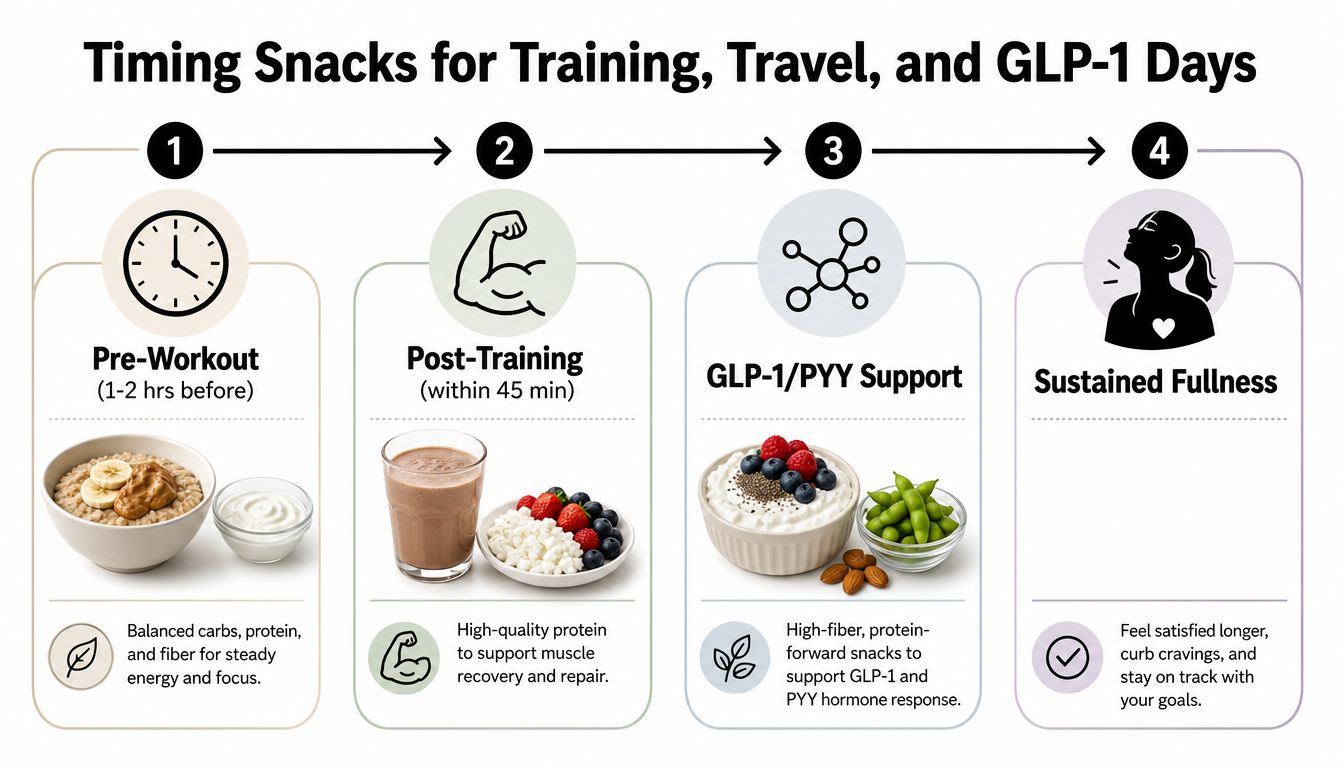
Build the snack around the moment
For pre-workout use, choose something that won't sit heavy and gives you a mix of protein and fiber. For post-training, lean into a snack that helps bridge you to the next meal without making you reach for random extras. Travel days call for snacks that stay intact in a bag and don't need refrigeration unless they're meant to.
That's also where protein-forward snacks fit naturally into routines shaped by GLP-1 medications. These medications are already changing appetite and fullness for many users, so a snack that is protein-dense and high-fiber can feel more useful than a sweet bar that disappears fast. People often do better with savory, crunchy snacks on lower-appetite days because the texture feels satisfying without being cloying.
Keep storage simple
Use airtight containers for anything crisp. Put softer snacks in smaller containers so they don't get smashed. Freeze-friendly batches are useful when you want a weekly backup, but they only work if you thaw them in a way that preserves texture.
A few practical storage habits make a big difference.
- Gym bag snacks: choose dry, sturdy items that won't crumble under a towel or water bottle.
- Desk drawer snacks: keep sealed portions so you're not eating from a half-open bag for three days.
- Travel snacks: prioritize items that can survive temperature swings and handling.
- Lower-appetite days: pick snacks with strong flavor and clear protein so each bite feels worth it.
The right snack is the one you'll eat, safely, when the day gets busy. If it's easy to pack, easy to trust, and easy to finish, it'll earn a place in your rotation.
If you want a snack that fits the tree nut free framework, stays gym-friendly, and doesn't make you settle for dessert-style bars, take a look at Gym Snack. It's a practical option for people who want savory, protein-forward crunch without the guesswork, and it's a good next stop if you're ready to build a safer, more satisfying snack routine.