

You packed yogurt with good intentions, then left your bag under your desk while meetings swallowed the morning. Now you're hungry, the office fridge is full, and the only backup is a protein cookie you don't want. The problem isn't your commitment to eating better. It's that your snack plan depends on a workday you rarely have.
Choosing high protein snacks to take to work starts with a practical question: where will this food spend the day? Sort out the commute, storage, and eating situation first. Then compare protein, fiber, and flavor.
Why Your Workday Snacks Are Failing You
A snack can look excellent on a nutrition label and still be useless at work. Refrigerated food without reliable cooling, a crumbly bar during a client call, or a giant bag you keep grazing from all solve the wrong problem. You need something that fits the gap between your meals, not another food purchase that requires perfect circumstances.
Protein distribution gives that gap some context. Approximately three-quarters of U.S. adults' protein intake happens at lunch and dinner, according to USDA's analysis of adult protein intake. That doesn't mean everyone needs a morning snack, but it does explain why lunch and dinner alone may leave your workday protein plan feeling uneven.
Start with your actual schedule. If breakfast is rushed, lunch gets delayed, or you train after work, identify the stretch when you're hungry and food access is unreliable. Put your snack there rather than eating it automatically because you've opened your laptop.
Identify the failure before buying the fix
- Your lunch keeps moving: Pack something substantial enough to bridge the delay, rather than expecting a token serving to substitute for a meal.
- You don't have dependable refrigeration: Stop choosing snacks that need it. Use commercially sealed, shelf-stable options with suitable storage instructions.
- You dislike sweet protein products: Choose a savory format instead of buying another box of bars you'll abandon.
- You eat straight from a large bag: Decide your portion before the workday, not while answering emails.
The most useful recommendation is also the least glamorous: buy for your difficult days. A snack that only works when you drive straight to the office, find fridge space, and take lunch on time isn't a dependable backup.
A work snack needs to survive the journey, fit the eating situation, and taste good enough that you'll actually choose it.
That doesn't require an elaborate meal-prep routine. It requires matching the food to the problem before treating the protein number as the deciding factor.
What Actually Makes a Snack Work at the Office
Ignore the front-of-pack fitness language initially. Turn the package over and check the serving size, protein, calories, fiber, added sugar, saturated fat, sodium, and allergens. Compare the portion you'll eat, not a tiny listed serving that makes the label look tidy.
A useful starting point is 15–20 grams of protein for a between-meal snack, rather than assuming every snack needs to resemble a full meal. Use that as a planning preference, not a universal requirement. Your appetite, meals, and training schedule still decide whether the portion makes sense.
Work Snack Scoring Criteria
| Criterion | Target | Why It Matters |
|---|---|---|
| Protein density | Calculate protein grams ÷ calories × 100 | Lets you compare protein per 100 kcal rather than package size |
| Actual portion | Enough food to bridge your intended meal gap | A label serving and a satisfying snack aren't necessarily the same |
| Fiber | Compare labels and favor a useful contribution | Adds another consideration beyond protein alone |
| Added sugar and saturated fat | Prefer less when otherwise comparable | Prevents choosing solely by the headline protein claim |
| Storage class | Match the package instructions to your day | A nutritious snack is no use if you can't store it safely |
| Eating experience | Flavor and texture you willingly eat | Avoids stocking emergency food you consistently ignore |
The protein-density calculation is a practical comparison tool, not a health score. A higher result doesn't automatically make a snack more enjoyable, more filling, or better suited to your diet. Likewise, a sugary bar with more protein doesn't automatically beat a smaller savory snack with fiber.
Plant protein needs context
Protein quality includes amino-acid composition and digestibility, not just grams. A review of protein quality and complementary plant sources explains that pea protein can improve appropriately designed plant-protein mixtures, but doesn't automatically match whey or soy when assessed alone. Judge a pea-based snack within a varied diet rather than expecting it to supply everything.
Homemade snacks deserve the same scrutiny. If you prefer preparing your own, Pep Tea's easy organic matcha energy bites offer a recipe to assess alongside packaged options. Check the ingredients, calculate your portion's nutrition, and establish storage requirements before calling any energy bite a high-protein desk snack.
My recommendation: choose the strongest overall fit, not the biggest protein badge. Keep a satisfying option you enjoy and a practical backup you can reliably store.
Storage and Food Safety for the Commute and Desk
The fridge question comes before the food list. Classify each snack as shelf-stable, insulated-bag dependent, or refrigerator dependent. The last two categories may contain the same foods; the difference is whether your bag can maintain safe cooling until you reach a dependable refrigerator.
Use this visual as a starting checklist, then verify the storage instructions on your particular package.
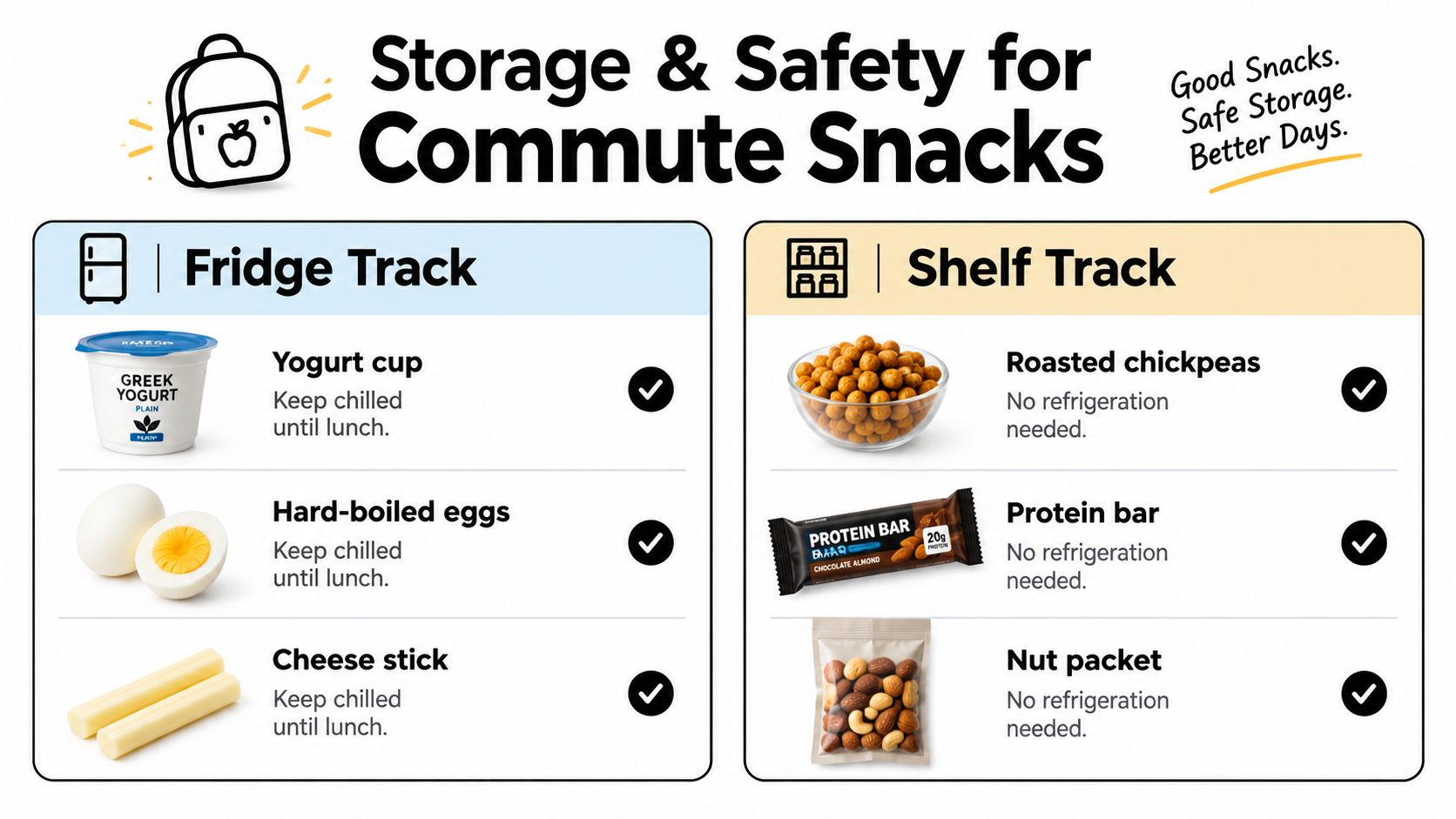
Classify, then control temperature
Dry, commercially sealed snacks are generally the practical desk-drawer candidates. Yogurt, eggs, cheese, cooked grains, tofu, and cut produce require more care. Don't assume that a protein bar is shelf-stable or that every tofu package requires identical handling; the product's storage directions decide.
For perishables, chill before packing, use an insulated bag with at least two frozen cold sources, and keep food at or below 40°F (4.4°C); limit room-temperature exposure to two hours, or one hour above 90°F (32.2°C), following USDA's guidance on keeping bag lunches safe. Discard food that exceeds those limits.
Don't confuse packing with cooling
- Paper bags: They carry food; they don't provide temperature control.
- Ice packs: Their presence doesn't prove the food stayed cold. Check the temperature when you need confidence.
- Hot cars: Don't use the boot or passenger seat as snack storage.
- Opened packages: Follow the after-opening instructions rather than assuming the unopened storage rules still apply.
For a broader kitchen reference, Monopack ltd's safe food storage guide is a useful companion to checking individual labels. For your work bag, use the shelf-stable protein guide to narrow the format before comparing nutrition.
Packing rule: If you can't confidently keep a perishable snack cold, replace it before leaving home.
A shared office fridge is helpful only when you can use it. Do not make your food-safety plan depend on someone moving their lunch containers when you arrive.
Plant-Based Savory Snacks That Survive the Workday
Choose a small rotation with different jobs: a protein-forward packet, a crunchy legume option, and something you enjoy when you want a change. You don't need an entire drawer of products marketed to gym-goers. You need foods with readable labels and storage instructions that match your workplace.
This is the kind of drawer worth building, with sealed portions rather than loose food scattered around stationery.
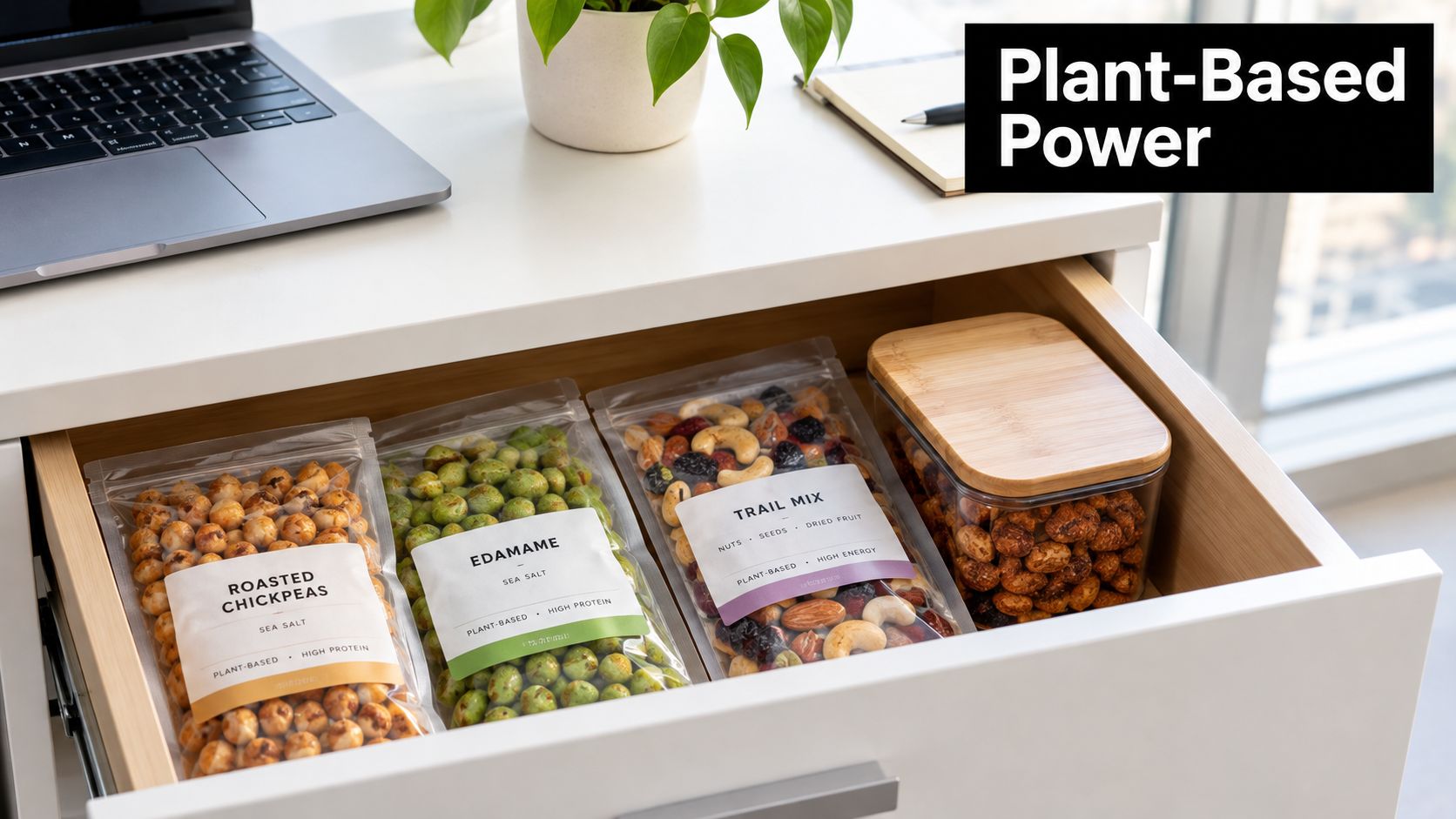
Choose by job, not by food halo
| Option | Protein check | Portability and prep | My verdict |
|---|---|---|---|
| Crunchy pea-protein snacks | Compare the actual serving and full-bag label | Choose sealed, shelf-stable products | A sensible starting point when you want savory protein without utensils |
| Commercially dry-roasted edamame | Check the product's protein and soy declaration | Ready-to-eat packets minimize preparation | Worth comparing closely with your usual bar |
| Commercially roasted chickpeas | Verify protein rather than assuming all legume snacks are equivalent | Choose dry products labeled for ambient storage | Useful for crunch; don't mistake a small handful for a substantial protein portion |
| Savory nuts and seeds | Compare protein against the calories in your chosen portion | Pre-portion or buy suitable individual packets | Keep for variety, not as an automatic protein-density winner |
| Unopened shelf-stable white beans | Read both nutrition and after-opening directions | Requires utensils and somewhere suitable to eat | Better for a proper break than keyboard snacking |
| Tofu or tempeh snack strips | Verify the formulation and storage label | Only ambient-safe products belong in the drawer | A conditional option, not a blanket no-fridge recommendation |
Dry-roasted isn't the same as freshly cooked. Don't transfer the convenience of a commercial packet to moist homemade chickpeas or refrigerated edamame. Similar ingredients can have different storage requirements.
Make savory snacks earn their place
A savory snack is a better choice than a sweet bar when you prefer it, its label fits your priorities, and it works in your setting. It isn't automatically healthier because it tastes like chips. Seasoning, sodium, portion size, and protein content still need inspection.
Chef-inspired pea-protein crisps fit that category, alongside roasted legumes and measured nut mixes. Use the vegan savory snack guide to explore formats, then narrow your purchases to options you can eat comfortably during an ordinary workday.
Keep the office context in mind, too. A spicy packet might suit your afternoon break but not your pre-training stomach; a bean portion might suit the kitchen table but not a call. Convenience includes where and how you'll eat, not merely whether the package fits inside your bag.
Sardines don't belong on a plant-based shortlist. If you eat fish, assess them separately rather than treating them as a vegan alternative.
Portioning, Packing, and Timing Your Snack Around Work
Sunday preparation should remove decisions, not create another project. Put your usual snack packages, containers, labels, and lunch bag on the counter. Work from your upcoming schedule: office days, travel days, and training days may need different portions.
Use this routine to separate choosing food from remembering to pack it.
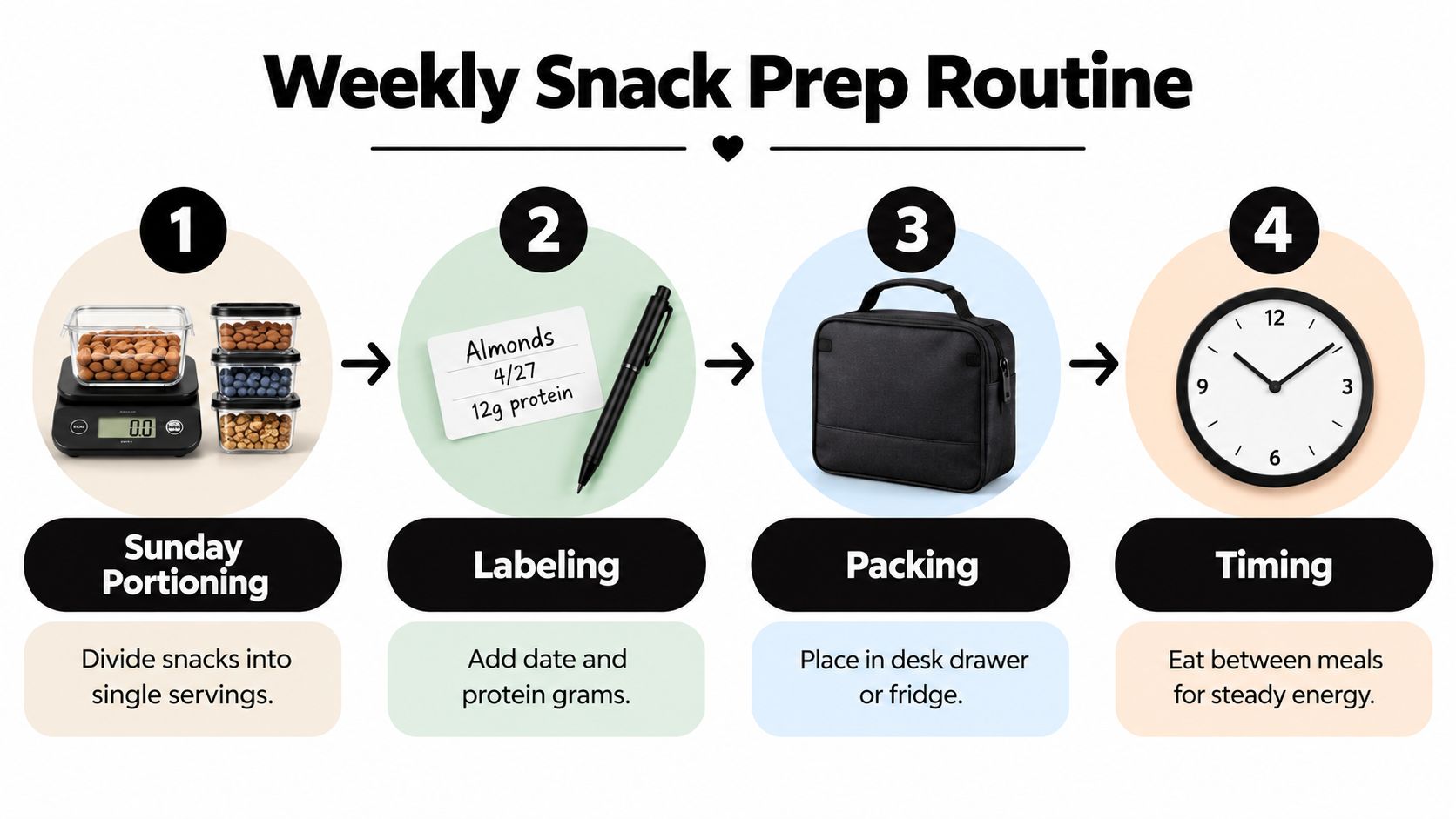
Portion for the gap you're covering
Read whether the nutrition panel describes the whole package or only part of it. If you'll eat the whole bag, record the whole-bag nutrition. If you're dividing it, use a kitchen scale and the label information rather than guessing from a few handfuls.
For a more substantial serving, roughly 20–40 grams of protein is a practical planning range, with a carbohydrate source alongside it before exercise, as outlined in the protein-snack portioning and training guidance. That's a different job from a light between-meal snack; don't force every break into the larger format.
Write the portion's protein and calories on its container if that helps you plan. For refrigerated items, add the preparation date and your relevant use-by information. Follow the product's instructions rather than assigning the same storage life to everything you prepare.
Pack once, adjust deliberately
- Desk supply: Keep appropriate unopened shelf-stable backups somewhere clean and away from heat.
- Daily bag: Pack the portion you expect to use, plus cooling equipment when required.
- Shared fridge: Label your container clearly and make it easy to retrieve without rummaging.
- Training bag: Choose food you've already tolerated during normal workdays.
- Car: Treat it as transport, not a permanent pantry.
Before training, choose a protein-plus-carbohydrate combination you can comfortably digest. Don't introduce an unfamiliar high-fiber snack immediately before a demanding session just because its label looks impressive. After training, choose a protein-forward option when your next meal isn't readily available, without turning timing into a stopwatch exercise.
This video can accompany your packing routine; keep your own storage labels and portion notes as the practical reference.
The final check is simple: does tomorrow's bag contain food for tomorrow's actual schedule? A backup is useful, but repeatedly packing more than you want creates clutter and makes portions harder to track. Adjust after a normal week rather than preparing an elaborate system you won't maintain.
Will a Protein Snack Actually Keep You Full
Protein can help with appetite, but feeling fuller isn't the same as automatically eating fewer calories. That distinction matters when you're buying snacks for weight management rather than trying to cover a long afternoon.
In a crossover study of 18 adults, a 30-gram plant-protein breakfast increased GLP-1 and PYY responses and reduced subjective appetite compared with a 10-gram protein, high-carbohydrate breakfast, but didn't reduce energy intake at the next meal, according to the plant-protein breakfast research record. That was a breakfast comparison, not proof that any particular office snack causes weight loss.
The visual below highlights the distinction between appetite responses and eating outcomes. Don't interpret hormone shorthand as evidence that a snack universally suppresses hunger hormones.
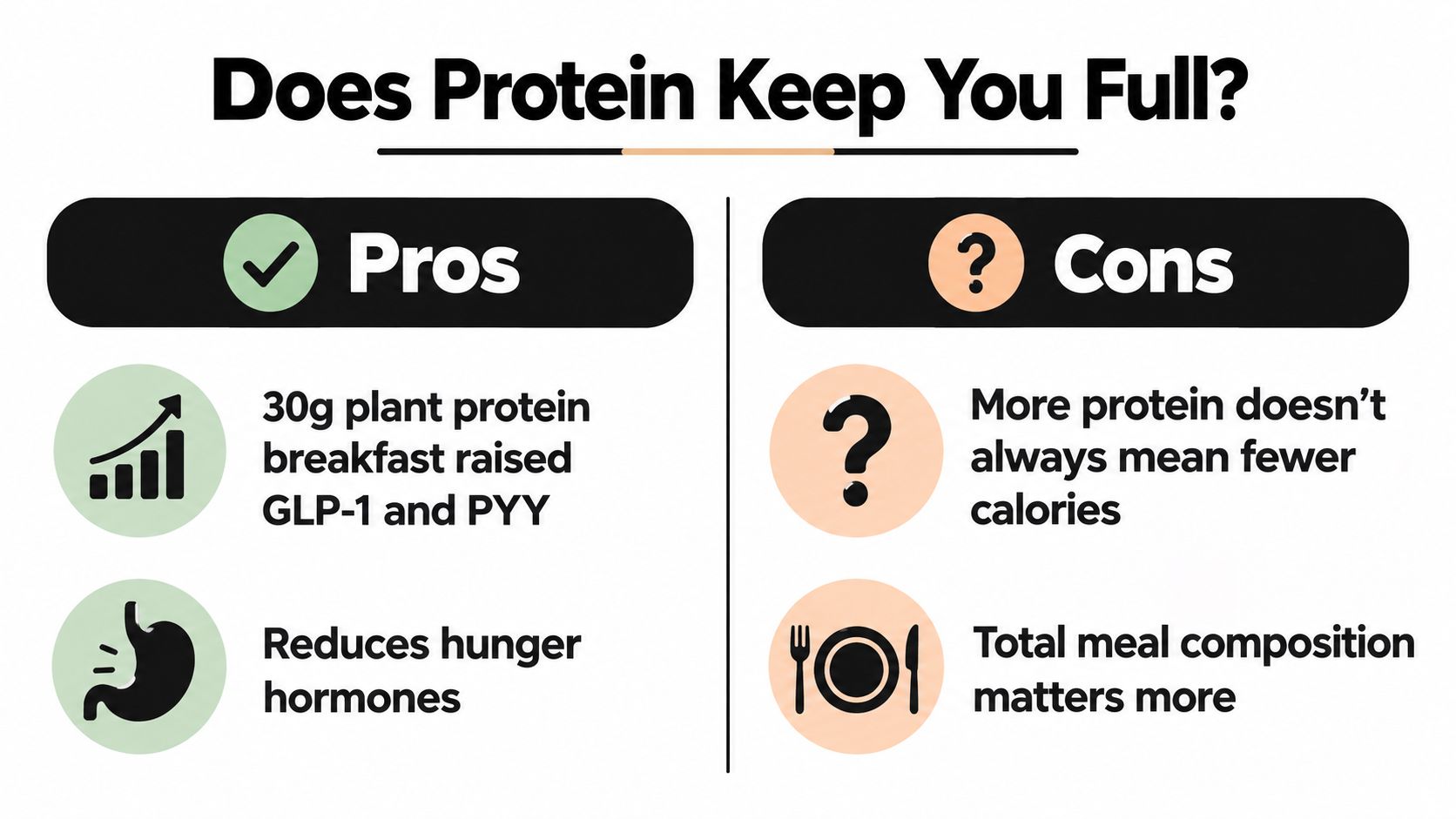
Judge the experience, not a hormone promise
Pay attention to whether the snack satisfies you in its intended context. Consider the portion, fiber, texture, flavor, and how recently you ate. Crunch and seasoning may make a savory option more appealing to you, but that preference isn't a guaranteed appetite mechanism.
Reality check: A useful snack can make the gap between meals more manageable without changing how much you eat later.
If you're reaching for food because a task is tedious, switching from a sweet bar to savory crisps won't automatically remove the habit. Take a brief break, assess whether you're hungry, and eat intentionally if you are.
For practical ways to assess your meals and snacks together, use the guide to staying full longer. If training nutrition is a separate priority, REVETIX's creatine-rich daily food options provides another topic to investigate, not a shortcut for evaluating snack satiety.
Expect useful nourishment and a snack you enjoy. Don't buy an implied weight-loss guarantee that the evidence doesn't establish.
Troubleshooting and Quick Answers for Busy Weeks
What if the snack stayed in a hot car?
For perishables, apply the storage limits already described. If you can't establish that it stayed safely cold, discard it. For sealed shelf-stable products, inspect the packaging and follow the manufacturer's temperature and storage instructions.
What if the office fridge is unavailable?
Use a properly cooled insulated bag or change the snack. An inaccessible fridge isn't refrigeration, and putting food beside it doesn't solve anything.
- Lunch is coming soon: Save the substantial snack for later, or choose a smaller portion if you're hungry.
- Training follows work: Pack a familiar option rather than experimenting while rushing to the gym.
- The package looks questionable: Check the seal, date, storage history, and after-opening directions before eating.
Can smell tell me whether it's safe?
Don't use smell or texture to overrule unsafe storage history. Obvious changes are reasons to reject food, but apparently normal food isn't proof that temperature control was adequate. For an additional practical reference, consult the safe packed-lunch guidance.
Keep your routine modest: choose for storage first, compare nutrition second, and pack a deliberate portion. Replace the option that keeps failing rather than blaming yourself for another disrupted workday.
Gym Snack offers chef-inspired, plant-based savory protein snacks for people who'd rather pack crunch than another dessert-style bar. Visit Gym Snack, compare the ingredients and serving information with your workday needs, and choose an option for your next office snack rotation.