

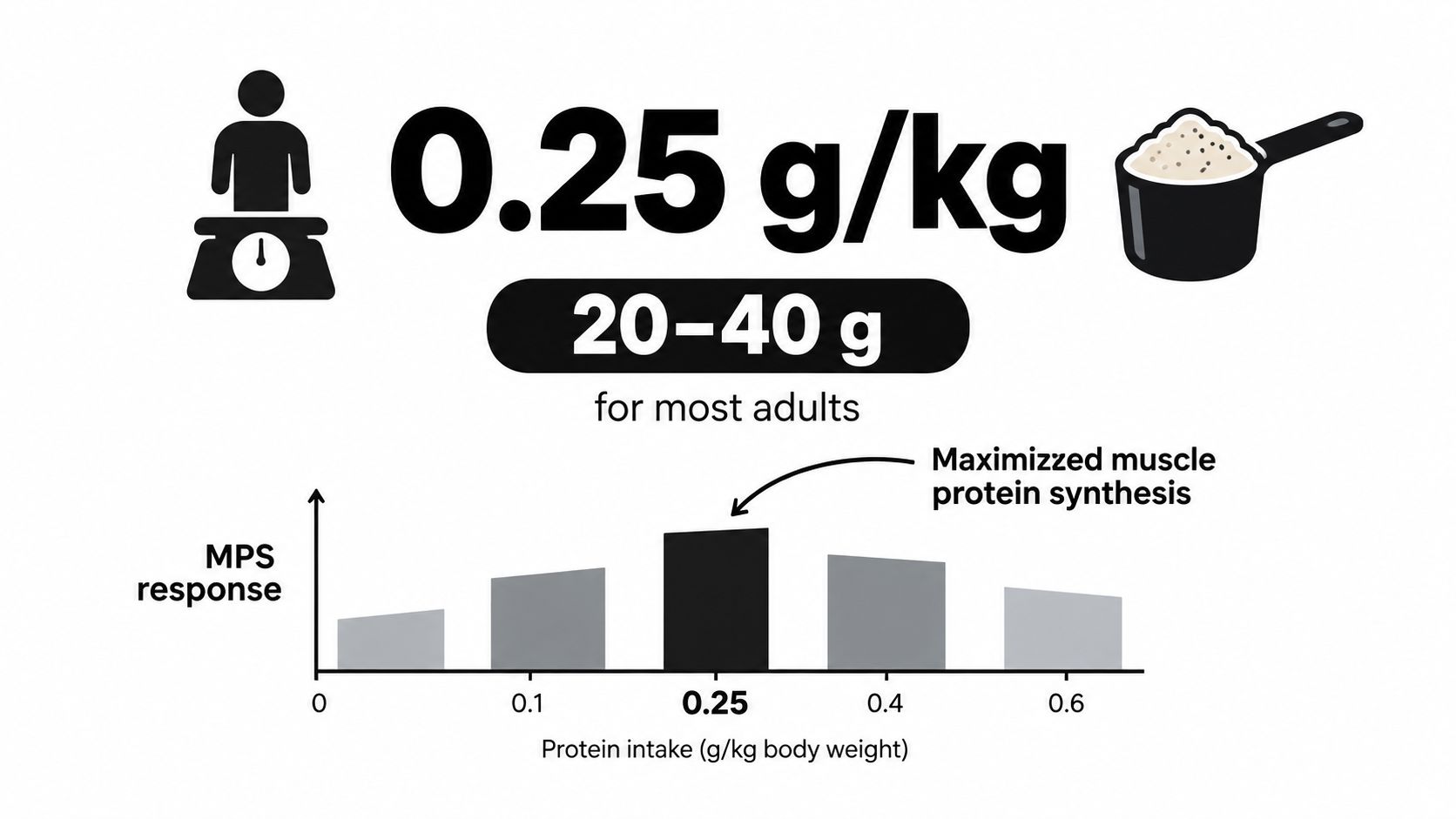
About 0.25 g of protein per kilogram of body weight is a strong pre-workout target, translating to roughly 20–40 g for most adults. For a 70 kg person, that formula gives about 17.5 g, so a practical serving often lands near 20 g, with larger or harder sessions pushing closer to 40 g.
But asking only “how much protein before workout?” misses the more useful question: who needs the lower end, who benefits from the upper end, and when does timing matter at all? A small shake may suit an early-morning lifter, while an older athlete, a large athlete, or someone training legs during a calorie deficit may need a more substantial serving. Plant-based eaters and people using appetite-suppressing medications also face practical challenges that a generic answer doesn't solve.
The science supports a simple baseline, but applying it well requires a little context.
What the Evidence Actually Says About Pre-Workout Protein
Does eating protein before training matter, or is the total you consume across the day more important? The evidence supports a practical middle ground. A serving near 0.25 g of protein per kilogram of body weight can provide enough amino acids to support the muscle protein synthesis response around resistance exercise. The ISSN position stand on nutrient timing also places this in a useful 20–40 g for most adults range, while emphasizing that protein consumed before or after training can help when overall intake is adequate. The ISSN position stand on nutrient timing
Protein before a workout is not a special switch that turns muscle growth on. Muscle protein synthesis continues after the session, and exercise keeps muscle tissue responsive to protein for an extended period. The response may lessen as more time passes, but the workout is not a narrow deadline. This explanation of how protein synthesis works can help clarify why the full day's intake matters.
What the serving size can and can't do
A pre-workout serving supplies building blocks for the session, but it cannot replace adequate daily protein, progressive training, sleep, or energy intake. It works like one deposit into your daily protein account, not a separate payment that guarantees muscle growth.
For resistance-trained adults, expert guidance generally places a useful serving at 20–40 g of high-quality protein, or close to 0.25 g/kg. Younger adults often respond well to 20–30 g, while a larger serving may provide more amino acids without creating a proportionally larger short-term muscle protein synthesis response. The ISSN position stand on protein and exercise explains this dose-response pattern. The ISSN position stand on protein and exercise
Why the answer isn't identical for everyone
A smaller lifter who ate a protein-rich meal recently may need little before training. A larger athlete, an older adult, or someone training hard while eating fewer calories may find a fuller serving easier to justify. Plant-based eaters may also need more planning because a snack's protein content and amino acid profile vary by food. People using appetite-suppressing medications face a different problem: fitting enough protein into a smaller appetite.
The workout itself adds context. A demanding lower-body session can create a stronger case for eating before training than a brief isolation workout, especially if the last meal was several hours earlier. Recent research found no overall change in exercise-related lean body mass from protein timing, yet it reported a strength signal for the leg press, with SMD 0.70 and a 95% confidence interval of 0.005 to 1.388. The PubMed-indexed meta-analysis also indicated that upper- and lower-limb strength may respond differently.
The practical lesson is simple: use the serving as a starting point, then consider body size, age, food pattern, appetite, the session's demands, and how recently you ate.
How to Calculate Your Personal Pre-Workout Protein Target
How much protein should you eat before training? Start with body weight, then adjust the result for the session, your age, diet, appetite, and the time since your last meal.
Body weight in kilograms × 0.25 = baseline protein grams
At 80 kg, that means 80 × 0.25, or 20 g. Treat this figure as a useful starting line, not a laboratory requirement. Round to a portion you digest comfortably and can repeat.
| Body weight | 0.25 g/kg baseline | Endurance session | Hypertrophy or heavy lift |
|---|---|---|---|
| 55 kg | 13.75 g | 15–25 g | 20–30 g |
| 70 kg | 17.5 g | 15–25 g | 20–40 g |
| 85 kg | 21.25 g | 15–25 g | 25–40 g |
| 100 kg | 25 g | 15–25 g | 30–40 g |
| 110 kg | 27.5 g | 15–25 g | 30–40 g |
The baseline follows the ISSN position stand's 0.25 g/kg recommendation and practical 20–40 g range for many adults. Per ISSN guidance, body weight provides the starting point, while the person and workout determine the adjustment.
Adjust the target to the workout
A high-volume hypertrophy session, heavy squats, or deadlifts can justify the middle or upper part of the range. Lower-body training often involves more total muscle and may create a stronger case for a substantial snack than a short isolation workout. If you ate a protein-rich meal recently, use the lower end. If several hours have passed, a fuller serving may be easier to justify.
Endurance training has a different priority. Protein can support recovery, but carbohydrates usually provide more immediate training fuel. A mixed snack, such as protein paired with a carbohydrate source, fits that demand better than protein alone.
During fat loss, keep the per-serving target rather than reducing protein because total calories are lower. A pre-workout serving can make a smaller meal more filling and prevent training nutrition from being overlooked. For the larger daily picture, use this guide to calculate your daily protein needs.
Older adults may prefer the upper end because distributing enough protein across meals can take more planning. Plant-based eaters should check the actual protein in a snack and consider combining foods when one source provides a smaller or less complete amino acid profile. People using appetite-suppressing medications may need a compact shake, yogurt, tofu snack, or another protein-dense option because a large meal feels difficult.
The formula gives you a starting point. Your body size, food pattern, appetite, last meal, and training demands determine the portion you finish with.
Timing Your Protein So It Actually Helps Your Training
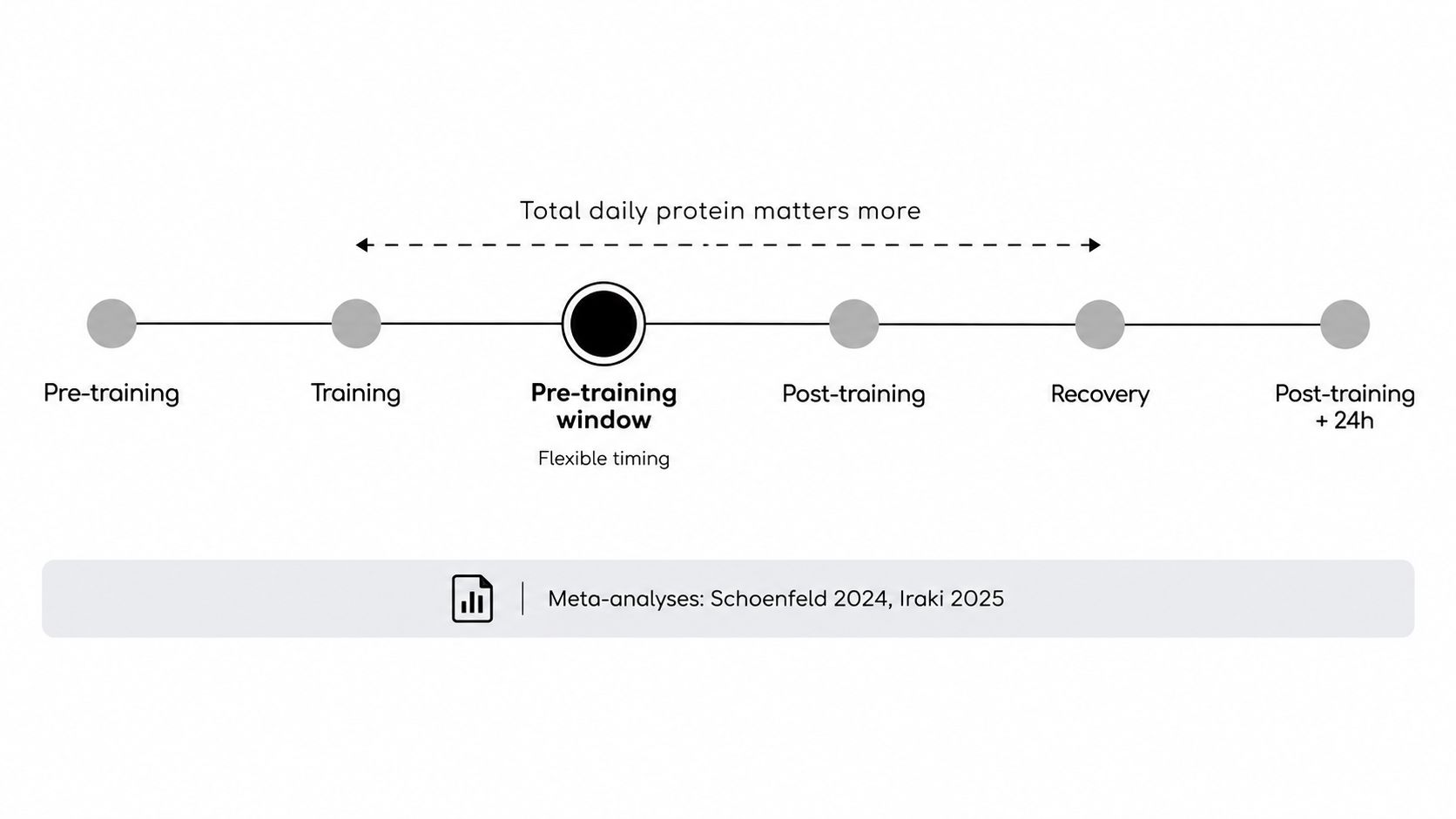
The old idea that you must consume protein immediately before or after lifting makes nutrition feel like a stopwatch competition. The evidence supports a more forgiving approach. A 2025 systematic review found no significant difference in chest-press strength or lean mass when protein was consumed from 15 minutes before exercise to about 2 hours afterward, while the evidence for a pre-exercise leg-press advantage remained weak and low certainty. The systematic review and meta-analysis on protein timing supports flexibility rather than panic.
Use the digestion window
For most mixed snacks or meals, 1–3 hours before training is a practical window. Protein eaten during that period can raise circulating amino acids during the session and support muscle protein synthesis. The expert statement on sports nutrition timing also notes that protein before or during exercise can stimulate the response, although very close ingestion may cause gastrointestinal discomfort for some people.
Meal size matters. A larger meal usually feels more comfortable when eaten earlier in the window, while a small shake or yogurt serving may work closer to training. High-fat, high-fiber foods digest more slowly, so they can feel unpleasant during sprinting, jumping, or heavy sets even when their nutrition profile looks excellent on paper.
If you miss the pre-workout serving
A post-workout meal can still supply useful protein. This is especially true if you trained after eating earlier in the day, because the body isn't starting from an empty nutritional slate. You also don't need to force a shake before every session if doing so makes your stomach uncomfortable or disrupts your routine.
Fasted morning training deserves a different practical strategy. If you tolerate food early, a small protein serving before the workout can provide amino acids without the heaviness of a full breakfast. If you can't eat, make the next meal protein-rich instead of treating the missed snack as a training failure.
Practical rule: Choose the earliest timing that lets you train comfortably. A serving you digest well is more useful than a theoretically perfect serving you dread or skip.
Choosing the Right Protein Type for a Pre-Workout Snack
Protein type matters mainly through amino-acid quality, serving size, and digestion comfort. Whey isolate digests relatively quickly and is rich in essential amino acids, making it convenient when training is close. Casein releases more slowly and can feel heavier shortly before intense movement, though it can work well when eaten farther from the session.
Plant-based athletes have several workable choices. Soy is a complete protein source, while pea and rice proteins can complement each other because combining them helps provide a broader essential amino-acid profile. You don't need to make every snack complicated, but you should pay attention to the protein content and how your stomach responds.
| Protein type | Digestion speed | Leucine per 25 g serving | Complete amino profile | Best use case |
|---|---|---|---|---|
| Whey isolate | Fast | Depends on product | Yes | Close-to-training shakes |
| Casein | Slower | Depends on product | Yes | Earlier pre-workout meals |
| Soy | Moderate | Depends on product | Yes | Plant-based complete protein |
| Pea | Moderate | Depends on product | Not always by itself | Shakes or blended formulas |
| Rice | Moderate | Depends on product | Not always by itself | Combined with pea protein |
The required leucine amount isn't identical for every person or food, so don't treat a single threshold as a universal pass-or-fail test. What matters in practice is choosing a sufficiently large serving of a high-quality protein, especially when the snack replaces a meal.
Protect training comfort
Beans, large portions of tofu, high-fat cheese, or a very large shake may leave you bloated when eaten close to explosive or heavy training. Earlier in the window, those foods may work perfectly. Closer to the session, a lower-fiber, lower-fat option often feels safer.
Good pairings include Greek yogurt with fruit, a pea-based shake with banana, soy yogurt with cereal, or a tofu scramble eaten well before training. For more detail on choosing between dairy and plant options, compare pea protein and whey protein.
Real Pre-Workout Snack Options and Their Protein Math
Nutrition becomes easier when you can see the food rather than memorize a formula. The following examples use practical portions, but exact protein values depend on the product label and recipe.
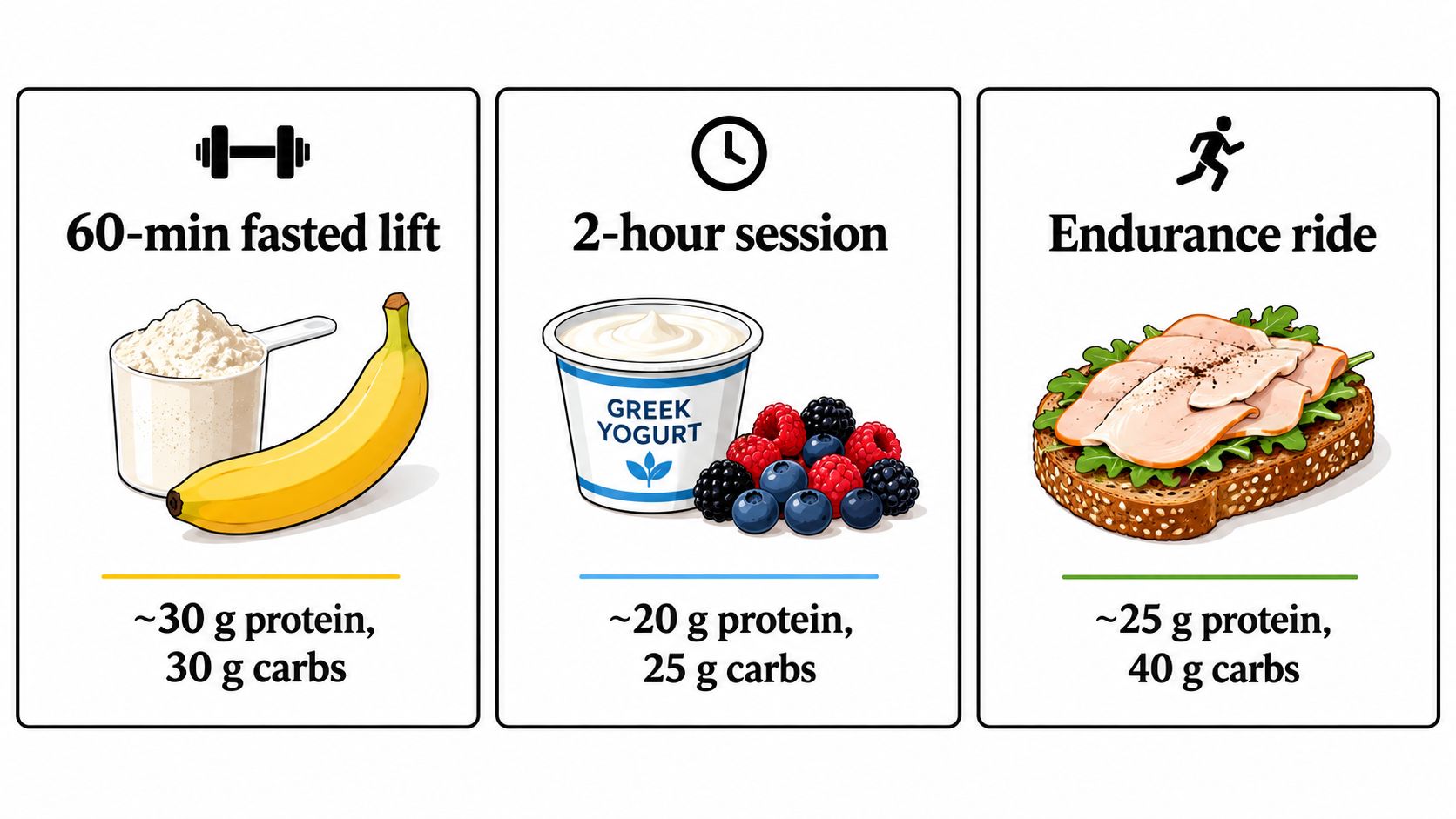
A 60-minute fasted-style lift could start with one scoop of whey and a banana. The example in the supplied meal guide represents roughly 30 g of protein and 30 g of carbohydrate, giving the lifter a compact combination of amino acids and readily usable fuel. It suits someone who doesn't want a full meal but doesn't want to train completely empty either.
Match the snack to the time available
With a 2-hour window, Greek yogurt with berries and granola gives you more room for volume and digestion. The supplied example lists roughly 20 g of protein and 25 g of carbohydrate, although the actual amount will vary by yogurt and granola brand. Because the snack is eaten earlier, the fruit and grain components have more time to settle.
For an evening plant-based session, edamame with rice cakes combines protein with a lighter carbohydrate source. If the portion doesn't reach your personal target, add a pea or soy-based drink, or choose a blended plant protein product. A savory, portable option such as Gym Snack can also help fill a gap when you need a protein-first snack without preparing a meal, but check the package serving information before calculating it into your target.
A smooth matcha protein shake can be another convenient format when you prefer a drinkable snack and want to combine protein with a familiar pre-training routine. This smooth matcha protein shake recipe from Pep Tea offers a starting point for that style of preparation.
What common portions look like
Use food portions as visual anchors rather than assuming every item has the same protein density.
- Around 20 g: A serving of Greek yogurt may approach this amount, depending on the label and portion.
- Around 30 g: A single scoop of whey often lands near this amount, but formulas differ.
- Around 40 g: A full cup of cottage cheese can provide a substantial serving, depending on the product.
- Mixed option: Two eggs with a slice of turkey can create a protein-focused snack, though the exact total depends on egg size and the turkey portion.
Estimating gets harder once the snack becomes a real recipe instead of a single ingredient. A collection like the Protein Powerhouse cookbook lists protein, calories, carbohydrate, and fat for every recipe and covers both animal and plant-based sources, which makes it easier to match a prepared meal to your 20–40 g target instead of guessing at the portion.
A simple plate rule works for many lifting sessions: choose a palm-sized protein source and add a fist-sized carbohydrate source. Move the meal earlier if the food is bulky, fatty, or fiber-rich. Move it closer only when the portion is small and familiar.
When Pre-Workout Protein Matters More Than the Average Advice Suggests
Does every workout need the same pre-training protein plan? The familiar 20–40 g range helps, but it can hide situations where a more deliberate choice makes sense. Heavy lower-body sessions are one example. Squats, deadlifts, and leg presses recruit a large amount of muscle, and, as noted earlier, the 2025 meta-analysis found a specific strength signal for leg-press repetitions, without showing an important overall lean-mass effect. Treat lower-body training as a situation worth testing rather than assuming every session responds identically.
Older adults may have another reason to choose the upper end of the range. Age-related anabolic resistance can make muscle less responsive to a small protein dose, so a larger, high-quality serving may work better than a minimal snack. Responses still vary, and the available trials include mixed populations. Personal tolerance and professional guidance remain relevant.
Plant-based eaters may need to pay closer attention to the food's protein quality and portion. A plant protein serving can fit before training, but the product's protein amount and amino acid profile matter more than the label's serving size alone. Combining sources, such as pea and rice protein, may make it easier to reach a useful dose without turning the snack into a full meal.
Situations that deserve priority
- Lower-body compound days: Use a substantial serving before demanding squats, deadlifts, or leg presses, especially when the previous meal was light.
- Low daily protein intake: Pre-workout food can close a gap in the day instead of leaving all your protein for the evening.
- Calorie restriction: Protein may help when appetite and meal size are limited, as long as it does not replace the carbohydrate and fluids needed for training.
- GLP-1 medication use: Appetite suppression can make a full meal difficult. A small, fast-digesting protein serving may be more realistic, but medication-related nutrition changes should be discussed with a qualified clinician.
Pre-workout protein deserves less attention after a recent balanced meal or when daily intake is already well organized. Easy, steady-state cardio may also require less immediate protein focus than resistance training, because the short-term muscle-building demand differs.
Ask one question before choosing a serving: Will protein before this session solve a real gap in my daily intake, recovery, or ability to train well? If yes, prioritize it. If no, use the timing that feels easiest.
A Quick Pre-Workout Protein Checklist You Can Use Today
Use this decision rule before your next session:
- Identify the session. Is it a heavy lower-body workout, a hypertrophy session, endurance training, or easy cardio? Harder resistance sessions generally justify more attention to the protein serving, while endurance sessions also need adequate carbohydrate.
- Calculate your baseline. Multiply body weight in kilograms by 0.25. Round the result to a practical serving that suits your size and appetite.
- Choose the timing. Use the broader 1–3 hour window. Eat larger meals earlier and smaller shakes or snacks closer to training.
- Select a tolerable source. Whey, Greek yogurt, eggs, soy, tofu, pea protein, or a pea-and-rice blend can work. Match the choice to your dietary preferences and digestion.
- Add easy carbohydrates when needed. Fruit, rice cakes, granola, bread, or another familiar carbohydrate can support demanding sessions. Don't add bulky foods right before training if they make you uncomfortable.
- Test the plan. Try the snack during ordinary training before relying on it for a heavy lift, long session, or competition.
The repeatable rule is simple: aim for 20–30 g of complete or high-quality protein 1–2 hours before lifting, move toward the upper end for larger athletes, older adults, or demanding leg sessions, and keep total daily protein ahead of perfect timing.
Gym Snack makes plant-based savory protein snacks designed for convenient, protein-first fueling, with products built around pea protein and portions listed on the packaging. Visit Gym Snack to explore an easy pre-workout option for days when preparing a full meal doesn't fit your schedule.